Neves Thiago, Ferriolli Eduardo, Lopes Marcela Bomfim Martin, Souza Milene Giovana Crespilho, Fett Carlos Alexandre, Fett Waléria Christiane Rezende
Department of Physical Education, University of the State of Mato Grosso, Diamantino, MT, Brazil.
Department of Internal Medicine, Faculty of Medicine of Ribeirão Preto, University of São Paulo, Ribeirão Preto, SP, Brazil.
J Frailty Sarcopenia Falls. 2018 Dec 1;3(4):194-202. doi: 10.22540/JFSF-03-194. eCollection 2018 Dec.
There is little information about the risk factors for sarcopenia and dynapenia. This study aimed to assess the prevalence of sarcopenia and dynapenia and to verify which risk factors are associated with the elderly population.
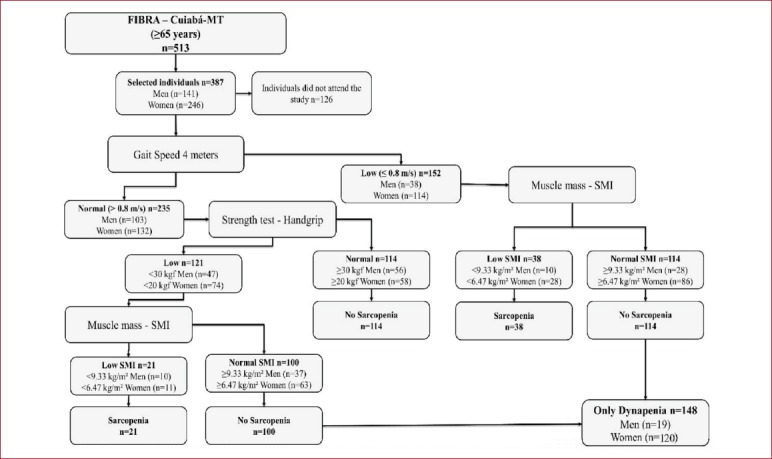
A total of 387 elderly people were evaluated. We used a questionnaire to identify socio-demographic and behavioral aspects. For physical performance, we used the Short Physical Performance Battery. Using the European Working Group of Sarcopenia in Older People consensus, we defined sarcopenia that includes the occurrence of low muscle mass, added to low muscle strength or low physical performance. Dynapenia was defined using handgrip strength.
Sarcopenia and dynapenia were identified in 15.3% and 38.2% of the elderly people, respectively; 15.8% of women and 14.2% of men had sarcopenia, and 52.4% of women and 13.5% of men had dynapenia. Sarcopenia was associated with the increase in aging, white race, smoking, and risk of malnutrition. Dynapenia is more likely to occur in women and hospitalized patients.
Sarcopenia had a greater association with the risk factors evaluated here, mainly with smoking and nutritional status. On the other hand, dynapenia was different, having a greater association with hospital intervention.
关于肌肉减少症和肌肉衰弱症的风险因素的信息较少。本研究旨在评估肌肉减少症和肌肉衰弱症的患病率,并验证哪些风险因素与老年人群相关。
共评估了387名老年人。我们使用问卷来确定社会人口统计学和行为方面的情况。对于身体机能,我们使用简短身体机能测试电池。根据老年人肌肉减少症欧洲工作组的共识,我们将肌肉减少症定义为包括低肌肉量的出现,加上低肌肉力量或低身体机能。肌肉衰弱症使用握力来定义。
分别在15.3%和38.2%的老年人中发现了肌肉减少症和肌肉衰弱症;15.8%的女性和14.2%的男性患有肌肉减少症,52.4%的女性和13.5%的男性患有肌肉衰弱症。肌肉减少症与衰老增加、白人种族、吸烟和营养不良风险相关。肌肉衰弱症更可能发生在女性和住院患者中。
肌肉减少症与这里评估的风险因素有更大的关联,主要与吸烟和营养状况有关。另一方面,肌肉衰弱症则不同,与医院干预有更大的关联。