Medical Faculty, University of Brasília, Brasília, Federal District, Brazil.
Kinesiology School and Physical Activity and Sports Science Master Program, Universidad Santo Tomás, Puerto Mont, Chile.
Am J Alzheimers Dis Other Demen. 2020 Jan-Dec;35:1533317520911573. doi: 10.1177/1533317520911573.
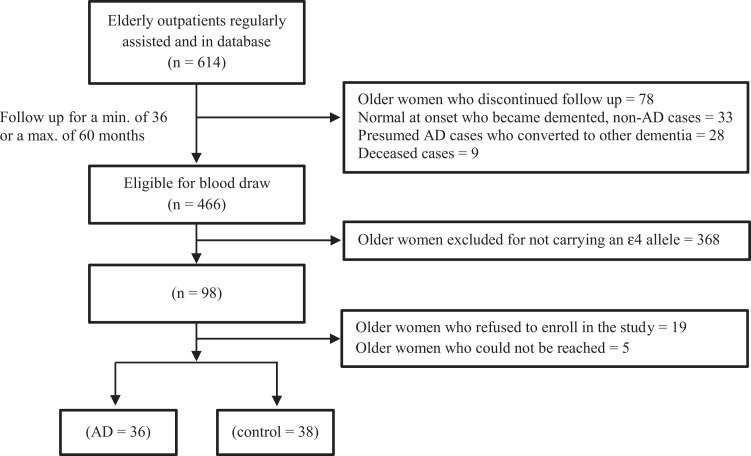
Recent evidence suggests changes in circulating microRNA levels may be promising biomarkers for the clinical diagnosis of Alzheimer disease (AD). We hypothesized that whole-blood microRNAs may be useful to identify individuals with established AD. For this purpose, a sample of community-dwelling women (≥55 years old) carrying the ∊4 allele were clinically evaluated using the American Psychiatric Association/, Fourth edition and the Alzheimer Disease Assessment Scale-Cognitive Subscale criteria to diagnose probable AD, and the Clinical Dementia Rating scale to stage the dementia. A set of 25 mature microRNAs was rationally selected for evaluation based on experimental evidence of interaction with genes linked to the late-onset AD neuropathology. Whole-blood concentrations were determined by quantitative real-time polymerase chain reaction. Compared to patients without dementia, a median 3-fold decrease in miR-9 levels was found among patients with AD ( = .001). Our findings support blood-borne miR-9 as a candidate biomarker for probable AD, embodied by evidence from the literature of its implication in amyloidogenesis.
最近的证据表明,循环 microRNA 水平的变化可能是阿尔茨海默病 (AD) 临床诊断有希望的生物标志物。我们假设全血 microRNAs 可能有助于识别已确诊 AD 的个体。为此,我们对一组携带 ∊4 等位基因的社区居住女性(≥55 岁)进行了临床评估,使用美国精神病学会/第四版和阿尔茨海默病评估量表认知分量表标准来诊断可能的 AD,并使用临床痴呆评定量表对痴呆进行分期。根据与晚发性 AD 神经病理学相关基因相互作用的实验证据,我们合理选择了一组 25 种成熟的 microRNAs 进行评估。通过定量实时聚合酶链反应确定全血浓度。与无痴呆症的患者相比,AD 患者的 miR-9 水平中位数降低了 3 倍( =.001)。我们的研究结果支持血液源性 miR-9 作为可能 AD 的候选生物标志物,这一证据来自文献中表明其与淀粉样蛋白形成有关的证据。