Animal Health Department, NEIKER-Instituto Vasco de Investigación y Desarrollo Agrario, Derio, Bizkaia, Spain.
PLoS One. 2020 Apr 17;15(4):e0231559. doi: 10.1371/journal.pone.0231559. eCollection 2020.
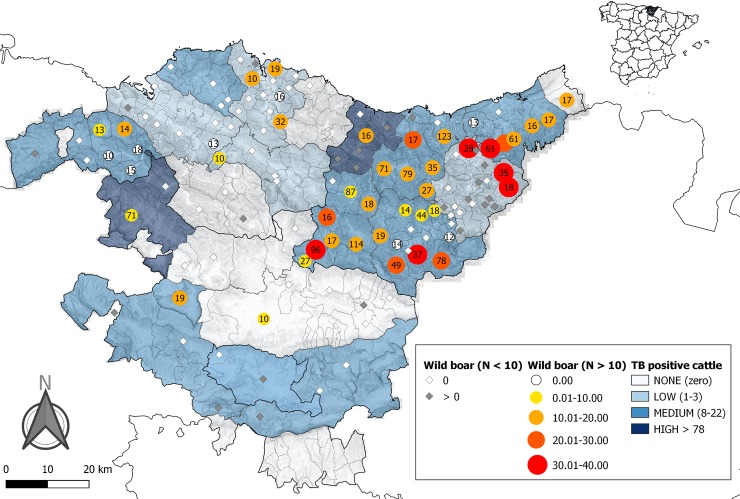
Animal tuberculosis is a worldwide zoonotic disease caused principally by Mycobacterium bovis, a member of the Mycobacterium tuberculosis complex (MTC). In southern Iberian Peninsula, wild reservoirs such as the wild boar, among other factors, have prevented the eradication of bovine tuberculosis. However, most of the studies have been focused on south-central Spain, where the prevalence of tuberculosis is high among wild ungulates and cattle herds. In northern regions, where wild boar density and bovine tuberculosis prevalence are lower, fewer studies have been carried out and the role of this species is still under debate. The aim of this study was to describe the temporal and spatial distribution of antibodies against MTC in wild boar from the Basque Country, northern Spain. Sera from 1902 animals were collected between 2010 and 2016. The seroprevalence was determined with an in house enzyme-linked immunosorbent assay and the search of risk factors was assessed by Generalized Linear Models. Overall, 17% of wild boars (326/1902; 95%CI, [15.5%-18.9%]) showed antibodies against MTC. Risk factors associated with seropositivity were the year and location of sampling, the number of MTC positive cattle, the distance to positive farms and the percentage of shrub cover. Younger age classes were associated with increased antibody titres among seropositive individuals. The seroprevalence detected was higher than those previously reported in neighbouring regions. Hence, further studies are needed to better understand the role of wild boar in the epidemiology of tuberculosis in low tuberculosis prevalence areas and consequently, its relevance when developing control strategies.
动物结核病是一种全球性的人畜共患病,主要由分枝杆菌属的牛分枝杆菌引起,它是结核分枝杆菌复合群(MTC)的一员。在伊比利亚半岛南部,野猪等野生动物是该病的主要贮存宿主,这一因素使得牛结核病难以被根除。然而,大多数研究都集中在西班牙中南部,该地区野生动物和牛群中的结核病流行率较高。在北部地区,野猪密度和牛结核病流行率较低,开展的研究较少,而这种物种的作用仍存在争议。本研究旨在描述西班牙北部巴斯克地区野猪中针对 MTC 的抗体的时间和空间分布。在 2010 年至 2016 年期间,共采集了 1902 只动物的血清。采用酶联免疫吸附试验测定血清抗体阳性率,并通过广义线性模型评估风险因素。总体而言,17%的野猪(326/1902;95%置信区间[15.5%-18.9%])表现出针对 MTC 的抗体。与血清阳性相关的风险因素包括采样年份和地点、MTC 阳性牛的数量、与阳性农场的距离以及灌木覆盖率。血清阳性个体中,年龄较小的年龄组与抗体滴度升高有关。检测到的血清阳性率高于以前在邻近地区报告的水平。因此,需要进一步研究以更好地了解野猪在低结核病流行地区结核病流行中的作用,以及在制定控制策略时的相关性。