Department of Cardiology, Tianjin First Central Hospital, Tianjing 300192, China.
Department of Cardiology, the First Medical Center, Chinese PLA General Hospital, Beijing 100853, China.
Aging (Albany NY). 2020 Apr 19;12(8):7299-7312. doi: 10.18632/aging.103078.
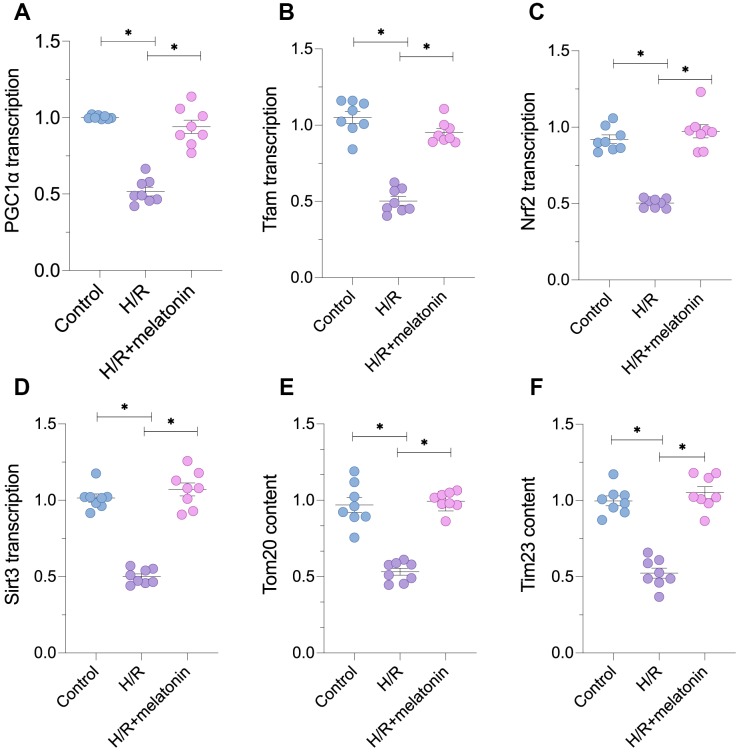
Cardiac ischemia/reperfusion injury is associated with reduced mitochondrial turnover and regeneration. There is currently no effective approach to stimulate mitochondrial biogenesis in the reperfused myocardium. In this study, we investigated whether melatonin could increase mitochondrial biogenesis and thus promote mitochondrial homeostasis in cardiomyocytes. Cardiomyocytes were subjected to hypoxia/reoxygenation (H/R) injury with or without melatonin treatment, and various mitochondrial functions were measured. H/R injury repressed mitochondrial biogenesis in cardiomyocytes, whereas melatonin treatment restored mitochondrial biogenesis through the 5' adenosine monophosphate-activated protein kinase (AMPK)/peroxisome proliferator-activated receptor-gamma coactivator 1 alpha (PGC1α) pathway. Melatonin enhanced mitochondrial metabolism, inhibited mitochondrial oxidative stress, induced mitochondrial fusion and prevented mitochondrial apoptosis in cardiomyocytes subjected to H/R injury. The melatonin-induced improvement in mitochondrial biogenesis was associated with increased cardiomyocyte survival during H/R injury. On the other hand, silencing of attenuated the protective effects of melatonin on cardiomyocyte viability, thereby impairing mitochondrial bioenergetics, disrupting the mitochondrial morphology, and activating mitochondrial apoptosis. Thus, H/R injury suppressed mitochondrial biogenesis, while melatonin activated the AMPK/PGC1α pathway and restored mitochondrial biogenesis, ultimately protecting the reperfused heart.
心肌缺血/再灌注损伤与线粒体周转率和再生减少有关。目前尚无有效的方法来刺激再灌注心肌中的线粒体生物发生。在这项研究中,我们研究了褪黑素是否可以增加线粒体生物发生,从而促进心肌细胞中线粒体的动态平衡。用或不用褪黑素处理心肌细胞进行缺氧/复氧(H/R)损伤,测量各种线粒体功能。H/R 损伤抑制了心肌细胞中线粒体的生物发生,而褪黑素通过 5' 腺苷单磷酸激活蛋白激酶(AMPK)/过氧化物酶体增殖物激活受体γ共激活因子 1α(PGC1α)途径恢复线粒体的生物发生。褪黑素增强了线粒体代谢,抑制了线粒体氧化应激,诱导了线粒体融合,并防止了心肌细胞在 H/R 损伤中发生线粒体凋亡。褪黑素诱导的线粒体生物发生改善与 H/R 损伤期间心肌细胞存活率的增加有关。另一方面,沉默 削弱了褪黑素对心肌细胞活力的保护作用,从而损害线粒体生物能量,破坏线粒体形态,并激活线粒体凋亡。因此,H/R 损伤抑制了线粒体生物发生,而褪黑素激活了 AMPK/PGC1α 途径并恢复了线粒体生物发生,最终保护了再灌注心脏。