Vectors and Vector-borne Diseases Research Programme, Department of Veterinary Tropical Diseases, Faculty of Veterinary Science, University of Pretoria, Private Bag X04, Onderstepoort, 0110, Republic of South Africa.
Utrecht Centre for Tick-borne Diseases (UCTD), FAO Reference Centre for Ticks and Tick-borne Diseases, Faculty of Veterinary Medicine, Utrecht University, Yalelaan 1, 3584 CL, Utrecht, The Netherlands.
Parasit Vectors. 2020 Apr 21;13(1):172. doi: 10.1186/s13071-020-04059-5.
In sub-Saharan Africa, Amblyomma ticks are vectors of heartwater disease in domestic ruminants, caused by the rickettsial pathogen Ehrlichia ruminantium. Immature tick stages often bite humans, whereby they act as vectors of tick-bite fever caused by Rickettsia africae. Moreover, Amblyomma ticks cause damage to livestock due to their feeding behaviour. In South Africa, we studied the abundance of Amblyomma hebraeum ticks on goats of emerging farmers in Mpumalanga Province. A selected number of A. hebraeum nymphs and adult ticks was tested for co-infection with E. ruminantium and R. africae.
A total of 630 indigenous goats, belonging to farmers in the Mnisi Community area, were examined for ticks in 2013 and 2014. All ticks were identified, and a selected number was tested by PCR with reverse line blot hybridisation.
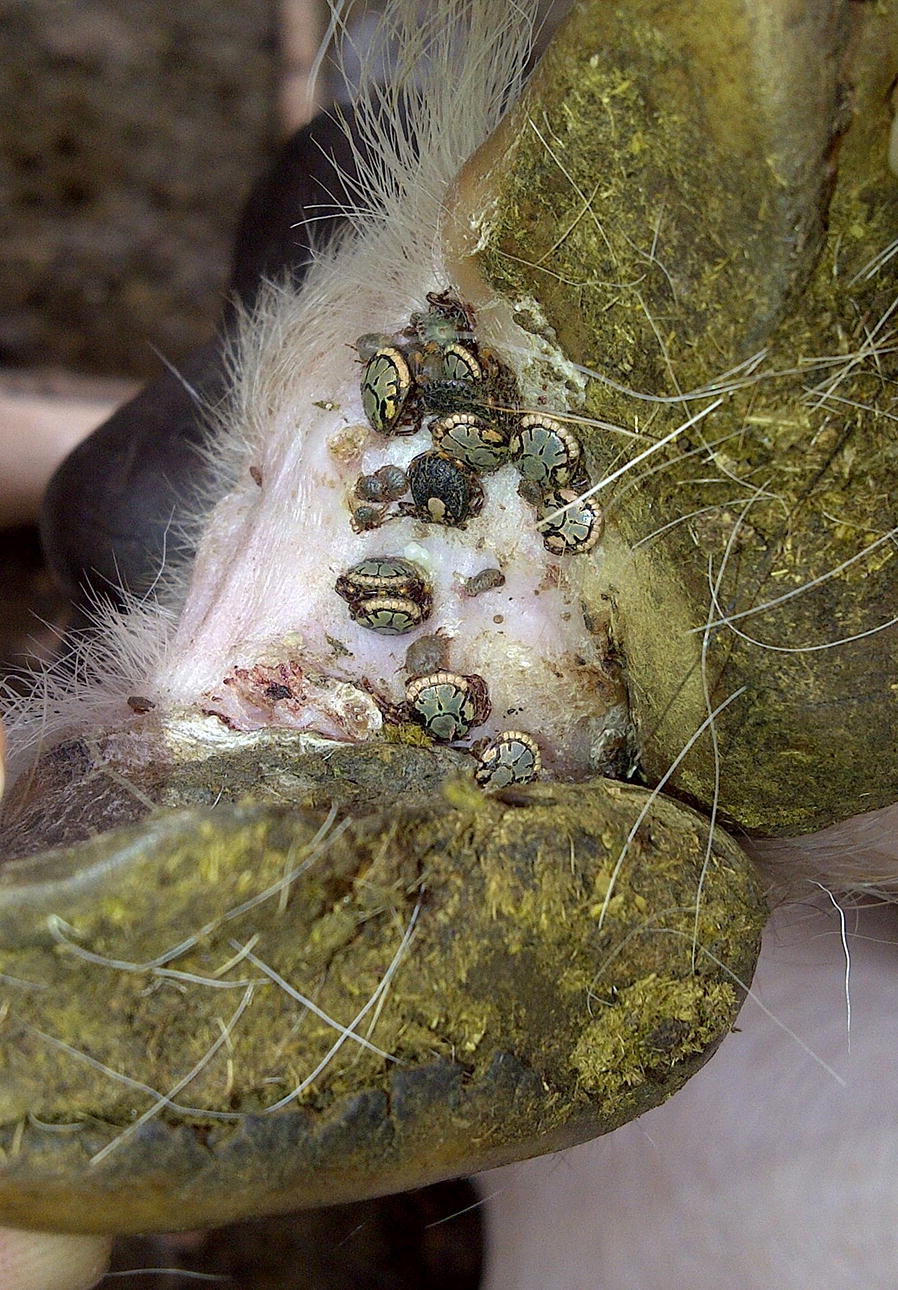
In total, 13,132 ticks were collected from goats distributed over 17 different households. Amblyomma hebraeum was the predominant species, followed by R. microplus. Rhipicephalus appendiculatus, R. simus and R. zambeziensis were also identified. Amblyomma hebraeum was present throughout the year, with peak activity of adults in summer (November) and nymphs in winter (July). The ratio between adults and nymphs ranged from 1:2.7 in summer to 1:55.1 in winter. The mean prevalence of infection for E. ruminantium by PCR/RLB in adult ticks was 17.4% (31/178), whereas 15.7% (28/178) were infected with R. africae. In pooled nymphs, 28.4% were infected with E. ruminantium and 38.8% carried R. africae infection. Co-infections of E. ruminantium and R. africae in adult and pooled nymphal ticks were 3.9% (7/178) and 10% (14.9), respectively. Lameness of goats due to predilection of ticks for the interdigital space of their feet was observed in 89% of the households.
Goats act as important alternative hosts for cattle ticks, which underscored the necessity to include goats in control programs. It is suggested to use acaricide-impregnated leg-bands as a sustainable method to kill ticks and prevent lameness in goats. The challenge of goats by considerable numbers of E. ruminantium-infected ticks is a major obstacle for upgrading the indigenous goat breeds. Humans may be at risk to contract tick-bite fever in this area.
在撒哈拉以南非洲,无花果树 tick 是家畜心水病的媒介,由立克次体病原体 ehrlichia ruminantium 引起。不成熟的 tick 阶段经常叮咬人类,从而成为由 rickettsia africae 引起的 tick-bite fever 的媒介。此外,无花果树 tick 因其摄食行为而对牲畜造成损害。在南非,我们研究了姆普马兰加省新兴农民的山羊身上 hebraeum 无花果树 tick 的丰度。对选定数量的 hebraeum 若虫和成虫 tick 进行了 e. ruminantium 和 r. africae 共感染的检测。
2013 年和 2014 年,对 mnisi 社区地区农民的 630 只本地山羊进行了 tick 检查。所有 tick 均被鉴定,并通过 PCR 与反向线印迹杂交对选定数量的 tick 进行了检测。
共从分布在 17 个不同家庭的山羊身上采集了 13132 只 tick。hebraeum 无花果树是主要物种,其次是 r. microplus。还鉴定出了 rhipicephalus appendiculatus、r. simus 和 r. zambeziensis。hebraeum 无花果树全年存在,夏季(11 月)成虫活动高峰,冬季(7 月)若虫活动高峰。成虫与若虫的比例从夏季的 1:2.7 到冬季的 1:55.1。PCR/RLB 成年 tick 感染 e. ruminantium 的平均患病率为 17.4%(31/178),而感染 r. africae 的 tick 为 15.7%(28/178)。在混合的若虫中,28.4%感染 e. ruminantium,38.8%感染 r. africae。成年和混合若虫 tick 的 e. ruminantium 和 r. africae 共感染率分别为 3.9%(7/178)和 10%(14.9)。由于 tick 偏爱它们脚部的趾间空间,89%的家庭都观察到了山羊跛行。
山羊是牛 tick 的重要替代宿主,这强调了有必要将山羊纳入控制计划中。建议使用驱虫剂浸渍的腿带作为一种可持续的方法来杀死 tick 并防止山羊跛行。大量感染 e. ruminantium 的 tick 对山羊构成了主要障碍,阻碍了本地山羊品种的升级。在该地区,人类可能有感染 tick-bite fever 的风险。