Zurich Center for Neuroeconomics, Department of Economics, University of Zurich, Blümlisalpstrasse, 10 8006, Zurich, Switzerland.
Department of Economics, The Ohio State University, 1945 North High Street, Columbus, OH, 43210, USA.
Nat Commun. 2020 Apr 20;11(1):1893. doi: 10.1038/s41467-020-15696-w.
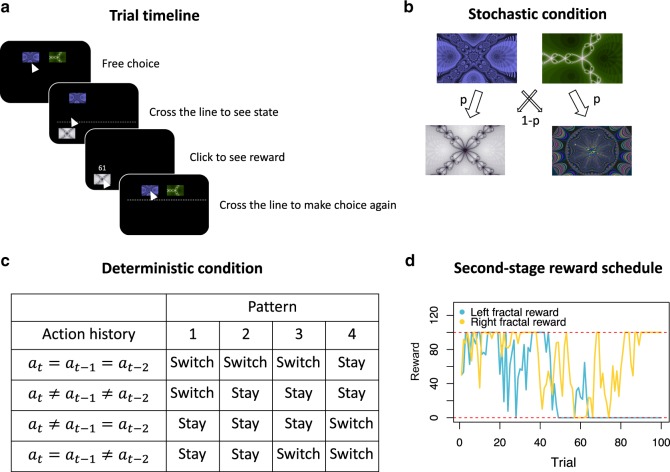
Converging evidence has demonstrated that humans exhibit two distinct strategies when learning in complex environments. One is model-free learning, i.e., simple reinforcement of rewarded actions, and the other is model-based learning, which considers the structure of the environment. Recent work has argued that people exhibit little model-based behavior unless it leads to higher rewards. Here we use mouse tracking to study model-based learning in stochastic and deterministic (pattern-based) environments of varying difficulty. In both tasks participants' mouse movements reveal that they learned the structures of their environments, despite the fact that standard behavior-based estimates suggested no such learning in the stochastic task. Thus, we argue that mouse tracking can reveal whether subjects have structure knowledge, which is necessary but not sufficient for model-based choice.
已有大量证据表明,人类在复杂环境中学习时有两种截然不同的策略。一种是无模型学习,即对奖励动作进行简单强化,另一种是基于模型的学习,即考虑环境的结构。最近的研究认为,除非基于模型的行为能带来更高的回报,否则人们很少表现出基于模型的行为。在这里,我们使用鼠标跟踪技术来研究随机和确定性(基于模式)环境中的基于模型的学习,这两种任务的参与者的鼠标运动都表明,他们学习了环境的结构,尽管基于标准行为的估计表明,在随机任务中没有这样的学习。因此,我们认为鼠标跟踪可以揭示被试是否具有结构知识,这是基于模型选择所必需的,但不是充分的。