Harris Orthopaedic Laboratory, Massachusetts General Hospital, Boston, MA, USA.
Department of Orthopedic Surgery, Copenhagen University Hospital Hvidovre, Hvidovre, Denmark.
Acta Orthop. 2020 Aug;91(4):372-377. doi: 10.1080/17453674.2020.1750877. Epub 2020 Apr 22.
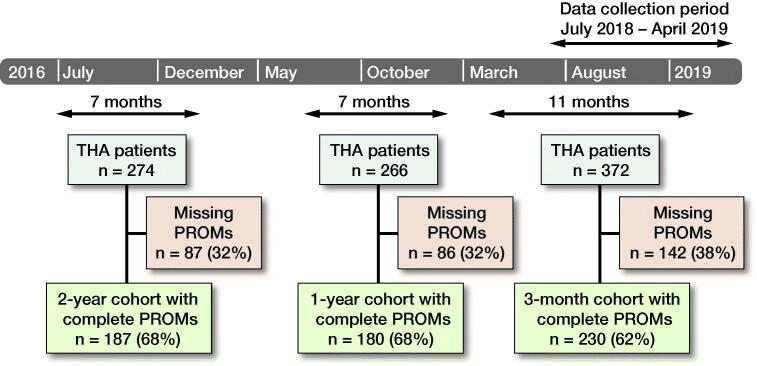
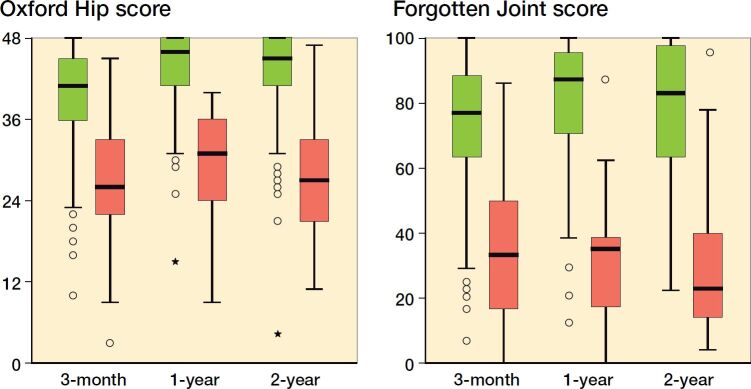
Background and purpose - Patient-acceptable symptom states (PASS) represent the level on a patient-reported outcome measure (PROM) at which patients are satisfied with postoperative outcomes. We defined the PASS for the Oxford Hip Score (OHS) and Forgotten Joint Score (FJS-12) at 3-month, 1-year, and 2-year intervals after primary total hip arthroplasty (THA).Patients and methods - Between July 2018 and April 2019, primary THA patients in an academic medical center's registry completed the OHS, FJS-12, and a satisfaction anchor question at 3-month (n = 230), 1-year (n = 180), or 2-year (n = 187) postoperative intervals. PASS thresholds were derived with receiver operating characteristic analysis using the 80% specificity method. 95% confidence intervals (CI) were calculated using 1,000 non-parametric bootstrap replications.Results - 74%, 85%, and 86% of patients reported having a satisfactory symptom state at 3 months, 1, and 2 years after surgery, respectively. At 3-month, 1-year, and 2-year intervals, PASS thresholds were 34 (CI 31-36), 40 (CI 36-44), and 39 (CI 35-42) points for the OHS and 59 (CI 54-64), 68 (CI 61-75), and 69 (CI 62-75) points for the FJS-12.Interpretation - PASS thresholds varied with time for both the OHS and the FJS-12, with lower 3-month compared with 1-year and 2-year thresholds. These PASS thresholds represent OHS and FJS-12 levels at which the average patient is satisfied with THA outcomes, helping to interpret PROMs and serving as clinically significant benchmarks and patient-centered outcomes for research.
背景与目的-患者可接受的症状状态(PASS)代表患者对术后结果满意的患者报告结局测量(PROM)水平。我们定义了牛津髋关节评分(OHS)和遗忘关节评分(FJS-12)在初次全髋关节置换术(THA)后 3 个月、1 年和 2 年的 PASS。
患者和方法-在 2018 年 7 月至 2019 年 4 月期间,学术医疗中心注册处的初次 THA 患者在术后 3 个月(n=230)、1 年(n=180)或 2 年(n=187)时完成了 OHS、FJS-12 和满意度锚定问题。使用 80%特异性方法的接收者操作特征分析得出 PASS 阈值。使用 1000 次非参数引导复制计算 95%置信区间(CI)。
结果-分别有 74%、85%和 86%的患者在术后 3 个月、1 年和 2 年报告有满意的症状状态。在 3 个月、1 年和 2 年的时间间隔内,OHS 的 PASS 阈值分别为 34(CI 31-36)、40(CI 36-44)和 39(CI 35-42)分,FJS-12 的 PASS 阈值分别为 59(CI 54-64)、68(CI 61-75)和 69(CI 62-75)分。
解释-PASS 阈值随时间在 OHS 和 FJS-12 中变化,3 个月的阈值低于 1 年和 2 年的阈值。这些 PASS 阈值代表 OHS 和 FJS-12 水平,患者对 THA 结果满意,有助于解释 PROM 并作为具有临床意义的基准和以患者为中心的研究结果。