Institute of Bio- and Geosciences, IBG-1: Biotechnology, Forschungszentrum Jülich GmbH, 52425, Jülich, Germany.
Bioeconomy Science Center (BioSC), Forschungszentrum Jülich GmbH, 52425, Jülich, Germany.
Microb Cell Fact. 2020 Apr 21;19(1):92. doi: 10.1186/s12934-020-01351-y.
The phenylbutanoid 4-(4-hydroxyphenyl)butan-2-one, commonly known as raspberry ketone, is responsible for the typical scent and flavor of ripe raspberries. Chemical production of nature-identical raspberry ketone is well established as this compound is frequently used to flavor food, beverages and perfumes. However, high demand for natural raspberry ketone, but low natural abundance in raspberries, render raspberry ketone one of the most expensive natural flavoring components.
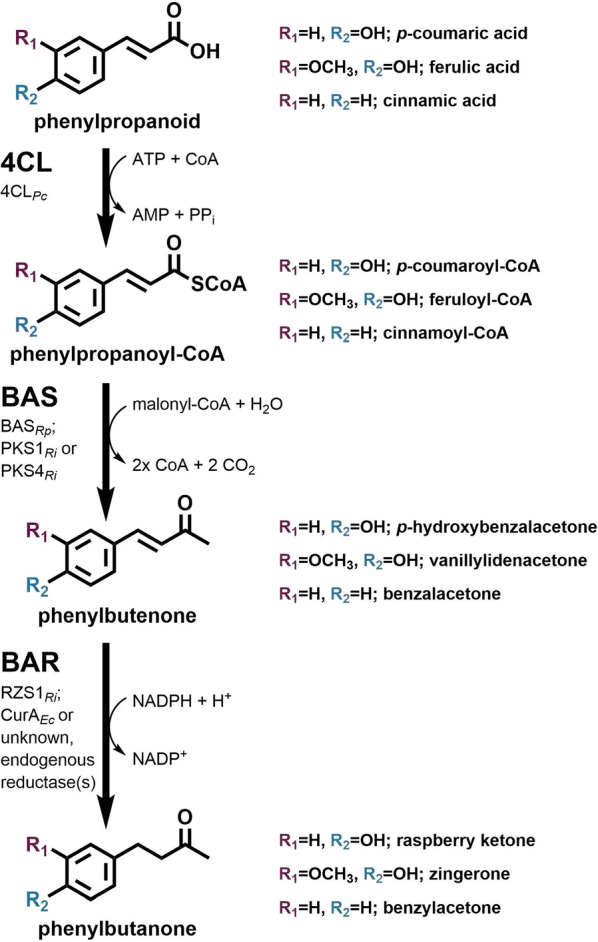
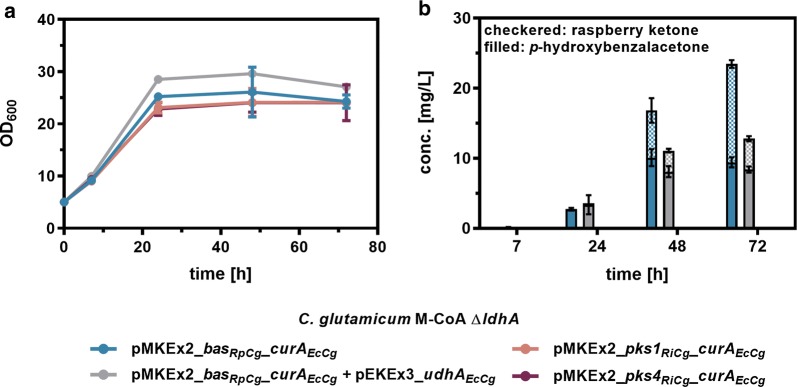
In this study, Corynebacterium glutamicum was engineered for the microbial synthesis of the character impact compound raspberry ketone from supplemented p-coumaric acid. In this context, the NADPH-dependent curcumin/dihydrocurcumin reductase CurA from Escherichia coli was employed to catalyze the final step of raspberry ketone synthesis as it provides a hitherto unknown benzalacetone reductase activity. In combination with a 4-coumarate: CoA ligase from parsley (Petroselinum crispum) and a monofunctional benzalacetone synthase from Chinese rhubarb (Rheum palmatum), CurA constitutes the synthetic pathway for raspberry ketone synthesis in C. glutamicum. The resulting strain accumulated up to 99.8 mg/L (0.61 mM) raspberry ketone. In addition, supplementation of other phenylpropanoids allowed for the synthesis of two other naturally-occurring and flavoring phenylbutanoids, zingerone (70 mg/L, 0.36 mM) and benzylacetone (10.5 mg/L, 0.07 mM).
The aromatic product portfolio of C. glutamicum was extended towards the synthesis of the flavoring phenylbutanoids raspberry ketone, zingerone and benzylacetone. Key to success was the identification of CurA from E. coli having a benzalacetone reductase activity. We believe, that the constructed C. glutamicum strain represents a versatile platform for the production of natural flavoring phenylbutanoids at larger scale.
苯丁酮 4-(4-羟基苯基)-2-丁酮,通常被称为覆盆子酮,是成熟覆盆子典型气味和味道的来源。由于该化合物常用于调味食品、饮料和香水,因此化学合成的天然等同覆盆子酮已经得到很好的确立。然而,由于对天然覆盆子酮的高需求,而覆盆子中天然含量低,使得覆盆子酮成为最昂贵的天然调味成分之一。
在这项研究中,通过补充对香豆酸,对谷氨酸棒杆菌进行了工程改造,以微生物合成特征影响化合物覆盆子酮。在这种情况下,来自大肠杆菌的 NADPH 依赖性姜黄素/二氢姜黄素还原酶 CurA 被用于催化覆盆子酮合成的最后一步,因为它提供了迄今为止未知的苯甲醛丙酮还原酶活性。与来自欧芹的 4-香豆酸:CoA 连接酶(Petroselinum crispum)和来自中国大黄(Rheum palmatum)的单功能苯甲醛丙酮合酶结合使用,CurA 构成了 C. glutamicum 中覆盆子酮合成的合成途径。由此产生的菌株积累了高达 99.8mg/L(0.61mM)的覆盆子酮。此外,补充其他苯丙烷类化合物可以合成另外两种天然存在的调味苯丁酮,即香草酮(70mg/L,0.36mM)和苯乙酮(10.5mg/L,0.07mM)。
通过鉴定来自大肠杆菌的 CurA 具有苯甲醛丙酮还原酶活性,扩展了谷氨酸棒杆菌的芳香产物组合,以合成调味苯丁酮覆盆子酮、香草酮和苯乙酮。成功的关键在于发现来自大肠杆菌的 CurA 具有苯甲醛丙酮还原酶活性。我们相信,构建的谷氨酸棒杆菌菌株代表了在更大规模生产天然调味苯丁酮的多功能平台。