Ifejika Nneka L, Bhadane Minal, Cai Chunyan C, Noser Elizabeth A, Grotta James C, Savitz Sean I
Department of Physical Medicine and Rehabilitation, University of Texas Southwestern Medical Center, Dallas, TX, United States.
Department of Neurology and Neurotherapeutics, University of Texas Southwestern Medical Center, Dallas, TX, United States.
JMIR Mhealth Uhealth. 2020 Apr 22;8(4):e17816. doi: 10.2196/17816.
Minorities have an increased incidence of early-onset, obesity-related cerebrovascular disease. Unfortunately, effective weight management in this vulnerable population has significant barriers.
Our objective was to determine the feasibility and preliminary treatment effects of a smartphone-based weight loss intervention versus food journals to monitor dietary patterns in minority stroke patients.
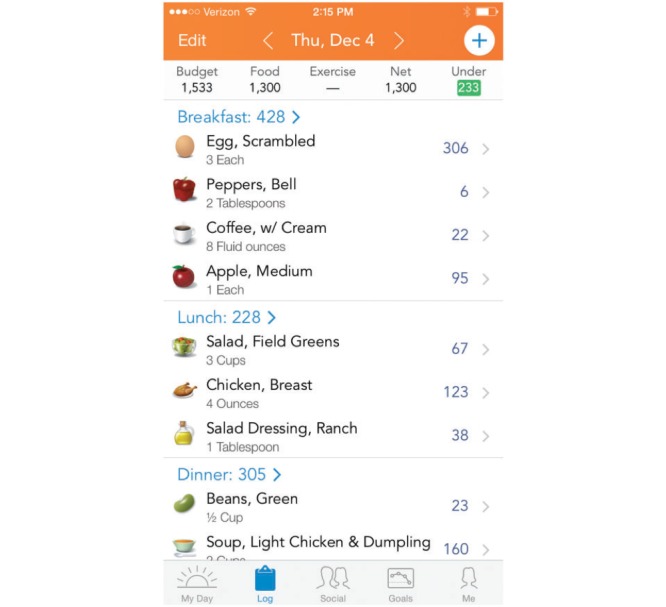
Swipe out Stroke was a pilot prospective randomized controlled trial with open blinded end point. Minority stroke patients and their caregivers were screened for participation using cluster enrollment. We used adaptive randomization for assignment to a behavior intervention with (1) smartphone-based self-monitoring or (2) food journal self-monitoring. The smartphone group used Lose it! to record meals and communicate with us. Reminder messages (first 30 days), weekly summaries plus reminder messages on missed days (days 31-90), and weekly summaries only (days 91-180) were sent via push notifications. The food journal group used paper diaries. Both groups received 4 in-person visits (baseline and 30, 90, and 180 days), culturally competent counseling, and educational materials. The primary outcome was reduced total body weight.
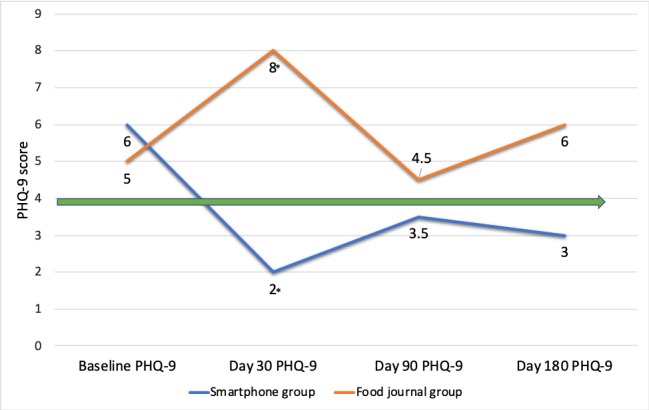
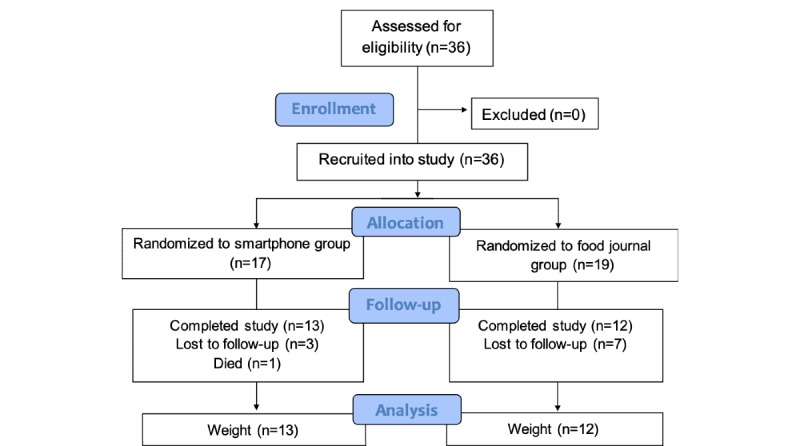
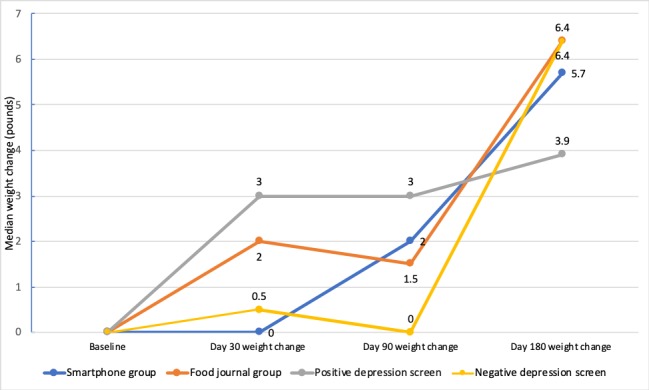
We enrolled 36 stroke patients (n=23, 64% African American; n=13, 36% Hispanic), 17 in the smartphone group, and 19 in the food journal group. Mean age was 54 (SD 9) years; mean body mass index was 35.7 (SD 5.7) kg/m2; education, employment status, and family history of stroke or obesity did not differ between the groups. Baseline rates of depression (Patient Health Questionnaire-9 [PHQ-9] score median 5.5, IQR 3.0-9.5), cognitive impairment (Montreal Cognitive Assessment score median 23.5, IQR 21-26), and inability to ambulate (5/36, 14% with modified Rankin Scale score 3) were similar. In total, 25 (69%) stroke survivors completed Swipe out Stroke (13/17 in the smartphone group, 12/19 in the food journal group); 1 participant in the smartphone group died. Median weight change at 180 days was 5.7 lb (IQR -2.4 to 8.0) in the smartphone group versus 6.4 lb (IQR -2.2 to 12.5; P=.77) in the food journal group. Depression was significantly lower at 30 days in the smartphone group than in the food journal group (PHQ-9 score 2 vs 8; P=.03). Clinically relevant depression rates remained in the zero to minimal range for the smartphone group compared with mild to moderate range in the food journal group at day 90 (PHQ-9 score 3.5 vs 4.5; P=.39) and day 180 (PHQ-9 score 3 vs 6; P=.12).
In a population of obese minority stroke survivors, the use of a smartphone did not lead to a significant difference in weight change compared with keeping a food journal. The presence of baseline depression (19/36, 53%) was a confounding variable, which improved with app engagement. Future studies that include treatment of poststroke depression may positively influence intervention efficacy.
ClinicalTrials.gov NCT02531074; https://www.clinicaltrials.gov/ct2/show/NCT02531074.
少数族裔早发性肥胖相关脑血管疾病的发病率有所增加。不幸的是,在这一弱势群体中进行有效的体重管理存在重大障碍。
我们的目的是确定基于智能手机的减肥干预措施与食物日记相比,在监测少数族裔中风患者饮食模式方面的可行性和初步治疗效果。
“消除中风”是一项前瞻性随机对照试验,采用开放盲终点设计。通过整群入组筛选少数族裔中风患者及其护理人员参与研究。我们采用适应性随机分组,将患者分配到行为干预组,一组为(1)基于智能手机的自我监测,另一组为(2)食物日记自我监测。智能手机组使用“Lose it!”应用程序记录饮食并与我们沟通。通过推送通知发送提醒消息(前30天)、每周总结以及错过日期的提醒消息(第31 - 90天),第91 - 180天仅发送每周总结。食物日记组使用纸质日记。两组均接受4次面对面访视(基线以及第30、90和180天)、具有文化敏感性的咨询以及教育材料。主要结局指标是总体重减轻。
我们招募了36名中风患者(n = 23,64%为非裔美国人;n = 13,36%为西班牙裔),智能手机组17人,食物日记组19人。平均年龄为54(标准差9)岁;平均体重指数为35.7(标准差5.7)kg/m²;两组在教育程度、就业状况以及中风或肥胖家族史方面无差异。基线时的抑郁发生率(患者健康问卷 - 9 [PHQ - 9]评分中位数5.5,四分位间距3.0 - 9.5)、认知障碍(蒙特利尔认知评估评分中位数23.5,四分位间距21 - 26)以及无法行走(5/36,改良Rankin量表评分为3分的占14%)情况相似。总共有25名(69%)中风幸存者完成了“消除中风”研究(智能手机组13/17,食物日记组12/19);智能手机组有1名参与者死亡。智能手机组在180天时体重变化中位数为5.7磅(四分位间距 - 2.4至8.0),食物日记组为6.4磅(四分位间距 - 2.2至12.5;P = 0.77)。智能手机组在第30天时的抑郁程度显著低于食物日记组(PHQ - 9评分2分对8分;P = 0.03)。在第90天(PHQ - 9评分3.5分对4.5分;P = 0.39)和第180天(PHQ - 9评分3分对6分;P = 0.12)时,与食物日记组处于轻度至中度范围相比,智能手机组临床上相关的抑郁发生率仍处于零至最低范围。
在肥胖的少数族裔中风幸存者群体中,与使用食物日记相比使用智能手机在体重变化方面未导致显著差异。基线抑郁的存在(19/36,53%)是一个混杂变量,随着应用程序的使用情况有所改善。未来纳入中风后抑郁治疗的研究可能会对干预效果产生积极影响。
ClinicalTrials.gov NCT02531074;https://www.clinicaltrials.gov/ct2/show/NCT0