Department of Infectious Diseases, Beijing Jishuitan Hospital, 4th Medical College of Peking University, Beijing, China.
Department of Pulmonary and Critical Care Medicine, Qingdao Municipal Hospital, Qingdao City, Shandong Province, China.
Infect Dis Poverty. 2020 Apr 22;9(1):42. doi: 10.1186/s40249-020-00655-w.
Inconsistencies exist regarding the severity of illness caused by different influenza strains. The aim of this study was to compare the clinical outcomes of hospitalized adults and adolescents with influenza-related pneumonia (Flu-p) from type A and type B strains in China.
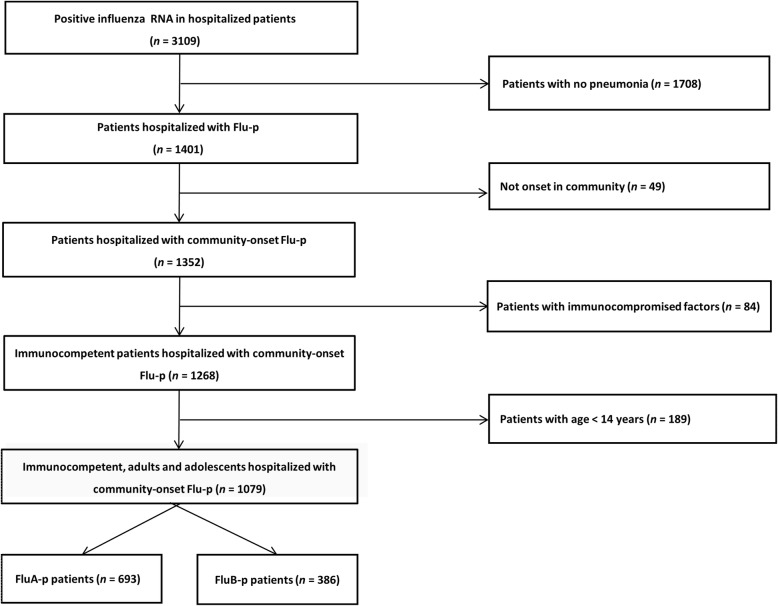
We retrospectively reviewed data from Flu-p patients in five hospitals in China from January 2013 to May 2019. Multivariate logistic and Cox regression models were used to assess the effects of influenza virus subtypes on clinical outcomes, and to explore the risk factors of 30-day mortality for Flu-p patients.
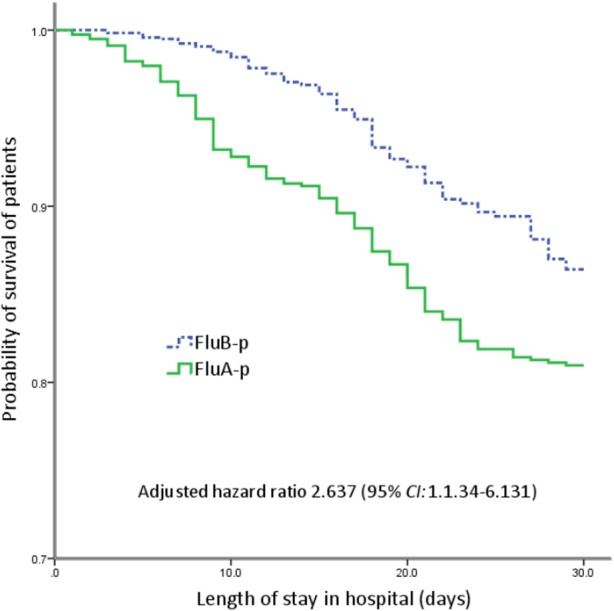
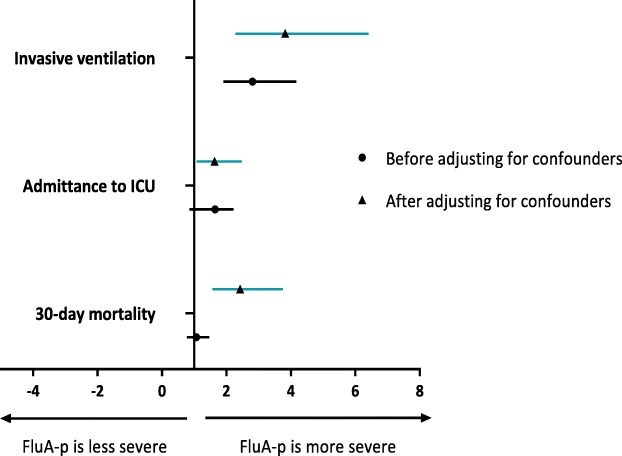
In total, 963 laboratory-confirmed influenza A-related pneumonia (FluA-p) and 386 influenza B-related pneumonia (FluB-p) patients were included. Upon adjustment for confounders, multivariate logistic regression models showed that FluA-p was associated with an increased risk of invasive ventilation (adjusted odds ratio [aOR]: 3.824, 95% confidence interval [CI]: 2.279-6.414; P < 0.001), admittance to intensive care unit (aOR: 1.630, 95% CI: 1.074-2.473, P = 0.022) and 30-day mortality (aOR: 2.427, 95% CI: 1.568-3.756, P < 0.001) compared to FluB-p. Multivariate Cox regression models confirmed that influenza A virus infection (hazard ratio: 2.637, 95% CI: 1.134-6.131, P = 0.024) was an independent predictor for 30-day mortality in Flu-p patients.
The severity of illness and clinical outcomes of FluA-p patients are more severe than FluB-p. This highlights the importance of identifying the virus strain during the management of severe influenza.
不同流感株引起的疾病严重程度存在差异。本研究旨在比较中国甲型和乙型流感相关肺炎(Flu-p)住院成人和青少年的临床结局。
我们回顾性分析了 2013 年 1 月至 2019 年 5 月期间中国五家医院 Flu-p 患者的数据。采用多变量逻辑回归和 Cox 回归模型评估流感病毒亚型对临床结局的影响,并探讨 Flu-p 患者 30 天死亡率的危险因素。
共纳入 963 例实验室确诊的甲型流感相关肺炎(FluA-p)和 386 例乙型流感相关肺炎(FluB-p)患者。调整混杂因素后,多变量逻辑回归模型显示,FluA-p 与侵入性通气(调整比值比[aOR]:3.824,95%置信区间[CI]:2.279-6.414;P<0.001)、入住重症监护病房(aOR:1.630,95% CI:1.074-2.473,P=0.022)和 30 天死亡率(aOR:2.427,95% CI:1.568-3.756,P<0.001)的风险增加相关,而与 FluB-p 相比。多变量 Cox 回归模型证实,流感 A 病毒感染(风险比:2.637,95% CI:1.134-6.131,P=0.024)是 Flu-p 患者 30 天死亡率的独立预测因素。
FluA-p 患者的疾病严重程度和临床结局比 FluB-p 更严重。这强调了在严重流感管理过程中识别病毒株的重要性。