Department of Colorectal Surgery, Huzhou Central Hospital, Huzhou, Zhejiang 313000, P.R. China.
Central Laboratory, Huzhou Central Hospital, Huzhou, Zhejiang 313000, P.R. China.
Oncol Rep. 2020 Apr;43(4):1187-1198. doi: 10.3892/or.2020.7511. Epub 2020 Feb 21.
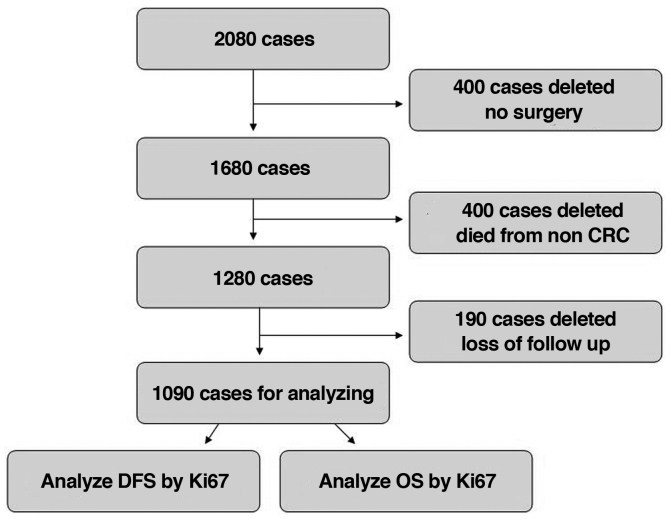
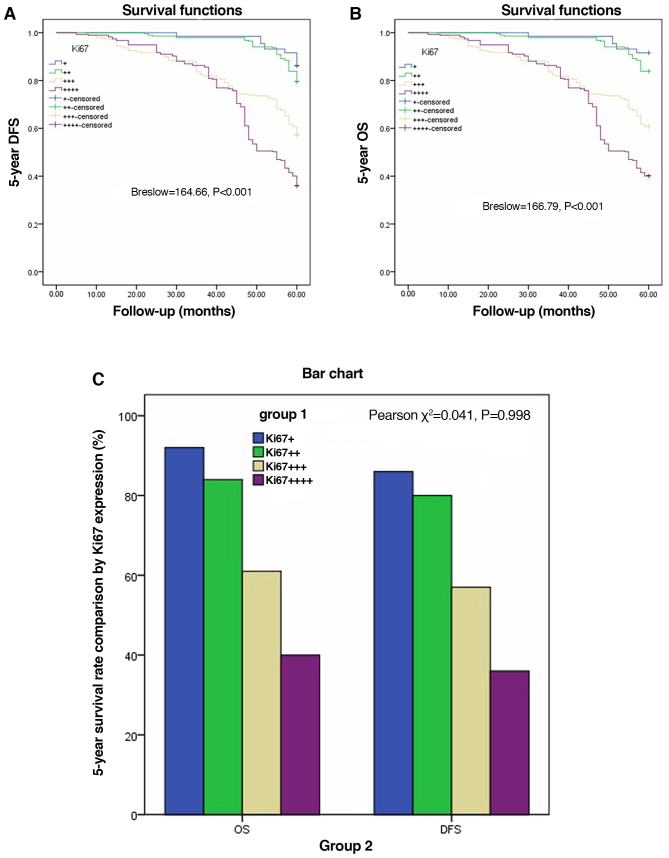
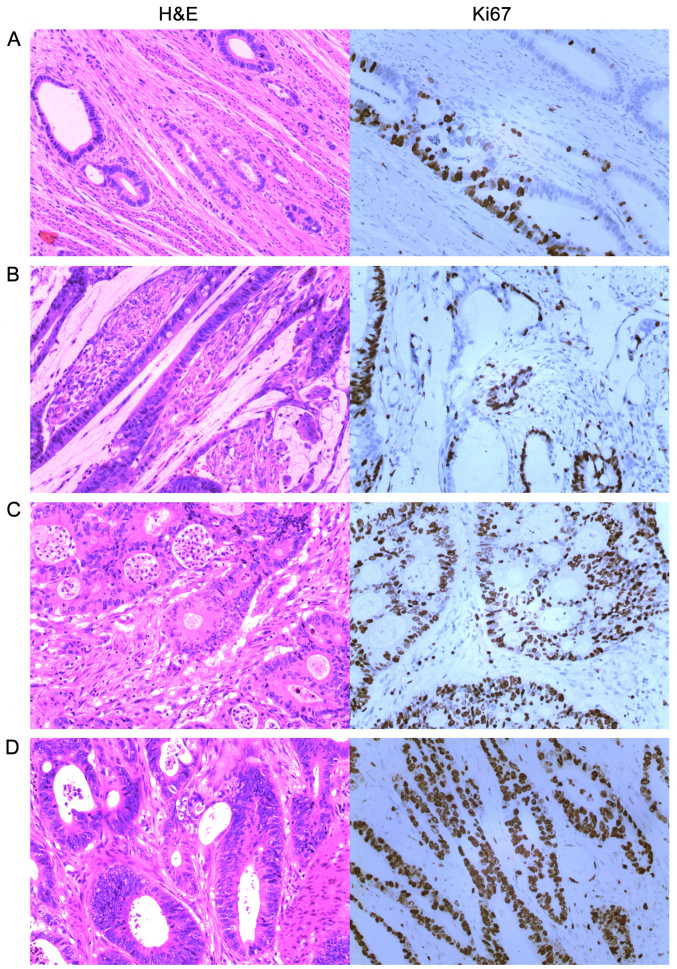
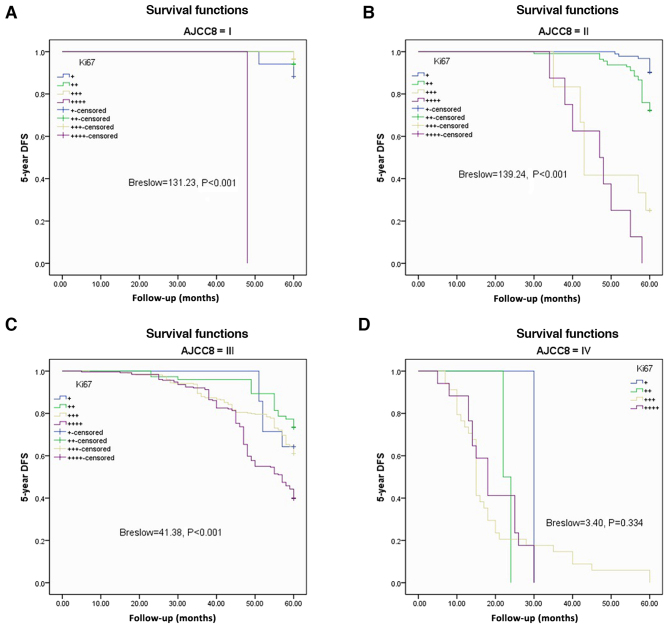
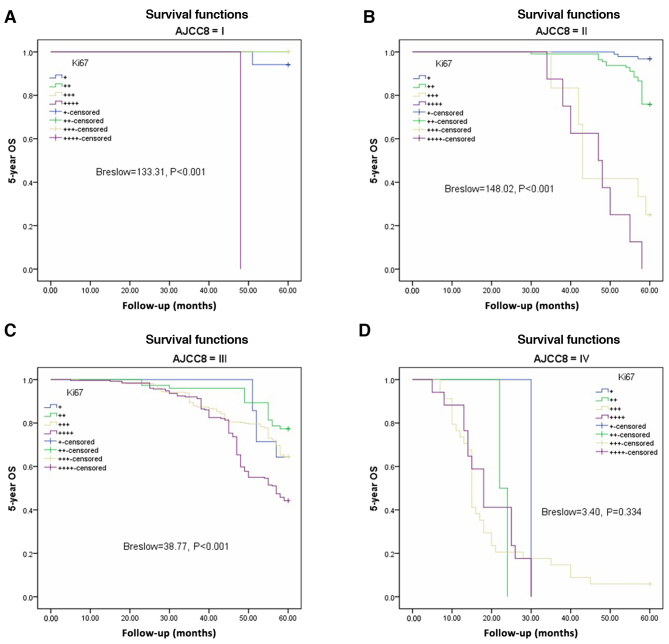
Ki‑67 expression has been widely used in clinical practice as an index to evaluate the proliferative activity of tumor cells. The cutoff for Ki67 expression in order to increase the prognostic value of Ki67 expression in colorectal cancer varies. The present study assessed the relationship between the 25% cutoff for Ki67 expression and prognosis in colorectal cancer in the AJCC‑8 (American Joint Committee on Cancer 8 edition) stratification. The current trial included 1,090 colorectal cancer patients enrolled from 2006 to 2012 at Huzhou Central Hospital. Ki67 expression was classified according to 25% intervals, dividing the patients into four groups. Measurement data were analyzed by ANOVA, and count data by Crosstabs. Bivariate correlation analysis was performed to assess clinicopathological indicators based on Ki67 expression. Disease‑free survival (DFS) and overall survival (OS) based on Ki67 levels were analyzed by the Kaplan‑Meier method. A total of 1,090 patients of the 2,080 enrolled CRC cases were evaluated (52.4%). Invasive depth, tumor differentiation, tumor size, AJCC‑8, positive number of lymph nodes and chemotherapy status showed significant differences in the various Ki67 expression groups (all P<0.05), with significant correlations (Spearman rho: 0.170, 0.456, 0.22, 0.195, 0.514 and ‑0.201, respectively, all P<0.001). DFS and OS for the different Ki67 level groups based on AJCC‑8 stratification were analyzed, and no significance was found in stage IV (P=0.334). DFS and OS survival rates were assessed at different Ki67 expression levels, and no significant differences were found (all P>0.05). Cox regression analysis showed that invasive depth, lymph node metastasis, tumor differentiation, AJCC‑8 and Ki67 were independent factors affecting colorectal cancer (P=0.030, all others P<0.001). In conclusion, a cutoff of 25% for Ki67 expression is a good classification tool. High Ki67 has a close association with poor prognosis in colorectal cancer and independently predicts prognosis in the AJCC‑8 stratification.
Ki-67 表达已广泛应用于临床实践中,作为评估肿瘤细胞增殖活性的指标。为了提高 Ki-67 表达在结直肠癌中的预后价值,Ki-67 表达的截断值有所不同。本研究评估了 Ki-67 表达 25%截断值与 AJCC-8(美国癌症联合委员会第 8 版)分层中结直肠癌预后之间的关系。本研究纳入了 2006 年至 2012 年在湖州市中心医院就诊的 1090 例结直肠癌患者。根据 25%间隔对 Ki-67 表达进行分类,将患者分为四组。采用方差分析分析计量资料,采用卡方检验分析计数资料。采用双变量相关分析根据 Ki-67 表达评估临床病理指标。根据 Ki67 水平分析无病生存(DFS)和总生存(OS),采用 Kaplan-Meier 法。共评估了 2080 例入组 CRC 病例中的 1090 例患者(52.4%)。在不同 Ki67 表达组中,浸润深度、肿瘤分化程度、肿瘤大小、AJCC-8、阳性淋巴结数量和化疗状态均有显著差异(均 P<0.05),具有显著相关性(Spearman rho:0.170、0.456、0.22、0.195、0.514 和-0.201,均 P<0.001)。根据 AJCC-8 分层分析不同 Ki67 水平组的 DFS 和 OS,IV 期无显著性差异(P=0.334)。评估不同 Ki67 表达水平的 DFS 和 OS 生存率,无显著性差异(均 P>0.05)。Cox 回归分析显示,浸润深度、淋巴结转移、肿瘤分化、AJCC-8 和 Ki67 是影响结直肠癌的独立因素(P=0.030,均 P<0.001)。总之,Ki67 表达 25%的截断值是一种很好的分类工具。高 Ki67 与结直肠癌不良预后密切相关,独立预测 AJCC-8 分层中的预后。