Key Laboratory of Animal Genetics, Breeding and Reproduction of Shaanxi Province, College of Animal Science and Technology, Northwest A&F University, Yangling, China.
Research Center for Chinese Frontier Archaeology, Jilin University, Changchun, China.
Mol Biol Evol. 2020 Jul 1;37(7):2099-2109. doi: 10.1093/molbev/msaa103.
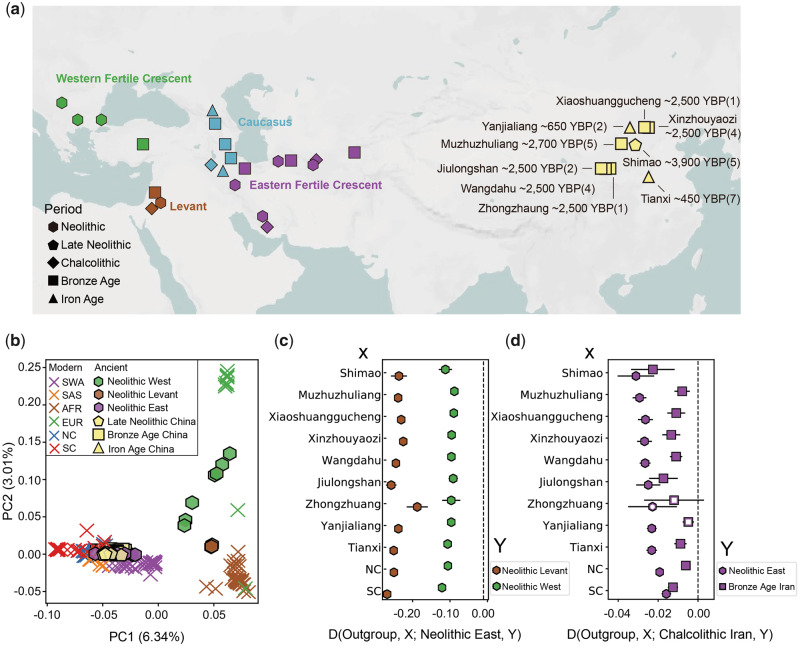
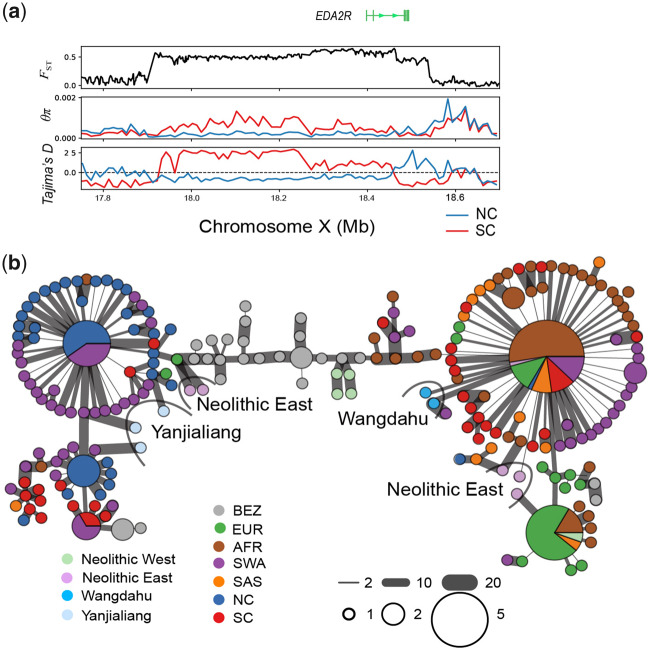
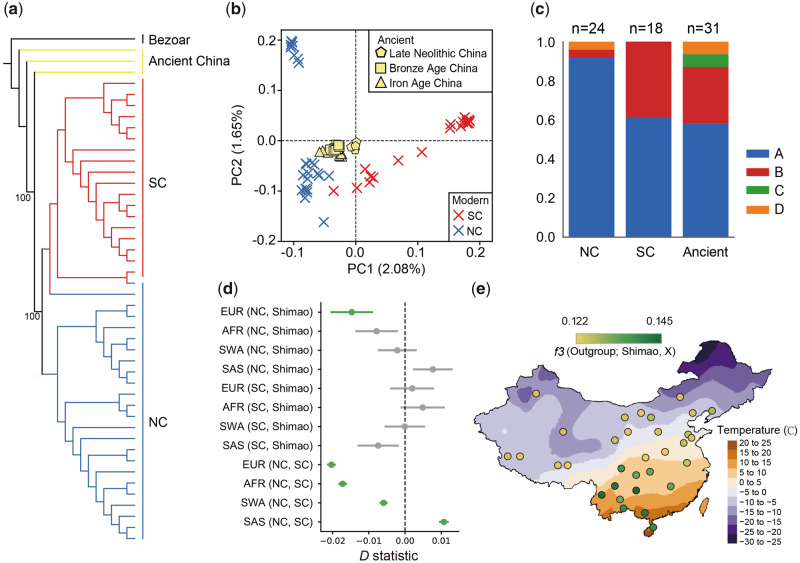
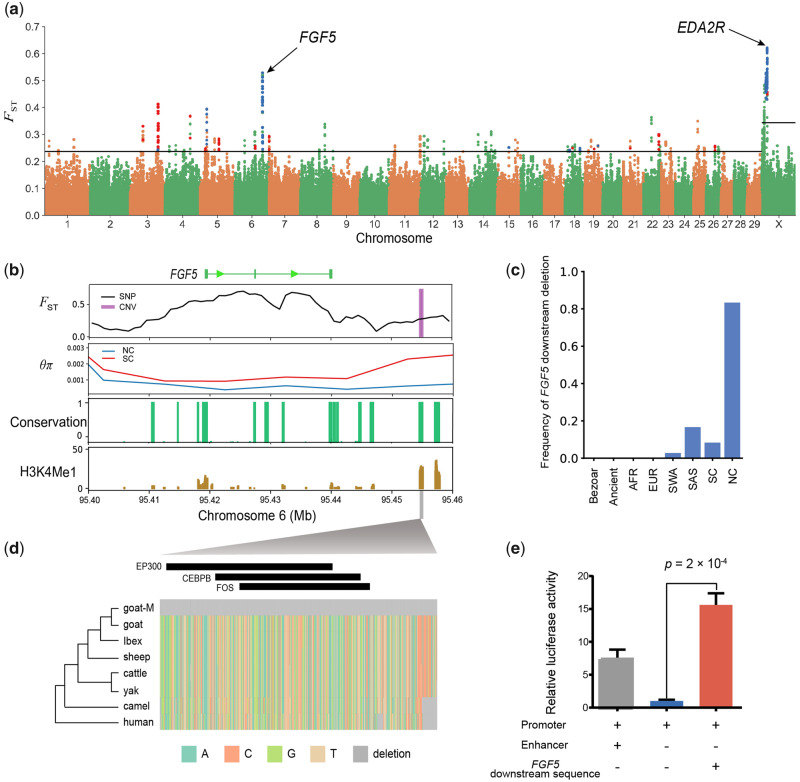
Goats are one of the most widespread farmed animals across the world; however, their migration route to East Asia and local evolutionary history remain poorly understood. Here, we sequenced 27 ancient Chinese goat genomes dating from the Late Neolithic period to the Iron Age. We found close genetic affinities between ancient and modern Chinese goats, demonstrating their genetic continuity. We found that Chinese goats originated from the eastern regions around the Fertile Crescent, and we estimated that the ancestors of Chinese goats diverged from this population in the Chalcolithic period. Modern Chinese goats were divided into a northern and a southern group, coinciding with the most prominent climatic division in China, and two genes related to hair follicle development, FGF5 and EDA2R, were highly divergent between these populations. We identified a likely causal de novo deletion near FGF5 in northern Chinese goats that increased to high frequency over time, whereas EDA2R harbored standing variation dating to the Neolithic. Our findings add to our understanding of the genetic composition and local evolutionary process of Chinese goats.
山羊是全球分布最广泛的养殖动物之一;然而,它们迁徙到东亚的路线以及当地的进化历史仍知之甚少。在这里,我们对 27 个来自新石器时代晚期到铁器时代的中国古代山羊基因组进行了测序。我们发现古代和现代中国山羊之间存在密切的遗传亲缘关系,证明了它们的遗传连续性。我们发现中国山羊起源于新月沃地周围的东部地区,并且我们估计中国山羊的祖先在铜石并用时代就与这个种群分化了。现代中国山羊分为北方和南方两个群体,与中国最显著的气候划分相吻合,两个与毛囊发育有关的基因 FGF5 和 EDA2R 在这两个群体之间存在高度分化。我们在北方中国山羊中鉴定到一个可能与 FGF5 有关的、新生的缺失突变,这个突变在过去的时间里增加到了很高的频率,而 EDA2R 则携带新石器时代以来的固定变异。我们的研究结果增加了我们对中国山羊遗传组成和当地进化过程的理解。