O'Brien Amanda M, Bayet Laurie, Riley Katherine, Nelson Charles A, Sahin Mustafa, Modi Meera E
Program in Speech and Hearing Bioscience and Technology, Division of Medical Sciences, Harvard University, Cambridge, MA, United States.
Department of Psychology, American University, Washington, DC, United States.
Front Integr Neurosci. 2020 Apr 9;14:14. doi: 10.3389/fnint.2020.00014. eCollection 2020.
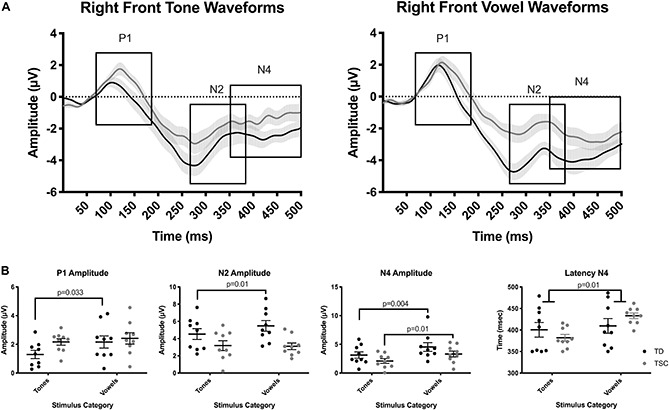
Individuals with Tuberous Sclerosis Complex (TSC) have atypical white matter integrity and neural connectivity in the brain, including language pathways. To explore functional activity associated with auditory and language processing in individuals with TSC, we used electroencephalography (EEG) to examine basic auditory correlates of detection (P1, N2, N4) and discrimination (mismatch negativity, MMN) of speech and non-speech stimuli for children with TSC and age- and sex-matched typically developing (TD) children. Children with TSC (TSC group) and without TSC (typically developing, TD group) participated in an auditory MMN paradigm containing two blocks of vowels (/a/and/u/) and two blocks of tones (800 Hz and 400 Hz). Continuous EEG data were collected. Multivariate pattern analysis (MVPA) was used to explore functional specificity of neural auditory processing. Speech-specific P1, N2, and N4 waveform components of the auditory evoked potential (AEP) were compared, and the mismatch response was calculated for both speech and tones. MVPA showed that the TD group, but not the TSC group, demonstrated above-chance pairwise decoding between speech and tones. The AEP component analysis suggested that while the TD group had an increased P1 amplitude in response to vowels compared to tones, the TSC group did not show this enhanced response to vowels. Additionally, the TD group had a greater N2 amplitude in response to vowels, but not tones, compared to the TSC group. The TSC group also demonstrated a longer N4 latency to vowels compared to tones, which was not seen in the TD group. No group differences were observed in the MMN response. In this study we identified features of the auditory response to speech sounds, but not acoustically matched tones, which differentiate children with TSC from TD children.
患有结节性硬化症(TSC)的个体大脑中存在非典型的白质完整性和神经连接,包括语言通路。为了探究与TSC个体的听觉和语言处理相关的功能活动,我们使用脑电图(EEG)检查了TSC儿童以及年龄和性别匹配的正常发育(TD)儿童对语音和非语音刺激的检测(P1、N2、N4)和辨别(失配负波,MMN)的基本听觉相关性。患有TSC的儿童(TSC组)和未患TSC的儿童(正常发育组,TD组)参与了一个听觉MMN范式,该范式包含两个元音块(/a/和/u/)和两个音调块(800赫兹和400赫兹)。收集了连续的EEG数据。使用多变量模式分析(MVPA)来探究神经听觉处理的功能特异性。比较了听觉诱发电位(AEP)的语音特异性P1、N2和N4波形成分,并计算了语音和音调的失配反应。MVPA显示,TD组而非TSC组在语音和音调之间表现出高于机遇水平的成对解码。AEP成分分析表明,与音调相比,TD组对元音的P1波幅增加,而TSC组未表现出对元音的这种增强反应。此外,与TSC组相比,TD组对元音的N2波幅更大,但对音调则不然。与音调相比,TSC组对元音的N4潜伏期也更长,而TD组未出现这种情况。在MMN反应中未观察到组间差异。在本研究中,我们确定了对语音而非声学匹配音调的听觉反应特征,这些特征可将TSC儿童与TD儿童区分开来。