Langlois Alexandra, Lavergne Marie-Hélène, Leroux Hélène, Killer Kerstin, Azzano Pauline, Paradis Louis, Samaan Kathryn, Lacombe-Barrios Jonathan, Mâsse Benoît, Des Roches Anne, Bégin Philippe
1Department of Allergy and Immunology, Centre Hospitalier Universitaire Sainte-Justine, Montreal, QC Canada.
3Centre Hospitalier Sainte-Justine Research Center, Montreal, QC Canada.
Allergy Asthma Clin Immunol. 2020 Apr 17;16:25. doi: 10.1186/s13223-020-00419-z. eCollection 2020.
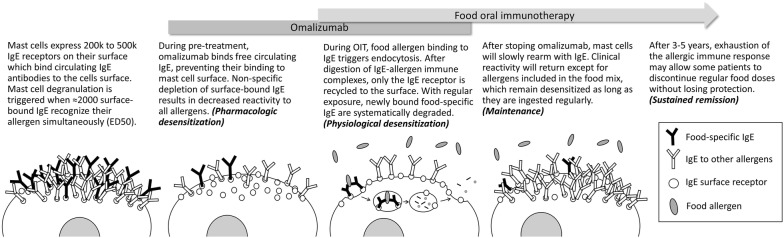
Previous proof-of-concept studies have shown that a short course of omalizumab can safely accelerate the oral immunotherapy schedule for multiple allergens simultaneously. Considering the high cost of medication, the dose-related efficacy of omalizumab at decreasing the duration of oral immunotherapy up-dosing phase must be objectively quantified before cost-benefit analyses can be performed. The primary objective of this trial will be to compare the efficacy of 2 omalizumab dosages to placebo at decreasing time-to-maintenance dose during a symptom-driven multi-food OIT protocol.
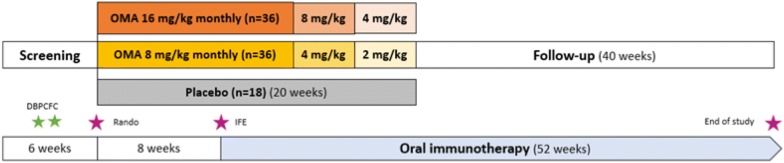
A total of 90 participants aged 6 to 25 with multiple food allergies (3 or more) will be enrolled at four sites in Canada. Participants will be randomized to: (A) Omalizumab 8 mg/kg per month (n = 36); (B) Omalizumab 16 mg/kg per month (n = 36); or (C) Placebo (n = 18). Study drug will be administered at full dosage for 12 weeks, then progressively tapered at 50% dosage (8 mg/kg vs 4 mg/kg vs placebo) for 4 weeks and at 25% dosage (4 mg/kg vs 2 mg/kg vs placebo) for another 4 weeks. After a pre-treatment period of 8 weeks, participants will undergo an initial food escalation (IFE) to an OIT mix containing 3 allergens and start daily home dosing with biweekly increases until a target daily maintenance of 1500 mg protein is achieved. The amount escalated at each visit will vary based on treatment tolerance according to a standardized up-dosing algorithm. Participants will be followed for at least 12 months following the initial food escalation. The primary endpoint will be time from IFE to the target maintenance dose of 1500 mg protein. Time-to-event analytic methods, including the log-rank test, will be used to compare the 3 arms.
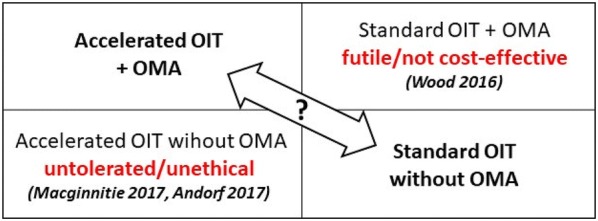
This trial uses a novel pragmatic approach to compare OIT with omalizumab to OIT without omalizumab in a blinded manner, which allows to single out the effect of this anti-IgE medication on treatment effectiveness speed without the recourse to predetermined schedules. The innovative patient-centered up-dosing algorithm allows to maximise treatment effectiveness speed without compromising patient safety, regardless of whether the patient is on omalizumab or not. This study will also provide novel prospective data to inform on the optimal and most cost-effective dosage for this indication. ClinicalTrials.gov, NCT04045301, Registered 5 August 2019, https://clinicaltrials.gov/ct2/show/NCT04045301.
先前的概念验证研究表明,短期使用奥马珠单抗可安全地同时加速多种过敏原的口服免疫治疗进程。考虑到药物成本高昂,在进行成本效益分析之前,必须客观量化奥马珠单抗在缩短口服免疫治疗剂量递增阶段持续时间方面与剂量相关的疗效。本试验的主要目的是在症状驱动的多种食物口服免疫治疗方案中,比较两种奥马珠单抗剂量与安慰剂在降低达到维持剂量所需时间方面的疗效。
在加拿大的四个地点共招募90名年龄在6至25岁之间、患有多种食物过敏(3种或更多)的参与者。参与者将被随机分为:(A)每月8 mg/kg奥马珠单抗组(n = 36);(B)每月16 mg/kg奥马珠单抗组(n = 36);或(C)安慰剂组(n = 18)。研究药物将以全剂量给药12周,然后在4周内逐渐减量至50%剂量(8 mg/kg vs 4 mg/kg vs安慰剂),并在接下来的4周内进一步减量至25%剂量(4 mg/kg vs 2 mg/kg vs安慰剂)。在为期8周的预处理期后,参与者将对包含3种过敏原的口服免疫治疗混合物进行初始食物剂量递增(IFE),并开始每日在家给药,每两周增加剂量,直至达到每日1500 mg蛋白质的目标维持剂量。根据标准化的剂量递增算法,每次就诊时递增的剂量将根据治疗耐受性而有所不同。在初始食物剂量递增后,将对参与者进行至少12个月的随访。主要终点将是从IFE到达到1500 mg蛋白质目标维持剂量的时间。将使用包括对数秩检验在内的事件发生时间分析方法来比较三组。
本试验采用了一种新颖的实用方法,以盲法比较使用奥马珠单抗的口服免疫治疗与不使用奥马珠单抗的口服免疫治疗,这使得能够在不依赖预定时间表的情况下,单独分离出这种抗IgE药物对治疗有效性速度的影响。创新的以患者为中心的剂量递增算法能够在不影响患者安全的情况下,最大限度地提高治疗有效性速度,无论患者是否使用奥马珠单抗。本研究还将提供新的前瞻性数据,以确定该适应症的最佳和最具成本效益的剂量。ClinicalTrials.gov,NCT04045301,2019年8月5日注册,https://clinicaltrials.gov/ct2/show/NCT04045301 。