Division of Training and Movement Sciences, Research Focus Cognition Sciences, University of Potsdam, Am Neuen Palais 10, Building 12, 14469, Potsdam, Germany.
Exercise Science and Neuroscience Unit, Department of Exercise and Health, Faculty of Science, Paderborn University, Warburger Straße 100, 33098, Paderborn, Germany.
Exp Brain Res. 2020 May;238(5):1323-1333. doi: 10.1007/s00221-020-05810-1. Epub 2020 Apr 23.
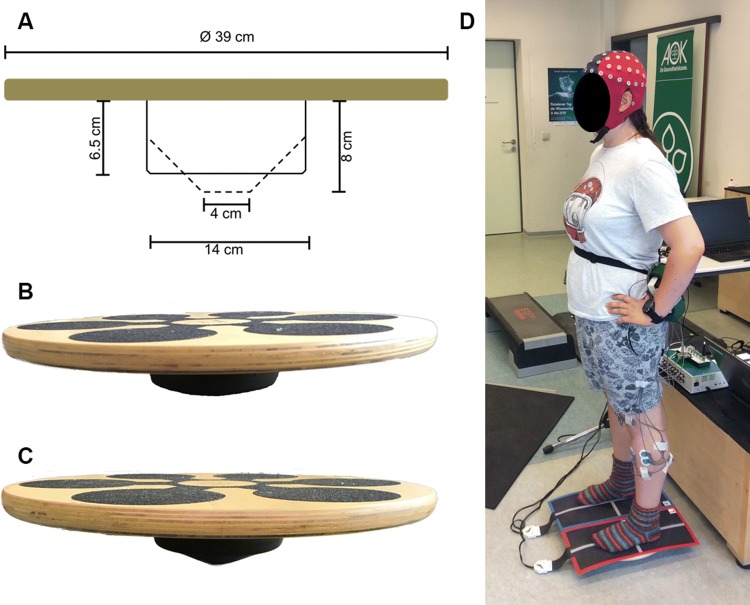
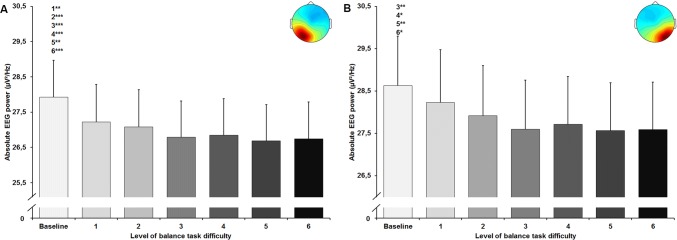
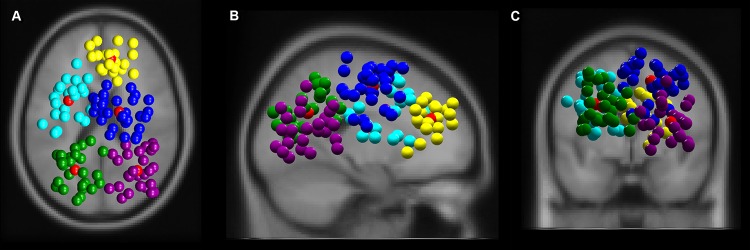
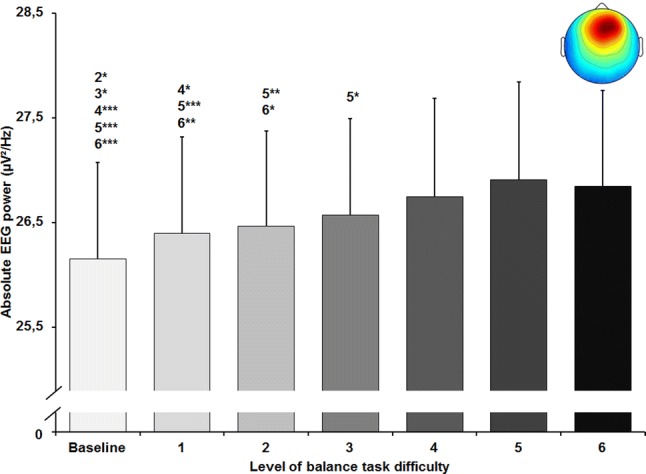
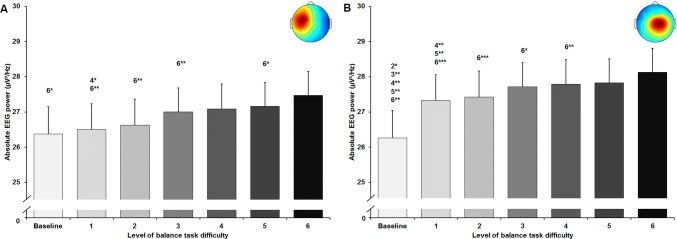
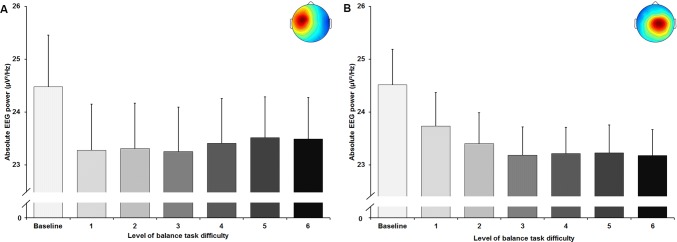
Electroencephalographic (EEG) research indicates changes in adults' low frequency bands of frontoparietal brain areas executing different balance tasks with increasing postural demands. However, this issue is unsolved for adolescents when performing the same balance task with increasing difficulty. Therefore, we examined the effects of a progressively increasing balance task difficulty on balance performance and brain activity in adolescents. Thirteen healthy adolescents aged 16-17 year performed tests in bipedal upright stance on a balance board with six progressively increasing levels of task difficulty. Postural sway and cortical activity were recorded simultaneously using a pressure sensitive measuring system and EEG. The power spectrum was analyzed for theta (4-7 Hz) and alpha-2 (10-12 Hz) frequency bands in pre-defined frontal, central, and parietal clusters of electrocortical sources. Repeated measures analysis of variance (rmANOVA) showed a significant main effect of task difficulty for postural sway (p < 0.001; d = 6.36). Concomitantly, the power spectrum changed in frontal, bilateral central, and bilateral parietal clusters. RmANOVAs revealed significant main effects of task difficulty for theta band power in the frontal (p < 0.001, d = 1.80) and both central clusters (left: p < 0.001, d = 1.49; right: p < 0.001, d = 1.42) as well as for alpha-2 band power in both parietal clusters (left: p < 0.001, d = 1.39; right: p < 0.001, d = 1.05) and in the central right cluster (p = 0.005, d = 0.92). Increases in theta band power (frontal, central) and decreases in alpha-2 power (central, parietal) with increasing balance task difficulty may reflect increased attentional processes and/or error monitoring as well as increased sensory information processing due to increasing postural demands. In general, our findings are mostly in agreement with studies conducted in adults. Similar to adult studies, our data with adolescents indicated the involvement of frontoparietal brain areas in the regulation of postural control. In addition, we detected that activity of selected brain areas (e.g., bilateral central) changed with increasing postural demands.
脑电图(EEG)研究表明,成年人在执行不同平衡任务时,前额顶叶脑区的低频带会发生变化,随着姿势需求的增加而变化。然而,当青少年执行相同的平衡任务且难度逐渐增加时,这个问题还没有得到解决。因此,我们研究了随着平衡任务难度的逐渐增加对青少年平衡表现和大脑活动的影响。13 名 16-17 岁的健康青少年在平衡板上以双足直立姿势进行测试,平衡板有六个逐渐增加难度的平衡任务。使用压力敏感测量系统和 EEG 同时记录姿势摆动和皮质活动。在预先定义的额、中、顶皮质源集群中,对 theta(4-7 Hz)和 alpha-2(10-12 Hz)频段的功率谱进行分析。重复测量方差分析(rmANOVA)显示,姿势摆动的任务难度有显著的主效应(p < 0.001;d = 6.36)。同时,功率谱在额、双侧中央和双侧顶集群中发生变化。rmANOVAs 显示,theta 频段在额(p < 0.001,d = 1.80)和双侧中央集群(左:p < 0.001,d = 1.49;右:p < 0.001,d = 1.42)以及 alpha-2 频段在双侧顶集群(左:p < 0.001,d = 1.39;右:p < 0.001,d = 1.05)和中央右集群(p = 0.005,d = 0.92)中的功率有显著的任务难度主效应。随着平衡任务难度的增加,theta 频段功率(额、中央)增加,alpha-2 频段功率(中央、顶)减少,这可能反映了注意力过程和/或错误监测的增加,以及由于姿势需求的增加而导致的感觉信息处理的增加。总的来说,我们的发现与在成年人中进行的研究基本一致。与成人研究类似,我们对青少年的数据表明,额顶叶脑区参与了姿势控制的调节。此外,我们发现随着姿势需求的增加,选定脑区(如双侧中央区)的活动发生了变化。