Brain Stimulation Laboratory, Department of Psychiatry, Medical University of South Carolina, Charleston, SC, USA.
Brain Stimulation Laboratory, Department of Psychiatry, Medical University of South Carolina, Charleston, SC, USA.
Brain Stimul. 2020 Jul-Aug;13(4):961-969. doi: 10.1016/j.brs.2020.04.007. Epub 2020 Apr 21.
Unique amongst brain stimulation tools, transcranial direct current stimulation (tDCS) currently lacks an easy or widely implemented method for individualizing dosage.
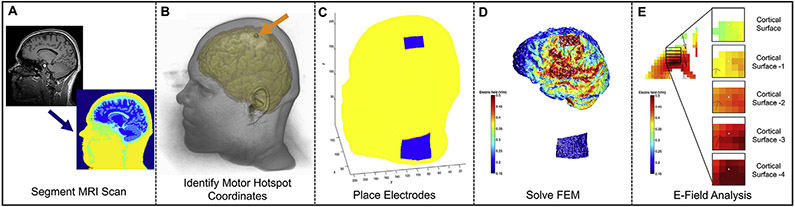
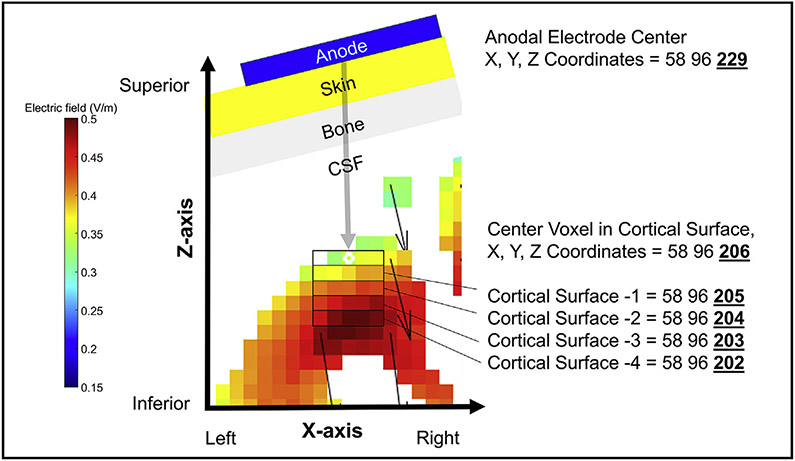
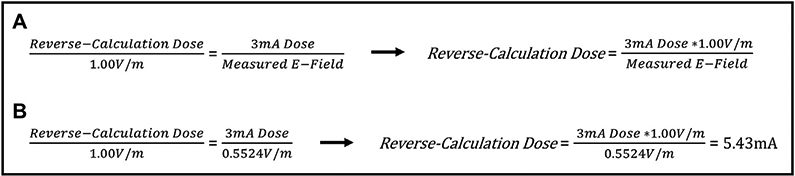
We developed a method of reverse-calculating electric-field (E-field) models based on Magnetic Resonance Imaging (MRI) scans that can estimate individualized tDCS dose. We also evaluated an MRI-free method of individualizing tDCS dose by measuring transcranial magnetic stimulation (TMS) motor threshold (MT) and single pulse, suprathreshold transcranial electrical stimulation (TES) MT and regressing it against E-field modeling. Key assumptions of reverse-calculation E-field modeling, including the size of region of interest (ROI) analysis and the linearity of multiple E-field models were also tested.
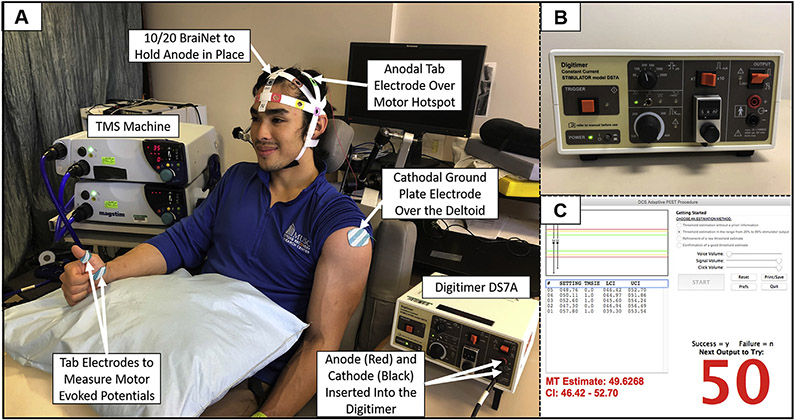
In 29 healthy adults, we acquired TMS MT, TES MT, and anatomical T1-weighted MPRAGE MRI scans with a fiducial marking the motor hotspot. We then computed a "reverse-calculated tDCS dose" of tDCS applied at the scalp needed to cause a 1.00 V/m E-field at the cortex. Finally, we examined whether the predicted E-field values correlated with each participant's measured TMS MT or TES MT.
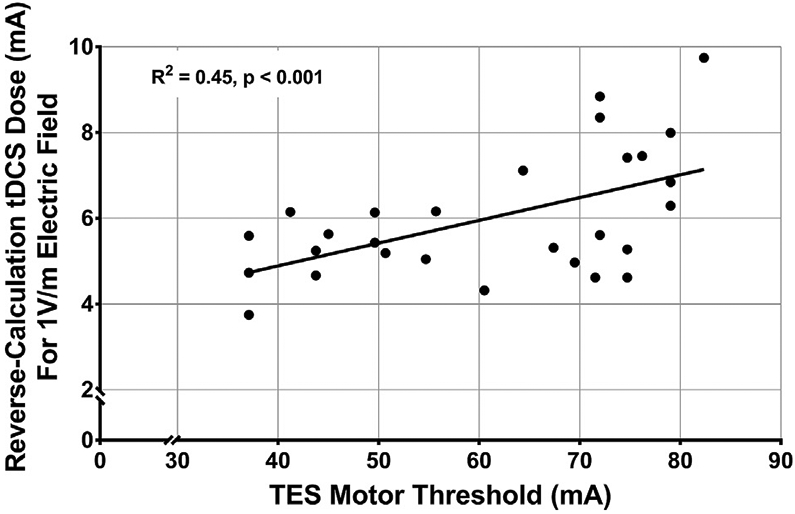
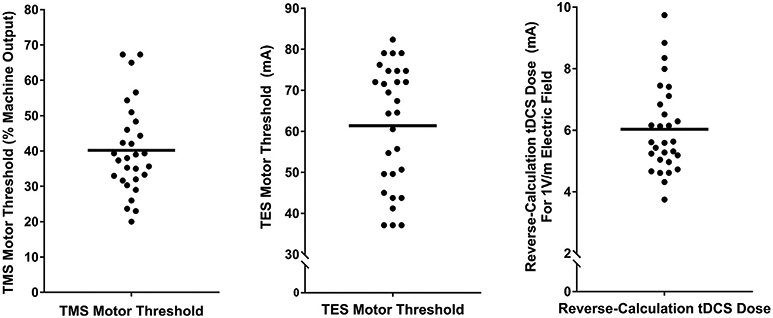
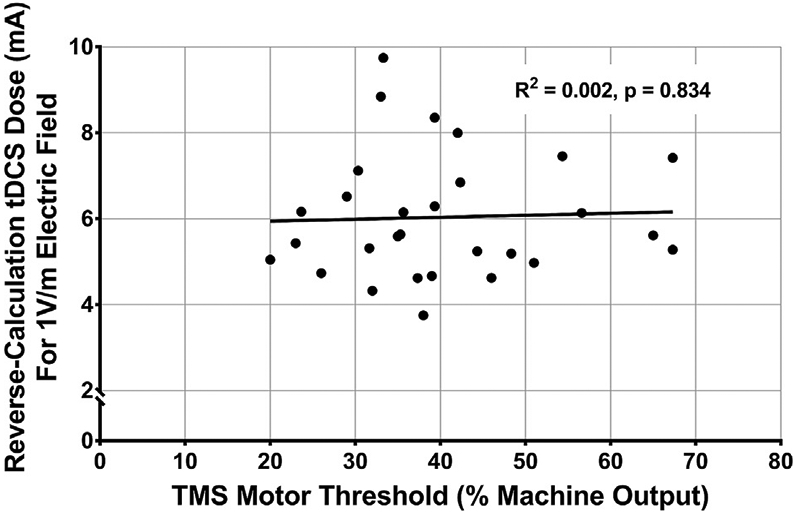
We were able to determine a reverse-calculated tDCS dose for each participant using a 5 × 5 x 5 voxel grid region of interest (ROI) approach (average = 6.03 mA, SD = 1.44 mA, range = 3.75-9.74 mA). The Transcranial Electrical Stimulation MT, but not the Transcranial Magnetic Stimulation MT, significantly correlated with the ROI-based reverse-calculated tDCS dose determined by E-field modeling (R = 0.45, p < 0.001).
Reverse-calculation E-field modeling, alone or regressed against TES MT, shows promise as a method to individualize tDCS dose. The large range of the reverse-calculated tDCS doses between subjects underscores the likely need to individualize tDCS dose. Future research should further examine the use of TES MT to individually dose tDCS as an MRI-free method of dosing tDCS.
在脑刺激工具中,经颅直流电刺激(tDCS)目前缺乏一种简单或广泛应用的剂量个体化方法。
我们开发了一种基于磁共振成像(MRI)扫描的反向计算电场(E-field)模型的方法,该方法可以估计个体化 tDCS 剂量。我们还通过测量经颅磁刺激(TMS)运动阈值(MT)和单脉冲、超阈经颅电刺激(TES)MT,并将其回归到 E-field 模型,评估了一种无 MRI 个体化 tDCS 剂量的方法。反向计算 E-field 模型的关键假设,包括感兴趣区域(ROI)分析的大小和多个 E-field 模型的线性度,也进行了测试。
在 29 名健康成年人中,我们采集了 TMS MT、TES MT 和带有标记运动热点的解剖学 T1 加权 MPRAGE MRI 扫描。然后,我们计算了头皮应用 tDCS 引起皮层 1.00 V/m E-field 所需的“反向计算 tDCS 剂量”。最后,我们检查了预测的 E-field 值是否与每个参与者的测量 TMS MT 或 TES MT 相关。
我们能够使用 5×5×5 体素网格 ROI 方法确定每个参与者的反向计算 tDCS 剂量(平均值=6.03 mA,标准差=1.44 mA,范围=3.75-9.74 mA)。TES MT,但不是 TMS MT,与基于 E-field 模型的 ROI 反向计算 tDCS 剂量显著相关(R=0.45,p<0.001)。
单独或回归 TES MT 的反向计算 E-field 模型显示出作为个体化 tDCS 剂量的方法的潜力。受试者之间反向计算 tDCS 剂量的范围很大,突出了个体化 tDCS 剂量的必要性。未来的研究应进一步探讨使用 TES MT 作为无 MRI 个体化 tDCS 剂量的方法。