Zhang Chuyi, Xiao Songlin, Shen Bin, Xu Zhen, Zhan Jianglong, Li Jingjing, Zhou Junhong, Fu Weijie
Key Laboratory of Exercise and Health Sciences of Ministry of Education, Shanghai University of Sport, Shanghai, 200438, China.
School of Sports Medicine and Health, Chengdu Sport University, Chengdu, 641418, China.
J Neuroeng Rehabil. 2025 Aug 21;22(1):182. doi: 10.1186/s12984-025-01721-w.
This study aimed to investigate the effects of four-week individualized transcranial direct current stimulation (tDCS) combined with foot core exercise (FCE) on foot and ankle sensorimotor function and postural control in individuals with chronic ankle instability (CAI).
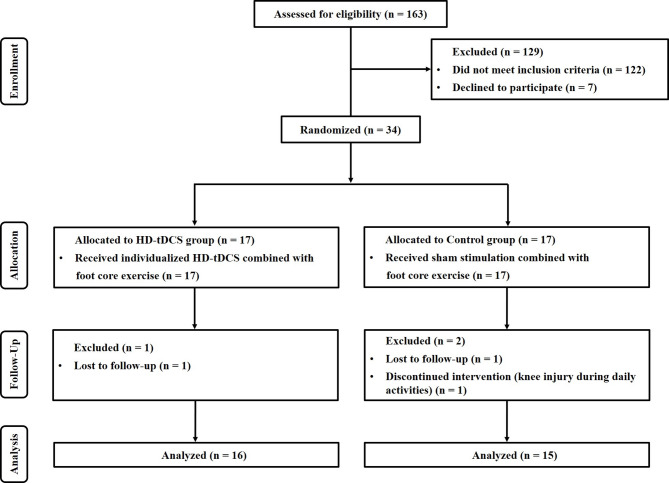
Thirty-four CAI individuals were randomly assigned to a tDCS combined with FCE group (tDCS group, n = 17) and a sham stimulation combined with FCE group (control group, n = 17). All participants received individualized stimulation combined with FCE and sham stimulation combined with FCE, respectively, three times a week for 20 min per session over four weeks. Ankle strength, joint position sense, and static and dynamic postural control were assessed at baseline and post-intervention.
Compared with the control group and baseline, individualized tDCS combined with FCE significantly increased the relative peak torque of plantarflexion, reduced the absolute error of ankle eversion position sense, and decreased the average sway velocity of the center of pressure during single-leg standing with eyes closed in CAI individuals (p values ranging from < 0.001 to 0.016).
Four weeks of individualized tDCS combined with FCE can effectively improve foot and ankle sensorimotor function and static postural control in CAI individuals.
本研究旨在探讨为期四周的个体化经颅直流电刺激(tDCS)联合足部核心训练(FCE)对慢性踝关节不稳(CAI)患者踝关节感觉运动功能和姿势控制的影响。
34例CAI患者被随机分为tDCS联合FCE组(tDCS组,n = 17)和假刺激联合FCE组(对照组,n = 17)。所有参与者分别接受个体化刺激联合FCE和假刺激联合FCE,每周3次,每次20分钟,共四周。在基线和干预后评估踝关节力量、关节位置觉以及静态和动态姿势控制。
与对照组和基线相比,个体化tDCS联合FCE显著增加了CAI患者跖屈的相对峰值扭矩,降低了踝关节外翻位置觉的绝对误差,并减少了闭眼单腿站立时压力中心的平均摆动速度(p值范围为<0.001至0.016)。
为期四周的个体化tDCS联合FCE可有效改善CAI患者的踝关节感觉运动功能和静态姿势控制。