Department of Health Management and Economics, School of Public Health, Tehran University of Medical Sciences, Poursina Ave, Tehran, 1417613191, Iran.
Department of Epidemiology and Biostatistics, Tehran University of Medical Sciences, Tehran, Iran.
Health Qual Life Outcomes. 2020 Apr 25;18(1):108. doi: 10.1186/s12955-020-01365-5.
EQ-5D is the most commonly used generic preference-based health-related quality of life (HRQoL) measure. The current study aimed at estimating the HRQoL index scores using EQ-5D-5 L measure in the capital of Iran; moreover, identifying some determinants of the HRQoL.
A sample of 3060 subjects was selected by a stratified random sampling method from the general adult population of Tehran. Face-to-face interview was conducted to fill out the questionnaire, in this cross-sectional survey. EQ-5D-5 L utility score were estimated using an interim value set, based on a crosswalk methodology. Additionally, the relationships between HRQoL and sociodemographic characteristics were tested by generalized linear model, using STATA version 13.
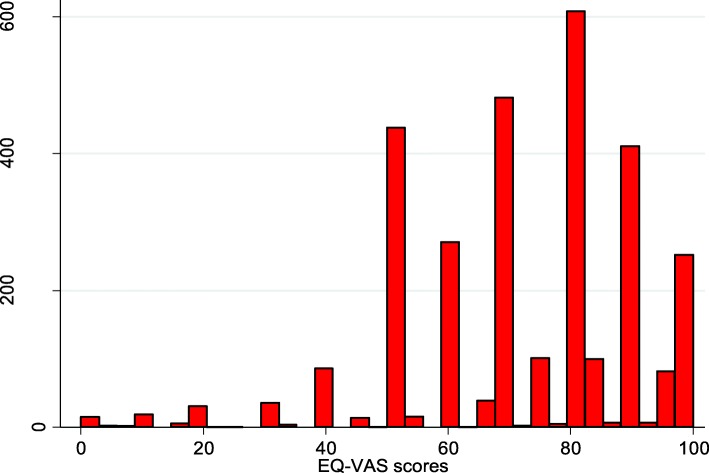
The mean ± standard deviation utility and EQ-VAS scores were 0.79 ± 0.17 and 71.72 ± 19.37. The utility scores ranged 0.61 ± 0.19 in > 69 year-old females to 0.88 ± 0.12 in < 30 year-old males. In mobility, self-care, and usual activity dimensions, most of the respondents reported "no problems" (70.47, 90.62, and 76.34%, respectively). However, in anxiety/depression and pain/discomfort dimensions, most of the respondents had problems (53.23 and 54.03%, respectively). Females had lower utility score than males; the utility score reduced with age increase; the educational level lead to higher utility scores; and the utility scores of individuals without spouse (divorced or widowed) were lower than those of the married individuals and never married ones.
The current study reported HRQoL norm data for the general adult population in the capital of Iran; these data could be very useful for policy making and economic evaluations. A significant percentage of people in Tehran reported anxiety/ depression, which highlights the risk of psychological problems. Effective interventions are needed to increase their HRQoL, especially for the vulnerable groups of the community.
EQ-5D 是最常用的通用偏好型健康相关生活质量(HRQoL)衡量标准。本研究旨在使用 EQ-5D-5L 量表估算伊朗首都的 HRQoL 指数得分;此外,还确定了 HRQoL 的一些决定因素。
采用分层随机抽样法从德黑兰的一般成年人群中抽取了 3060 名受试者。在这项横断面调查中,通过面对面访谈填写问卷。使用基于交叉方法的中间值集估算 EQ-5D-5L 效用得分。此外,使用 STATA 版本 13 通过广义线性模型测试 HRQoL 与社会人口统计学特征之间的关系。
平均(±标准差)效用和 EQ-VAS 得分分别为 0.79±0.17 和 71.72±19.37。效用得分范围从>69 岁女性的 0.61±0.19 到<30 岁男性的 0.88±0.12。在移动性、自我护理和日常活动维度,大多数受访者报告“无问题”(分别为 70.47、90.62 和 76.34%)。然而,在焦虑/抑郁和疼痛/不适维度,大多数受访者存在问题(分别为 53.23%和 54.03%)。女性的效用得分低于男性;随着年龄的增长,效用得分降低;教育程度导致更高的效用得分;无配偶(离婚或丧偶)的个体的效用得分低于已婚和未婚个体。
本研究报告了伊朗首都一般成年人群的 HRQoL 规范数据;这些数据对政策制定和经济评估非常有用。德黑兰有相当一部分人报告有焦虑/抑郁,这突出了心理问题的风险。需要采取有效的干预措施来提高他们的 HRQoL,特别是针对社区中的弱势群体。