Department of Psychology, University of Cologne, Richard-Strauss-Straße 2, 50931, Cologne, Germany.
Department of Medical Psychology, Neuropsychology and Gender Studies and Center for Neuropsychological Diagnostics and Intervention (CeNDI), Medical Faculty, University Hospital Cologne, Kerpener Str. 68, 50937, Cologne, Germany.
Psychol Res. 2021 Jun;85(4):1529-1552. doi: 10.1007/s00426-020-01337-w. Epub 2020 Apr 25.
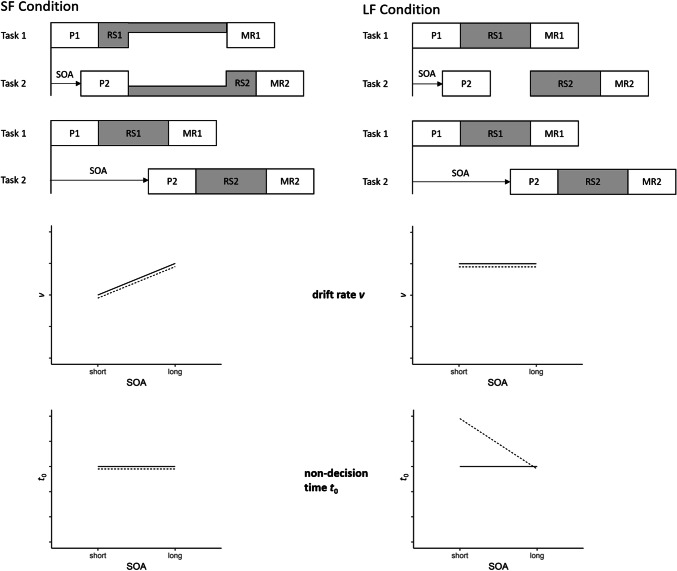
Even after a long time of research on dual-tasking, the question whether the two tasks are always processed serially (response selection bottleneck models, RSB) or also in parallel (capacity-sharing models) is still going on. The first models postulate that the central processing stages of two tasks cannot overlap, producing a central processing bottleneck in Task 2. The second class of models posits that cognitive resources are shared between the central processing stages of two tasks, allowing for parallel processing. In a series of three experiments, we aimed at inducing parallel vs. serial processing by manipulating the relative frequency of short vs. long SOAs (Experiments 1 and 2) and including no-go trials in Task 2 (Experiment 3). Beyond the conventional response time (RT) analyses, we employed drift-diffusion model analyses to differentiate between parallel and serial processing. Even though our findings were rather consistent across the three experiments, they neither support unambiguously the assumptions derived from the RSB model nor those derived from capacity-sharing models. SOA frequency might lead to an adaptation to frequent time patterns. Overall, our diffusion model results and mean RTs seem to be better explained by participant's time expectancies.
尽管对双重任务进行了长时间的研究,但两个任务是始终按顺序处理(反应选择瓶颈模型,RSB)还是并行处理(能力共享模型)的问题仍在继续。第一个模型假设两个任务的中央处理阶段不能重叠,从而在任务 2 中产生中央处理瓶颈。第二类模型假设认知资源在两个任务的中央处理阶段之间共享,允许并行处理。在三个实验系列中,我们旨在通过操纵短 SOA 与长 SOA 的相对频率(实验 1 和 2)以及在任务 2 中包含禁止试验(实验 3)来诱发并行与串行处理。除了传统的反应时(RT)分析外,我们还采用漂移-扩散模型分析来区分并行和串行处理。尽管我们的发现三个实验中相当一致,但它们既不能明确支持源自 RSB 模型的假设,也不能支持源自能力共享模型的假设。SOA 频率可能导致对频繁时间模式的适应。总的来说,我们的扩散模型结果和平均 RT 似乎可以更好地用参与者的时间预期来解释。