The UWA Institute of Agriculture, and School of Agriculture and Environment, The University of Western Australia, LB 5005, Perth, WA, 6001, Australia.
CSIRO Agriculture & Food, Private Bag No. 5, Wembley, WA, 6913, Australia.
BMC Plant Biol. 2020 Apr 28;20(1):185. doi: 10.1186/s12870-020-02390-8.
Understanding root system morphology in bread wheat is critical for identifying root traits to breed cultivars with improved resource uptake and better adaptation to adverse environments. Variability in root morphological traits at early vegetative stages was examined among 184 bread wheat genotypes originating from 37 countries grown in a semi-hydroponic phenotyping system.
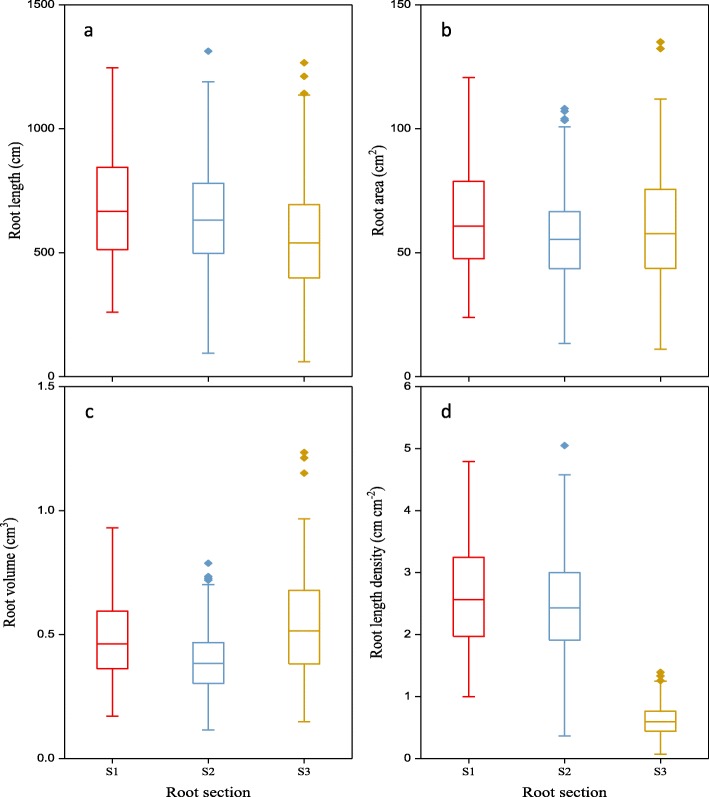
At the onset of tillering (Z2.1, 35 days after transplanting), plants had up to 42 cm in shoot height and 158 cm long in root depth. Phenotypic variation existed for both shoot and root traits, with a maximal 4.3-fold difference in total root length and 5-fold difference in root dry mass among the 184 genotypes. Of the 41 measured traits, 24 root traits and four shoot traits had larger coefficients of variation (CV ≥ 0.25). Strong positive correlations were identified for some key root traits (i.e., root mass, root length, and these parameters at different depths) and shoot traits (i.e., shoot mass and tiller number) (P ≤ 0.05). The selected 25 global traits (at whole-plant level) contributed to one of the five principal components (eigenvalues> 1) capturing 83.0% of the total variability across genotypes. Agglomerative hierarchical clustering analysis separated the 184 genotypes into four (at a rescaled distance of 15) or seven (at a rescaled distance of 10) major groups based on the same set of root traits. Strong relationships between performance traits (dry mass) with several functional traits such as specific root length, root length intensity and root tissue density suggest their linkage to plant growth and fitness strategies.
Large phenotypic variability in root system morphology in wheat genotypes was observed at the tillering stage using established semi-hydroponic phenotyping techniques. Phenotypic differences in and trait correlations among some interesting root traits may be considered for breeding wheat cultivars with efficient water acquisition and better adaptation to abiotic stress.
了解小麦根系形态对于鉴定根系特性至关重要,这些特性可用于培育具有改良资源吸收能力和更好适应不利环境的品种。本研究在半水培表型系统中种植 37 个国家的 184 份小麦基因型,分析了早期营养生长阶段根系形态特性的变异性。
在分蘖开始时(移栽后 35 天,Z2.1),植株的地上部分高可达 42cm,根系深 158cm。地上和地下部分的表型均存在差异,184 份基因型之间的总根长差异最大可达 4.3 倍,根干重差异最大可达 5 倍。在测量的 41 个性状中,24 个根系性状和 4 个地上性状的变异系数(CV≥0.25)较大。一些关键的根系性状(如根质量、根长和不同深度的这些参数)和地上性状(如地上部分质量和分蘖数)之间存在强烈的正相关关系(P≤0.05)。选择的 25 个全球性状(在整个植株水平上)可用于捕获基因型间 83.0%总变异性的五个主成分之一(特征值>1)。基于同一套根系性状,凝聚层次聚类分析将 184 个基因型分为四组(在重标距离为 15 时)或七组(在重标距离为 10 时)。一些功能性状(如比根长、根长强度和根组织密度)与干物质等表现型性状之间的强关系表明它们与植物生长和适应性策略有关。
使用已建立的半水培表型技术,在分蘖阶段观察到小麦基因型根系形态存在较大的表型变异性。一些有趣的根系性状之间的表型差异和性状相关性可能可用于培育具有高效水分获取能力和更好适应非生物胁迫的小麦品种。