Special Infectious Agents Unit, King Fahd Medical Research Center, King Abdulaziz University, Jeddah, Saudi Arabia.
Aix Marseille Université, IRD, APHM, VITROME, IHU-Méditerranée Infection, Marseille, France.
PLoS One. 2020 Apr 29;15(4):e0230895. doi: 10.1371/journal.pone.0230895. eCollection 2020.
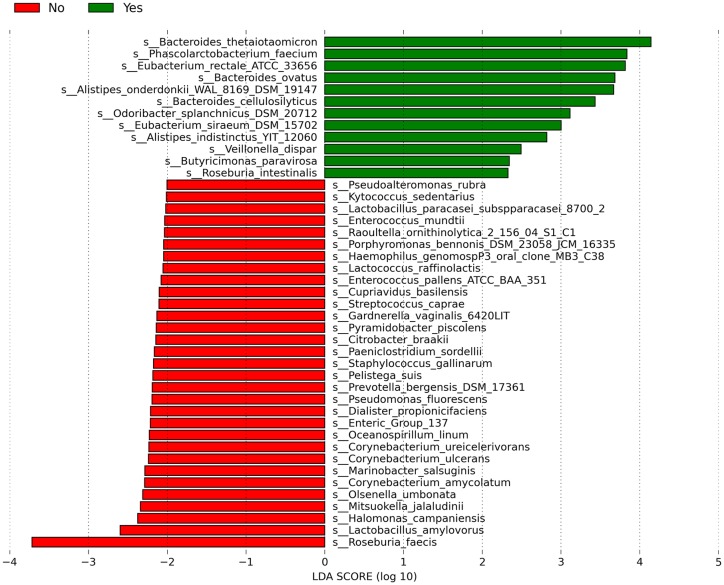
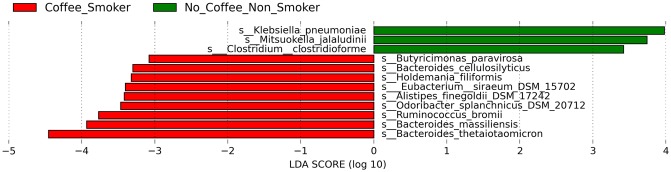
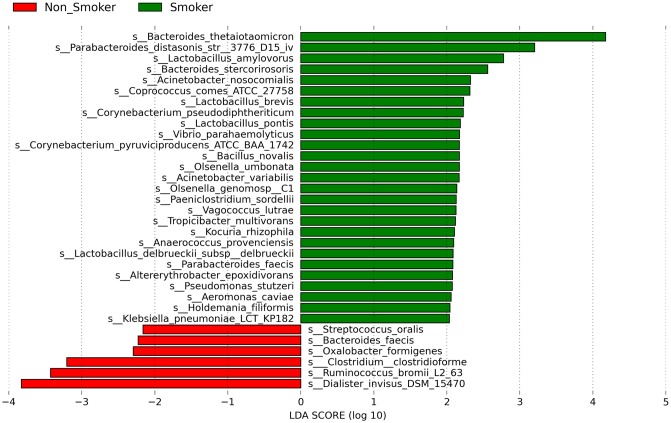
The gut microbiota is often affected by the dietary and lifestyle habits of the host, resulting in a better efficacy that favors energy harvesting from the consumed food. Our objective was to characterize the composition of gut microbiota in adult Saudis and investigate possible association with lifestyle and dietary practices. Feces from 104 Saudi volunteers (48% males) were tested for microbiota by sequencing the V3-V4 region of bacterial 16S ribosomal RNA (rRNA). For all participants, data were collected related to their lifestyle habits and dietary practices. The relative abundance (RA) of Fusobacteria was significantly higher in normal weight Saudis (P = 0.005, false discovery rate-FDR = 0.014). Individuals who consumed more coffee presented marginally significant more RA of Fusobacteria (P = 0.02, FDR = 0.20) in their gut microbiota compared to those reporting low or no coffee intake, but the RA of Fusobacteria was significantly higher in smokers compared to non-smokers (P = 0.009, FDR = 0.027). The RA of Fusobacteria was also significantly higher in those reporting daily consumption of bread (P = 0.005, FDR = 0.015). At the species level, the gut microbiota of people who consumed coffee was dominated by Bacteroides thetaiotaomicron followed by Phascolarctobacterium faecium and Eubacterium rectale. Similarly, the gut microbiota of smokers was also enriched by B. thetaiotaomicron and Lactobacillus amylovorus. Smoking cessation, bread and coffee consumption induce changes in the intestinal microbial composition of Saudis. This indicates the significance of diet and lifestyle practices in the determination of the composition of the gut microbiota, which could possibly lead later to changes in metabolic profile and weight.
肠道微生物群通常受到宿主饮食和生活方式的影响,从而产生更好的功效,有利于从消耗的食物中获取能量。我们的目的是描述沙特成年人肠道微生物群的组成,并研究其与生活方式和饮食实践的可能关联。对 104 名沙特志愿者(48%为男性)的粪便进行了细菌 16S 核糖体 RNA(rRNA)V3-V4 区测序,以检测微生物群。对于所有参与者,都收集了与他们的生活方式和饮食习惯相关的数据。在体重正常的沙特人中,梭菌的相对丰度(RA)明显更高(P=0.005,错误发现率-FDR=0.014)。与低或不喝咖啡摄入的个体相比,摄入更多咖啡的个体肠道微生物群中梭菌的 RA 略高(P=0.02,FDR=0.20),但吸烟者的梭菌 RA 明显高于不吸烟者(P=0.009,FDR=0.027)。每日食用面包的人肠道中梭菌的 RA 也明显更高(P=0.005,FDR=0.015)。在物种水平上,喝咖啡的人的肠道微生物群以拟杆菌属为主,其次是粪拟杆菌和真杆菌。同样,吸烟者的肠道微生物群也富含拟杆菌属和乳酸杆菌。戒烟、食用面包和咖啡会引起沙特人的肠道微生物组成发生变化。这表明饮食和生活方式实践在决定肠道微生物群组成方面的重要性,这可能会导致代谢谱和体重的变化。