Lei Xiujuan, Wang Yueyue
School of Computer Science, Shaanxi Normal University, Xi'an, China.
Front Microbiol. 2020 Apr 15;11:579. doi: 10.3389/fmicb.2020.00579. eCollection 2020.
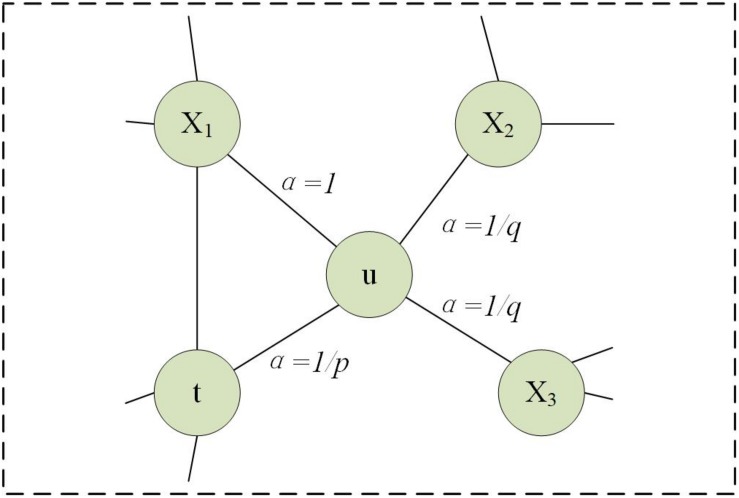
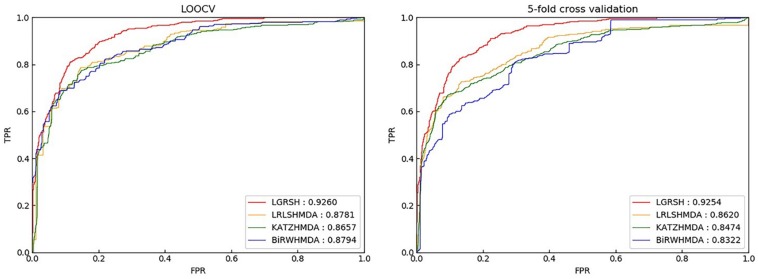
More and more clinical observations have implied that microbes have great effects on human diseases. Understanding the relations between microbes and diseases are of profound significance for disease prevention and therapy. In this paper, we propose a predictive model based on the known microbe-disease associations to discover potential microbe-disease associations through integrating Learning Graph Representations and a modified Scoring mechanism on the Heterogeneous network (called LGRSH). Firstly, the similarity networks for microbe and disease are obtained based on the similarity of Gaussian interaction profile kernel. Then, we construct a heterogeneous network including these two similarity networks and microbe-disease associations' network. After that, the embedding algorithm Node2vec is implemented to learn representations of nodes in the heterogeneous network. Finally, according to these low-dimensional vector representations, we calculate the relevance between each microbe and disease by utilizing a modified rule-based inference method. By comparison with three other methods including LRLSHMDA, KATZHMDA and BiRWHMDA, LGRSH performs better than others. Moreover, in case studies of asthma, Chronic Obstructive Pulmonary Disease and Inflammatory Bowel Disease, there are 8, 8, and 10 out of the top-10 discovered disease-related microbes were validated respectively, demonstrating that LGRSH performs well in predicting potential microbe-disease associations.
越来越多的临床观察表明,微生物对人类疾病有很大影响。了解微生物与疾病之间的关系对于疾病的预防和治疗具有深远意义。在本文中,我们提出了一种基于已知微生物-疾病关联的预测模型,通过整合学习图表示和异质网络上的改进评分机制(称为LGRSH)来发现潜在的微生物-疾病关联。首先,基于高斯相互作用轮廓核的相似性获得微生物和疾病的相似性网络。然后,我们构建一个包含这两个相似性网络和微生物-疾病关联网络的异质网络。之后,实施嵌入算法Node2vec来学习异质网络中节点的表示。最后,根据这些低维向量表示,我们利用改进的基于规则的推理方法计算每种微生物与疾病之间的相关性。通过与包括LRLSHMDA、KATZHMDA和BiRWHMDA在内的其他三种方法进行比较,LGRSH的性能优于其他方法。此外,在哮喘、慢性阻塞性肺疾病和炎症性肠病的案例研究中,发现的前10种与疾病相关的微生物中分别有8种、8种和10种得到了验证,表明LGRSH在预测潜在的微生物-疾病关联方面表现良好。