Wang Lei, Wang Yuqi, Li Hao, Feng Xiang, Yuan Dawei, Yang Jialiang
Key Laboratory of Hunan Province for Internet of Things and Information Security, Xiangtan University, Xiangtan, China.
College of Computer Engineering and Applied Mathematics, Changsha University, Changsha, China.
Front Microbiol. 2019 Apr 9;10:684. doi: 10.3389/fmicb.2019.00684. eCollection 2019.
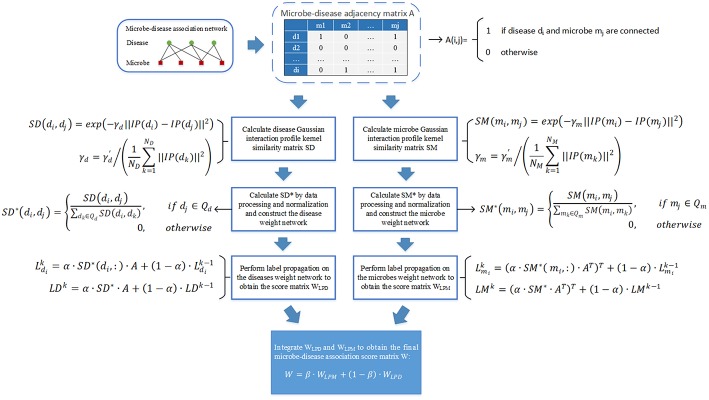
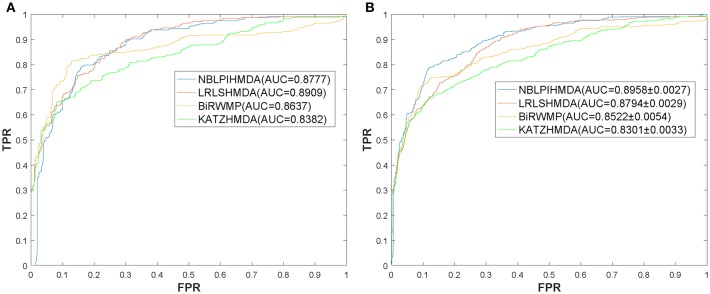
A growing number of clinical observations have indicated that microbes are involved in a variety of important human diseases. It is obvious that in-depth investigation of correlations between microbes and diseases will benefit the prevention, early diagnosis, and prognosis of diseases greatly. Hence, in this paper, based on known microbe-disease associations, a prediction model called NBLPIHMDA was proposed to infer potential microbe-disease associations. Specifically, two kinds of networks including the disease similarity network and the microbe similarity network were first constructed based on the Gaussian interaction profile kernel similarity. The bidirectional label propagation was then applied on these two kinds of networks to predict potential microbe-disease associations. We applied NBLPIHMDA on Human Microbe-Disease Association database (HMDAD), and compared it with 3 other recent published methods including LRLSHMDA, BiRWMP, and KATZHMDA based on the leave-one-out cross validation and 5-fold cross validation, respectively. As a result, the area under the receiver operating characteristic curves (AUCs) achieved by NBLPIHMDA were 0.8777 and 0.8958 ± 0.0027, respectively, outperforming the compared methods. In addition, in case studies of asthma, colorectal carcinoma, and Chronic obstructive pulmonary disease, simulation results illustrated that there are 10, 10, and 8 out of the top 10 predicted microbes having been confirmed by published documentary evidences, which further demonstrated that NBLPIHMDA is promising in predicting novel associations between diseases and microbes as well.
越来越多的临床观察表明,微生物与多种重要的人类疾病有关。显然,深入研究微生物与疾病之间的相关性将极大地有益于疾病的预防、早期诊断和预后。因此,本文基于已知的微生物 - 疾病关联,提出了一种名为NBLPIHMDA的预测模型来推断潜在的微生物 - 疾病关联。具体而言,首先基于高斯相互作用轮廓核相似性构建了包括疾病相似性网络和微生物相似性网络在内的两种网络。然后将双向标签传播应用于这两种网络以预测潜在的微生物 - 疾病关联。我们将NBLPIHMDA应用于人类微生物 - 疾病关联数据库(HMDAD),并分别基于留一法交叉验证和五折交叉验证将其与其他3种最近发表的方法(包括LRLSHMDA、BiRWMP和KATZHMDA)进行比较。结果,NBLPIHMDA获得的受试者工作特征曲线下面积(AUC)分别为0.8777和0.8958±0.0027,优于比较方法。此外,在哮喘、结肠直肠癌和慢性阻塞性肺疾病的案例研究中,模拟结果表明,在前10个预测的微生物中,分别有10个、10个和8个已被已发表的文献证据证实,这进一步证明了NBLPIHMDA在预测疾病与微生物之间的新关联方面也很有前景。