Zhang Yun, Wang Jinju, Li Hui, Zheng Tianying, Jiang Hanyu, Li Mou, Song Bin
Department of Radiology, Sichuan University West China Hospital, Chengdu 610041, China.
Department of Liver Surgery & Liver Transplantation Center, West China Hospital, Chengdu 610041, China.
Ann Transl Med. 2020 Mar;8(6):388. doi: 10.21037/atm.2020.03.120.
The Liver Imaging Reporting and Data System treatment response algorithm (LI-RADS TRA) was developed to evaluate the tumor response of patients with hepatocellular carcinoma (HCC) after locoregional treatments. This study aimed to evaluate the performance of LI-RADS computed tomography (CT) TRA version 2018 in tumor response assessment and survival prediction of patients with single HCC after radiofrequency ablation (RFA).
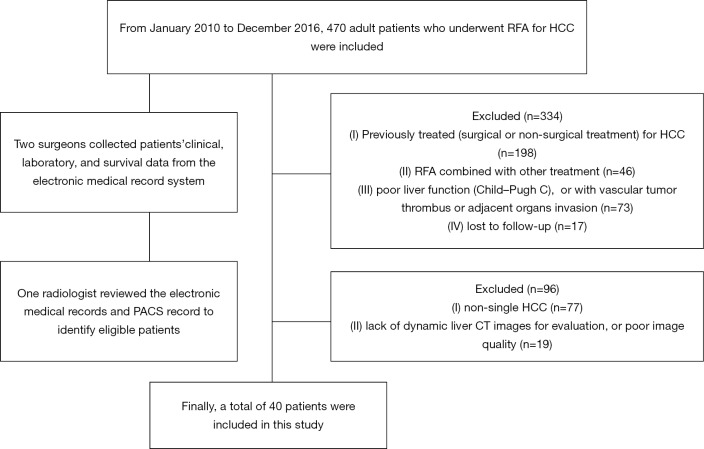
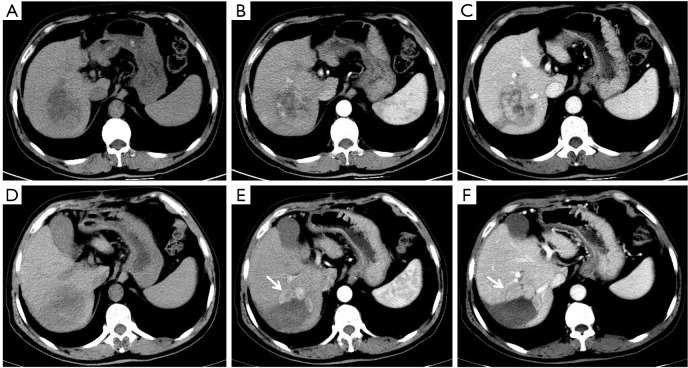
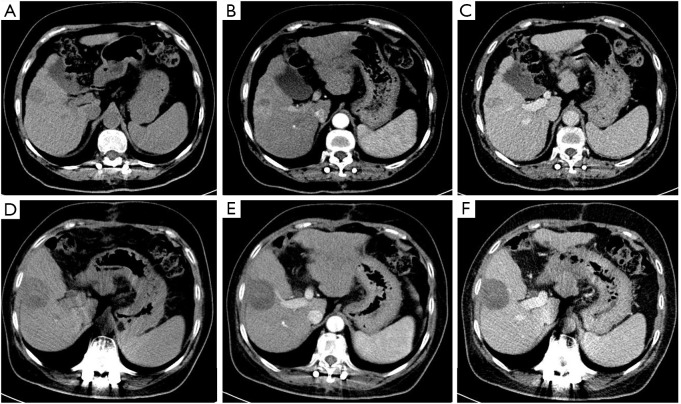
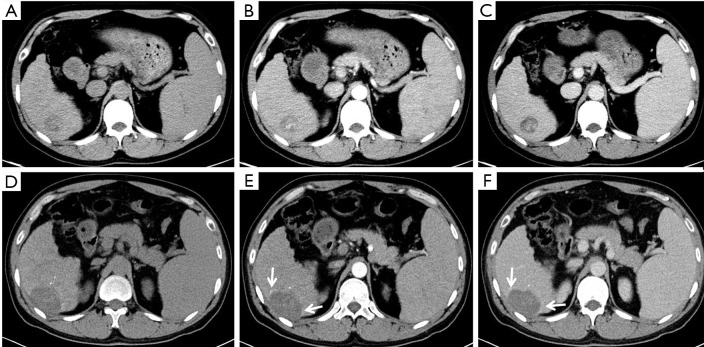
Forty patients who underwent RFA for single HCC between 2010 and 2016 were included in this retrospective study. The overall survival (OS) data from all the patients after the first therapy was collected. Two readers independently assessed the pretreatment (within 7 d) and posttreatment (within 90 d after RFA) CT manifestations using the LI-RADS version 2018 CT TRA. Inter-reader agreement was assessed. Another radiologist re-evaluated any divergent results and came to the final conclusion. The performance of LI-RADS version 2018 CT TRA for tumor response assessment and predicting survival of patients with single HCC after RFA was evaluated.
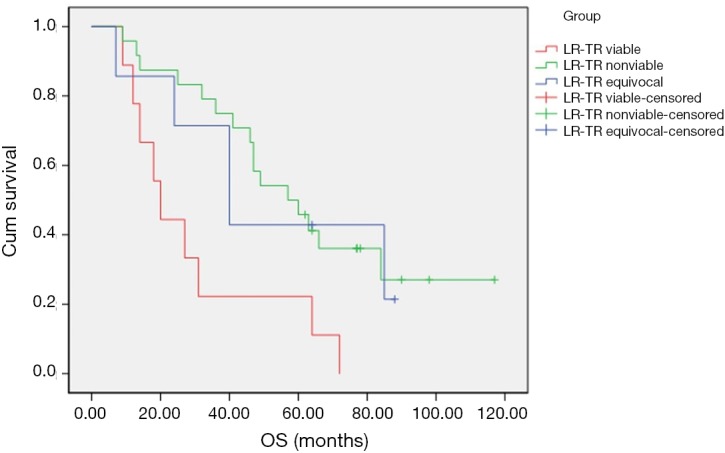
Interobserver agreement was moderate between the 2 readers [κ=0.602, 95% confidence interval (CI): 0.390-0.814] when using LI-RADS version 2018 TRA to evaluate tumor response for patients with single HCC after RFA. Patients classified as LR-TR viable had significantly lower OS than those classified as LR-TR nonviable (P=0.005) and LR-TR equivocal (P=0.036). However, the OS between LR-TR nonviable and LR-TR equivocal did not differ significantly (P=0.901).
LI-RADS version 2018 CT TRA can be applied to predict viable or nonviable HCC after RFA. Patients with LR-TR viable had significantly lower OS than those with LR-TR nonviable and LR-TR equivocal. More research is needed to validate the performance of LI-RADS version 2018 TRA in HCC tumor response evaluation, to better grasp the use of the tie-breaking rule, and to improve the accuracy of prediction for tumor viability.
肝脏影像报告和数据系统治疗反应算法(LI-RADS TRA)旨在评估肝细胞癌(HCC)患者经局部区域治疗后的肿瘤反应。本研究旨在评估LI-RADS 2018版计算机断层扫描(CT)TRA在射频消融(RFA)治疗后单发性HCC患者的肿瘤反应评估及生存预测中的性能。
本回顾性研究纳入了2010年至2016年间因单发性HCC接受RFA治疗的40例患者。收集了所有患者首次治疗后的总生存(OS)数据。两名阅片者使用LI-RADS 2018版CT TRA独立评估治疗前(7天内)和治疗后(RFA后90天内)的CT表现。评估阅片者间的一致性。另一位放射科医生对任何有分歧的结果进行重新评估并得出最终结论。评估LI-RADS 2018版CT TRA在RFA治疗后单发性HCC患者的肿瘤反应评估及生存预测中的性能。
当使用LI-RADS 2018版TRA评估RFA治疗后单发性HCC患者的肿瘤反应时,两名阅片者间的观察者间一致性为中等(κ=0.602,95%置信区间[CI]:0.390-0.814)。分类为LR-TR存活的患者的OS显著低于分类为LR-TR非存活(P=0.005)和LR-TR不确定(P=0.036)的患者。然而,LR-TR非存活和LR-TR不确定患者之间的OS差异无统计学意义(P=0.901)。
LI-RADS 2018版CT TRA可用于预测RFA治疗后HCC的存活或非存活情况。LR-TR存活的患者的OS显著低于LR-TR非存活和LR-TR不确定的患者。需要更多研究来验证LI-RADS 2018版TRA在HCC肿瘤反应评估中的性能,以更好地掌握打破平局规则的使用,并提高肿瘤存活预测的准确性。