Sanz Libia, Pérez Alicia, Quesada-Bernat Sarai, Diniz-Sousa Rafaela, Calderón Leonardo A, Soares Andreimar M, Calvete Juan J, Caldeira Cleópatra A S
Evolutionary and Translational Venomics Laboratory, Spanish National Research Council (CSIC), Valencia, Spain.
Center for the Study of Biomolecules Applied to Health (CEBio), Oswaldo Cruz Foundation Rondônia, Porto Velho, RO, Brazil.
J Venom Anim Toxins Incl Trop Dis. 2020 Apr 17;26:e20190103. doi: 10.1590/1678-9199-JVATITD-2019-0103. eCollection 2020.
The Brazil's lancehead, , is a poorly studied pit viper distributed in lowlands of the equatorial rainforests of southern Colombia, northeastern Peru, eastern Ecuador, southern and southeastern Venezuela, Guyana, Suriname, French Guiana, Brazil, and northern Bolivia. Few studies have been reported on toxins isolated from venom of Ecuadorian and Brazilian . The aim of the present study was to elucidate the qualitative and quantitative protein composition of venom from Pará (Brazil), and to carry out a comparative antivenomics assessment of the immunoreactivity of the Brazilian antibothropic pentavalent antivenom [ (SAB) in Portuguese] against the venoms of and reference species, .
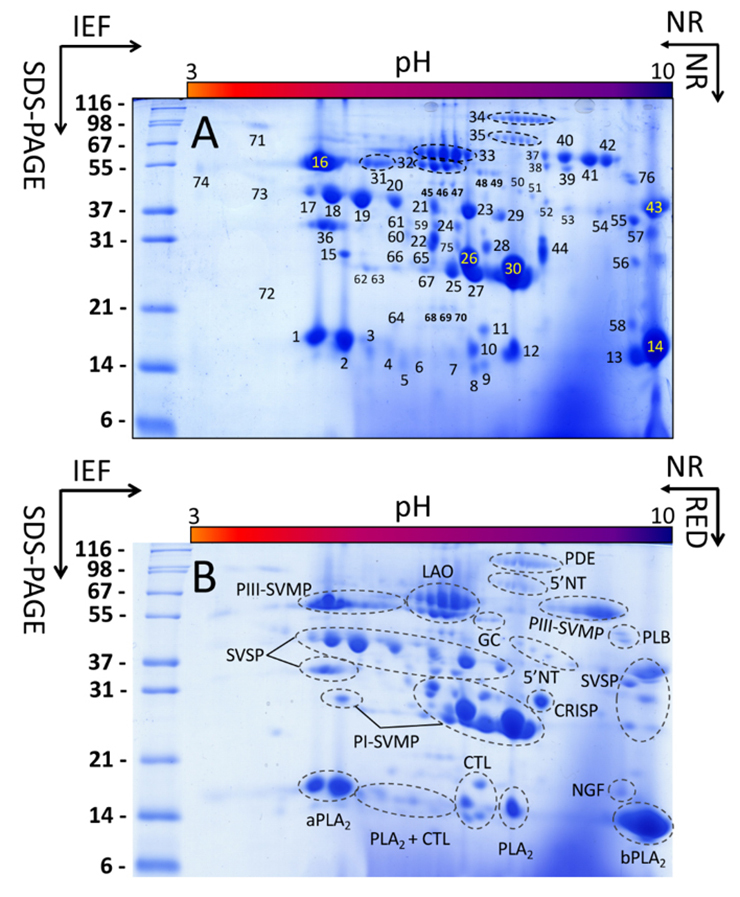
We have applied a quantitative snake venomics approach, including reverse-phase and two-dimensional electrophoretic decomplexation of the venom toxin arsenal, LC-ESI-MS mass profiling and peptide-centric MS/MS proteomic analysis, to unveil the overall protein composition of venom from Pará (Brazil). Using third-generation antivenomics, the specific and paraspecific immunoreactivity of the Brazilian SAB against homologous () and heterologous () venoms was investigated.
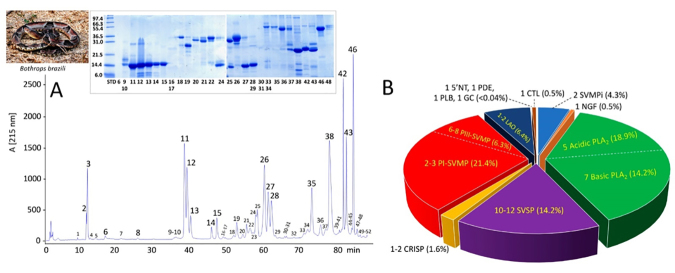
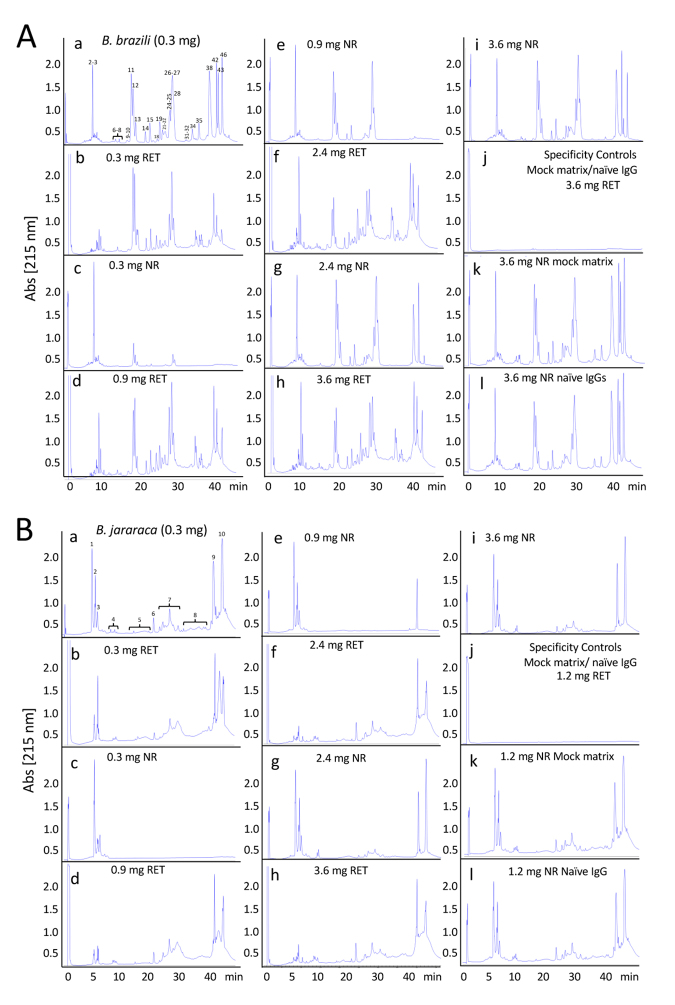
The venom proteome of the Brazil's lancehead (Pará) is predominantly composed of two major and three minor acidic (19%) and two major and five minor basic (14%) phospholipase A molecules; 7-11 snake venom metalloproteinases of classes PI (21%) and PIII (6%); 10-12 serine proteinases (14%), and 1-2 L-amino acid oxidases (6%). Other toxins, including two cysteine-rich secretory proteins, one C-type lectin-like molecule, one nerve growth factor, one 5'-nucleotidase, one phosphodiesterase, one phospholipase B, and one glutaminyl cyclase molecule, represent together less than 2.7% of the venom proteome. Third generation antivenomics profile of the Brazilian pentabothropic antivenom showed paraspecific immunoreactivity against all the toxin classes of venom with maximal binding capacity of 132.2 mg venom/g antivenom. This figure indicates that 19% of antivenom's F(ab') antibodies bind venom toxins.
The proteomics outcome contribute to a deeper insight into the spectrum of toxins present in the venom of the Brazil's lancehead, and rationalize the pathophysiology underlying this snake bite envenomings. The comparative qualitative and quantitative immunorecognition profile of the Brazilian pentabothropic antivenom toward the venom toxins of and (the reference venom for assessing the bothropic antivenom's potency in Brazil), provides clues about the proper use of the Brazilian antibothropic polyvalent antivenom in the treatment of bites by the Brazil's lancehead.
巴西矛头蝮蛇分布于哥伦比亚南部、秘鲁东北部、厄瓜多尔东部、委内瑞拉南部和东南部、圭亚那、苏里南、法属圭亚那、巴西以及玻利维亚北部的赤道雨林低地,是一种研究较少的蝰蛇。关于从厄瓜多尔和巴西的巴西矛头蝮蛇毒液中分离出的毒素的研究报道较少。本研究的目的是阐明巴西帕拉州巴西矛头蝮蛇毒液的定性和定量蛋白质组成,并对巴西抗五步蛇毒五价抗蛇毒血清[葡萄牙语为“Serum Antibotrópico Brasileiro (SAB)”]针对巴西矛头蝮蛇毒液和参考物种的毒液的免疫反应性进行比较抗蛇毒血清组学评估。
我们应用了一种定量蛇毒蛋白质组学方法,包括毒液毒素库的反相和二维电泳解聚、液相色谱 - 电喷雾电离 - 质谱(LC - ESI - MS)质量分析和以肽为中心的串联质谱(MS/MS)蛋白质组学分析,以揭示巴西帕拉州巴西矛头蝮蛇毒液的整体蛋白质组成。使用第三代抗蛇毒血清组学方法,研究了巴西SAB对同源(巴西矛头蝮蛇)和异源(其他物种)毒液的特异性和交叉特异性免疫反应性。
巴西矛头蝮蛇(帕拉州)的毒液蛋白质组主要由两种主要和三种次要酸性(19%)以及两种主要和五种次要碱性(14%)磷脂酶A分子组成;7 - 11种PI类(21%)和PIII类(6%)的蛇毒金属蛋白酶;10 - 12种丝氨酸蛋白酶(14%),以及1 - 2种L - 氨基酸氧化酶(6%)。其他毒素,包括两种富含半胱氨酸的分泌蛋白、一种C型凝集素样分子、一种神经生长因子、一种5'-核苷酸酶、一种磷酸二酯酶、一种磷脂酶B和一种谷氨酰胺环化酶分子,总共占毒液蛋白质组的比例不到2.7%。巴西五步蛇毒抗蛇毒血清的第三代抗蛇毒血清组学图谱显示对巴西矛头蝮蛇毒液的所有毒素类别都有交叉特异性免疫反应性,最大结合能力为132.2毫克毒液/克抗蛇毒血清。这个数字表明抗蛇毒血清19%的F(ab')抗体结合巴西矛头蝮蛇毒液毒素。
蛋白质组学结果有助于更深入地了解巴西矛头蝮蛇毒液中存在的毒素谱,并使这种蛇咬伤中毒的病理生理学合理化。巴西五步蛇毒抗蛇毒血清对巴西矛头蝮蛇和(巴西评估抗五步蛇毒血清效力的参考毒液)毒液毒素的比较定性和定量免疫识别图谱,为巴西抗五步蛇毒多价抗蛇毒血清在治疗巴西矛头蝮蛇咬伤中的正确使用提供了线索。