Graduate Program in Tropical Diseases, Botucatu Medical School (FMB), São Paulo State University (UNESP-Universidade Estadual Paulista), Botucatu 18618-687, São Paulo, Brazil.
Department of Bioprocess and Biotechnology, School of Agriculture, Agronomic Sciences, São Paulo State University (UNESP-Universidade Estadual Paulista), Botucatu 18610-034, São Paulo, Brazil.
Toxins (Basel). 2023 Feb 27;15(3):180. doi: 10.3390/toxins15030180.
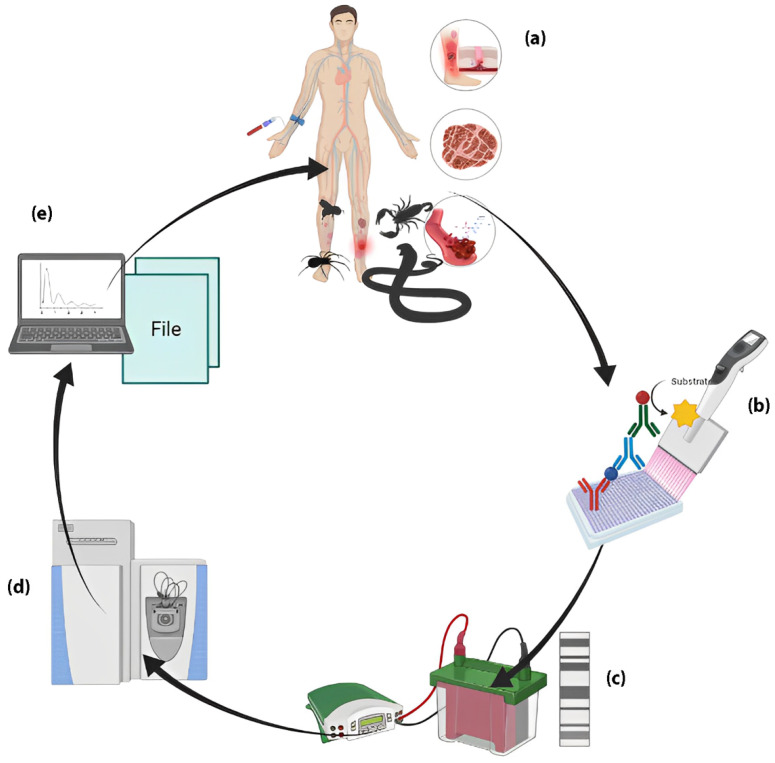
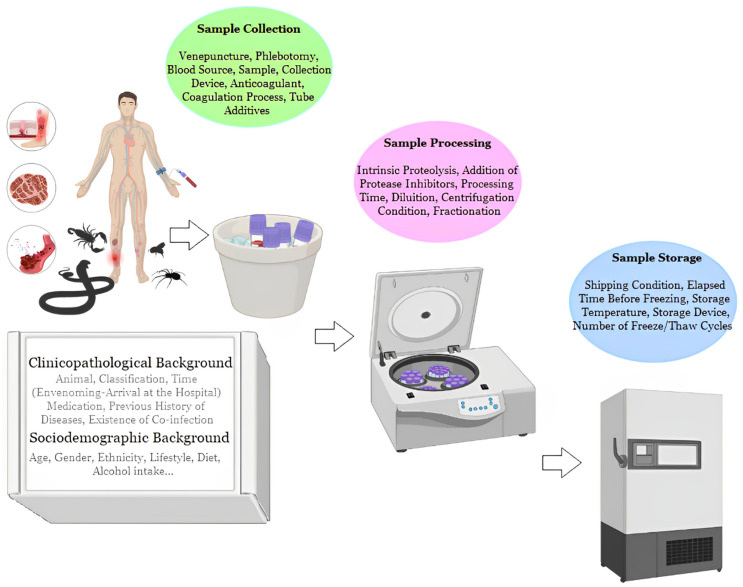
Specific and sensitive tools for the diagnosis and monitoring of accidents by venomous animals are urgently needed. Several diagnostic and monitoring assays have been developed; however, they have not yet reached the clinic. This has resulted in late diagnoses, which represents one of the main causes of progression from mild to severe disease. Human blood is a protein-rich biological fluid that is routinely collected in hospital settings for diagnostic purposes, which can translate research progress from the laboratory to the clinic. Although it is a limited view, blood plasma proteins provide information about the clinical picture of envenomation. Proteome disturbances in response to envenomation by venomous animals have been identified, allowing mass spectrometry (MS)-based plasma proteomics to emerge as a tool in a range of clinical diagnostics and disease management that can be applied to cases of venomous animal envenomation. Here, we provide a review of the state of the art on routine laboratory diagnoses of envenomation by snakes, scorpions, bees, and spiders, as well as a review of the diagnostic methods and the challenges encountered. We present the state of the art on clinical proteomics as the standardization of procedures to be performed within and between research laboratories, favoring a more excellent peptide coverage of candidate proteins for biomarkers. Therefore, the selection of a sample type and method of preparation should be very specific and based on the discovery of biomarkers in specific approaches. However, the sample collection protocol (e.g., collection tube type) and the processing procedure of the sample (e.g., clotting temperature, time allowed for clotting, and anticoagulant used) are equally important to eliminate any bias.
目前迫切需要用于诊断和监测动物毒液伤害的特异性和灵敏性工具。已经开发出了几种诊断和监测检测方法;然而,它们尚未进入临床阶段。这导致了诊断的延迟,这是疾病从轻症发展到重症的主要原因之一。人类血液是一种富含蛋白质的生物液体,通常在医院环境中收集用于诊断目的,这可以将实验室的研究进展转化为临床应用。尽管这是一个有限的视角,但血浆蛋白提供了有关毒液伤害临床情况的信息。已经确定了毒液伤害引起的蛋白质组紊乱,使得基于质谱(MS)的血浆蛋白质组学成为一系列临床诊断和疾病管理的工具,可以应用于毒液动物毒液伤害的病例。在这里,我们综述了蛇、蝎子、蜜蜂和蜘蛛毒液伤害的常规实验室诊断的最新进展,以及诊断方法和遇到的挑战。我们介绍了临床蛋白质组学的最新进展,即将程序标准化,在研究实验室内部和之间执行,有利于候选生物标志物蛋白的肽覆盖率更优异。因此,样本类型和制备方法的选择应该非常具体,并基于特定方法中生物标志物的发现。然而,样本采集方案(例如,采集管类型)和样本处理程序(例如,凝血温度、允许凝血的时间和使用的抗凝剂)同样重要,可以消除任何偏差。