Kostas Emily T, White Daniel A, Cook David J
1International Centre for Brewing Science, Division of Food Science, The University of Nottingham, Sutton Bonington Campus, Loughborough, Leicestershire, LE12 5RD UK.
2Department of Biochemical Engineering, The Advanced Centre of Biochemical Engineering, Bernard Katz Building, University College London, Gower Street, London, WC1H 6BT UK.
Bioenergy Res. 2020;13(1):271-285. doi: 10.1007/s12155-019-10054-1. Epub 2019 Oct 26.
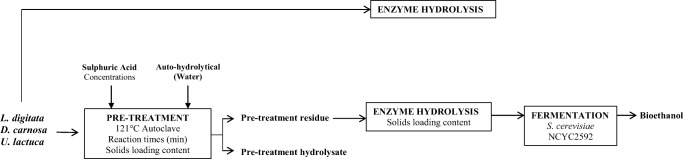
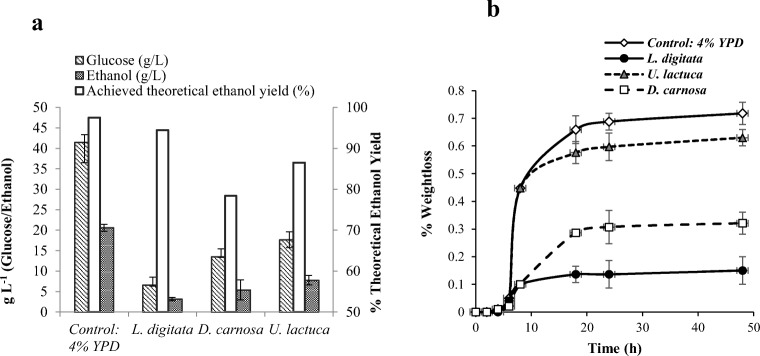
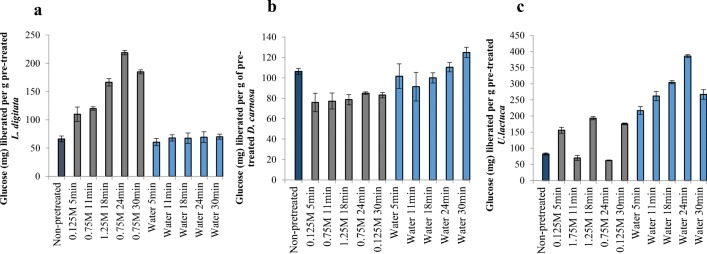
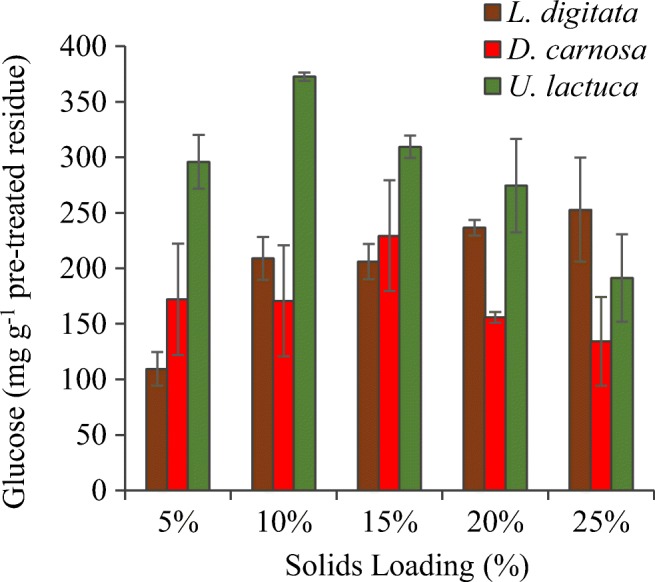
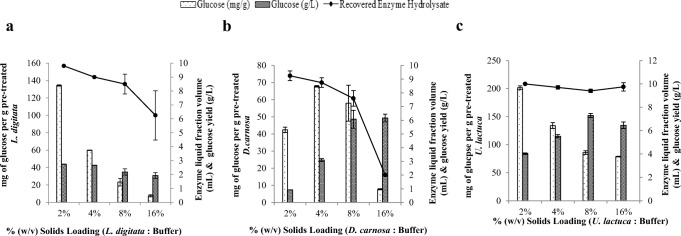
This study describes the method development for bioethanol production from three species of seaweed. , and for the first time were used as representatives of brown, green and red species of seaweed, respectively. Acid thermo-chemical and entirely aqueous (water) based pre-treatments were evaluated, using a range of sulphuric acid concentrations (0.125-2.5 M) and solids loading contents (5-25 % [w/v]; biomass: reactant) and different reaction times (5-30 min), with the aim of maximising the release of glucose following enzyme hydrolysis. A pre-treatment step for each of the three seaweeds was required and pre-treatment conditions were found to be specific to each seaweed species. and were more suited with an aqueous (water-based) pre-treatment (yielding 125.0 and 360.0 mg of glucose/g of pre-treated seaweed, respectively), yet interestingly non pre-treated yielded 106.4 g g glucose. required a dilute acid thermo-chemical pre-treatment in order to liberate maximal glucose yields (218.9 mg glucose/g pre-treated seaweed). Fermentations with NCYC2592 of the generated hydrolysates gave ethanol yields of 5.4 g L, 7.8 g L and 3.2 g L from , and , respectively. This study highlighted that entirely aqueous based pre-treatments are effective for seaweed biomass, yet bioethanol production alone may not make such bio-processes economically viable at large scale.
本研究描述了利用三种海藻生产生物乙醇的方法开发。分别使用(海藻名称1)、(海藻名称2)和(海藻名称3)首次作为褐藻、绿藻和红藻的代表。评估了酸性热化学预处理和完全基于水的预处理,使用了一系列硫酸浓度(0.125 - 2.5 M)、固体负载量(5 - 25% [w/v];生物质:反应物)和不同反应时间(5 - 30分钟),目的是在酶水解后使葡萄糖释放最大化。三种海藻都需要一个预处理步骤,并且发现预处理条件因每种海藻种类而异。(海藻名称1)和(海藻名称2)更适合水基预处理(分别产生125.0和360.0毫克葡萄糖/克预处理海藻),然而有趣的是,未预处理的(海藻名称3)产生了106.4毫克葡萄糖。(海藻名称3)需要稀酸热化学预处理以释放最大葡萄糖产量(218.9毫克葡萄糖/克预处理海藻)。用酿酒酵母NCYC2592对生成的水解产物进行发酵,从(海藻名称1)、(海藻名称2)和(海藻名称3)得到的乙醇产量分别为5.4克/升、7.8克/升和3.2克/升。本研究强调,完全基于水的预处理对海藻生物质是有效的,但仅生物乙醇生产可能无法使这种生物过程在大规模上具有经济可行性。