Seo Hee Won, Kim Namju, Kim Sohee
Department of Robotics Engineering, Daegu Gyeongbuk Institute of Science and Technology (DGIST), Daegu 42988, Korea.
Micromachines (Basel). 2020 Apr 29;11(5):467. doi: 10.3390/mi11050467.
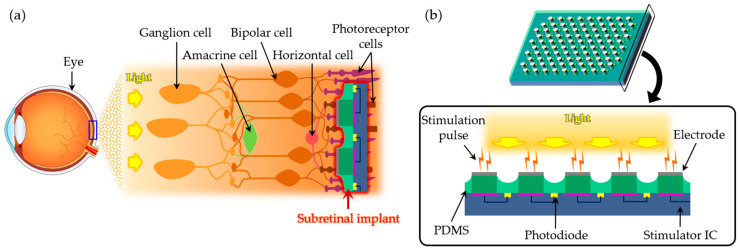
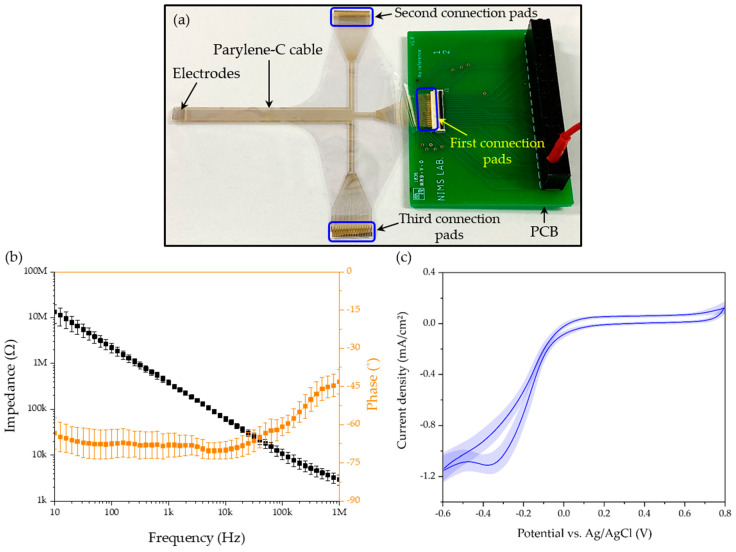
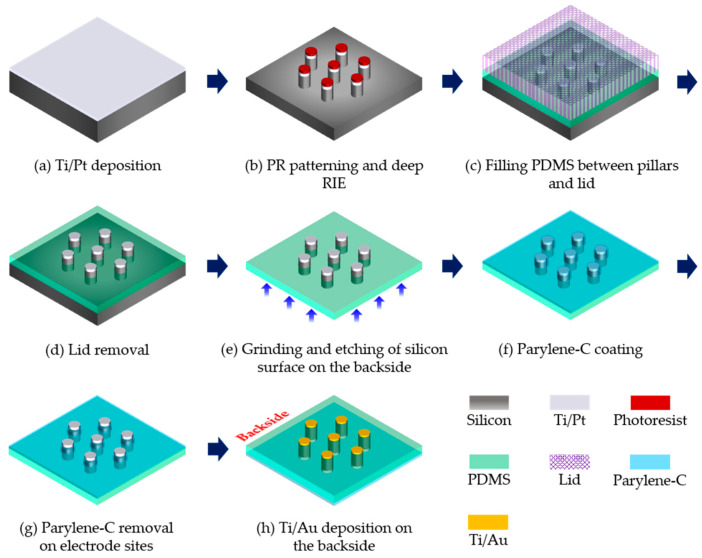
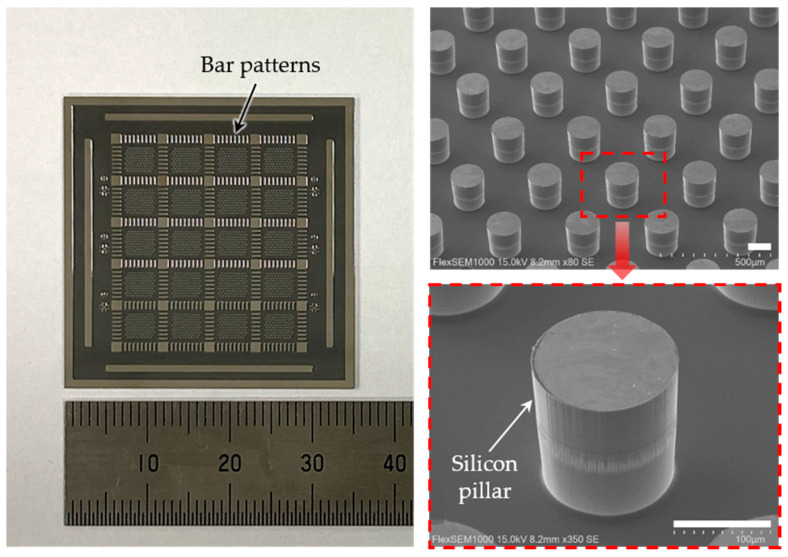
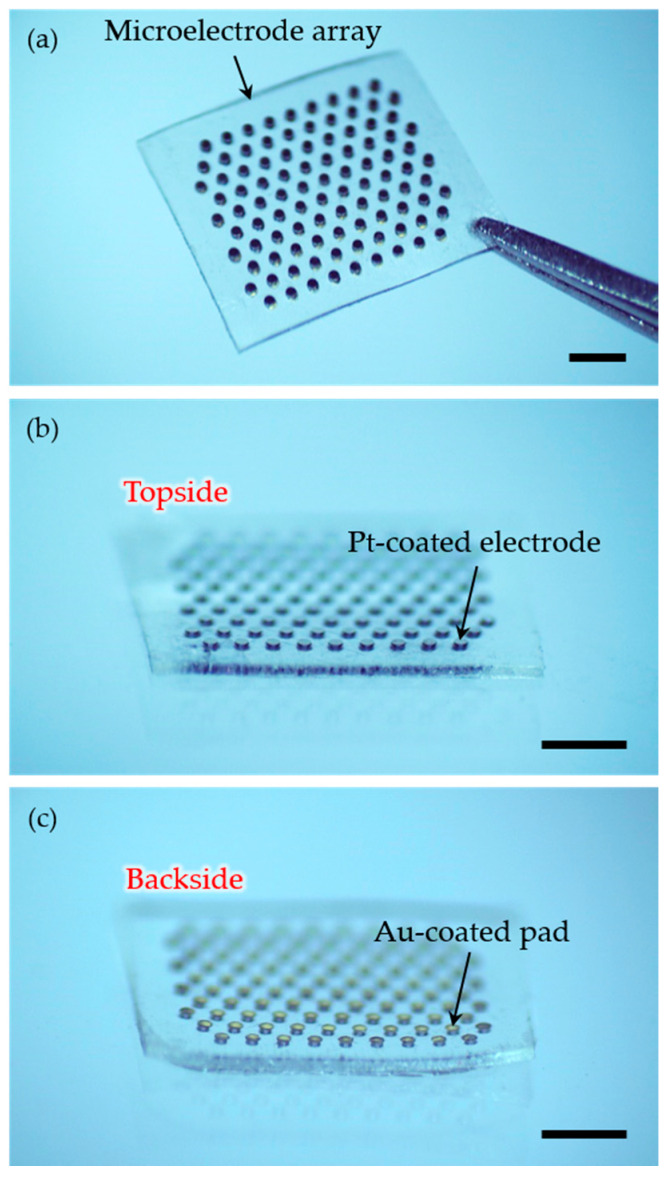
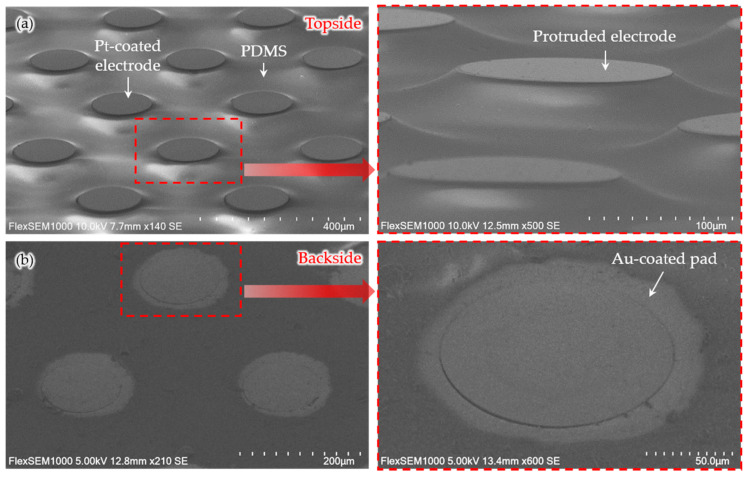
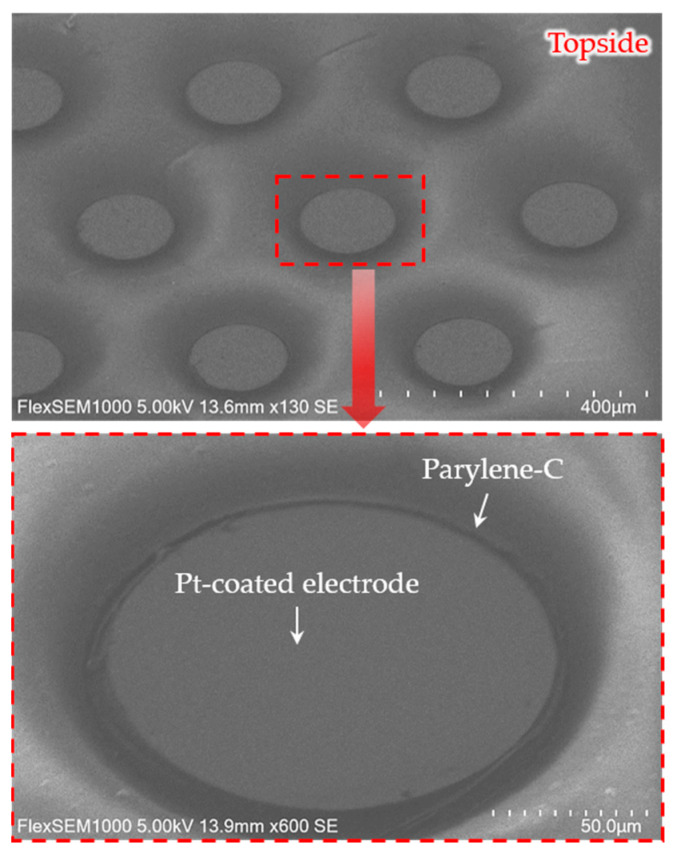
This study presents the fabrication of three-dimensional (3D) microelectrodes for subretinal stimulation, to accommodate adjacent return electrodes surrounding a stimulating electrode. For retinal prosthetic devices, the arrangement of return electrodes, the electrode size and spacing should be considered together, to reduce the undesired dissipation of electric currents. Here, we applied the hexagonal arrangement to the microelectrode array for the localized activation of retinal cells and better visual acuity. To provide stimuli more efficiently to non-spiking neurons, a 3D structure was created through a customized pressing process, utilizing the elastic property of the materials used in the fabrication processes. The diameter and pitch of the Pt-coated electrodes were 150 μm and 350 μm, respectively, and the height of the protruded electrodes was around 20 μm. The array consisted of 98 hexagonally arranged electrodes, supported by a flexible and transparent polydimethylsiloxane (PDMS) base, with a thickness of 140 μm. Also, the array was coated with 2 μm-thick parylene-C, except the active electrode sites, for more focused stimulation. Finally, the electrochemical properties of the fabricated microelectrodes were characterized, resulting in the mean impedance of 384.87 kΩ at 1 kHz and the charge storage capacity (CSC) of 2.83 mC·cm. The fabricated microelectrodes are to be combined with an integrated circuit (IC) for additional in vitro and in vivo experiments.
本研究展示了用于视网膜下刺激的三维(3D)微电极的制造方法,以容纳围绕刺激电极的相邻返回电极。对于视网膜假体装置,应综合考虑返回电极的排列、电极尺寸和间距,以减少电流的不必要耗散。在此,我们将六边形排列应用于微电极阵列,以实现视网膜细胞的局部激活并提高视力。为了更有效地向非尖峰神经元提供刺激,利用制造过程中所用材料的弹性特性,通过定制的压制工艺创建了三维结构。涂有铂的电极直径和间距分别为150μm和350μm,突出电极的高度约为20μm。该阵列由98个六边形排列的电极组成,由厚度为140μm的柔性透明聚二甲基硅氧烷(PDMS)基底支撑。此外,除了有源电极部位外,阵列还涂有2μm厚的聚对二甲苯-C,以实现更聚焦的刺激。最后,对制造的微电极的电化学特性进行了表征,在1kHz时平均阻抗为384.87kΩ,电荷存储容量(CSC)为2.83mC·cm 。制造的微电极将与集成电路(IC)结合,用于进一步的体外和体内实验。