Vu Que Anh, Seo Hee Won, Choi Kwang-Eon, Kim Namju, Kang Yoo Na, Lee Jaemeun, Park Sun-Hyun, Kim Jee Taek, Kim Sohee, Kim Seong-Woo
Department of Ophthalmology, Korea University School of Medicine, Seoul, South Korea.
Department of Ophthalmology, Hanoi Medical University, Hanoi, Vietnam.
Front Neurosci. 2022 Sep 30;16:1010445. doi: 10.3389/fnins.2022.1010445. eCollection 2022.
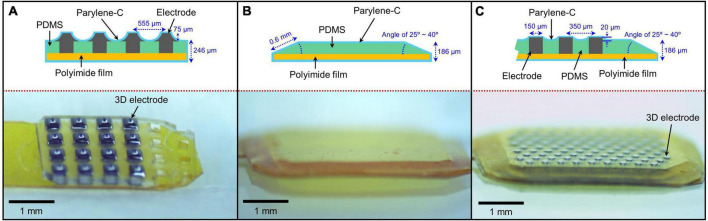
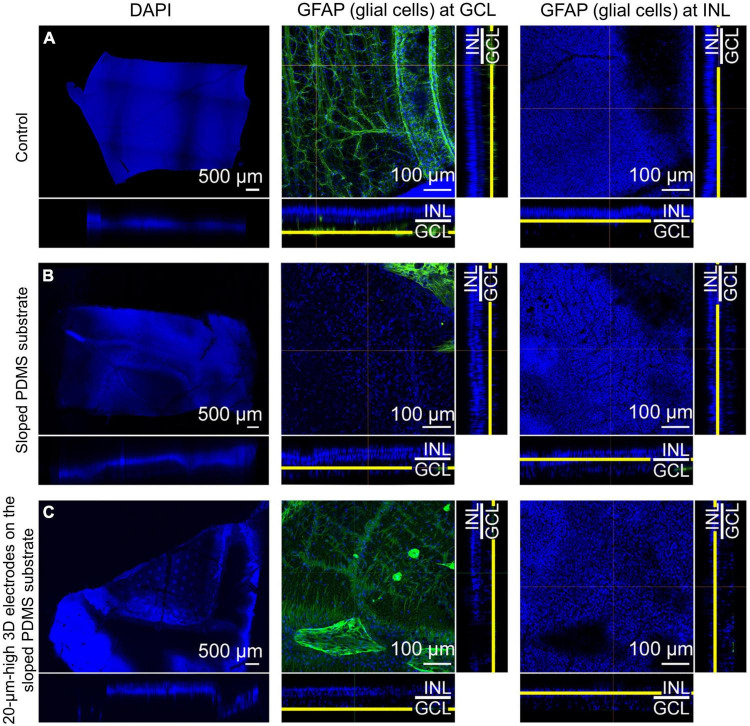
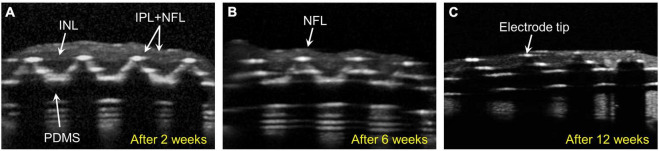
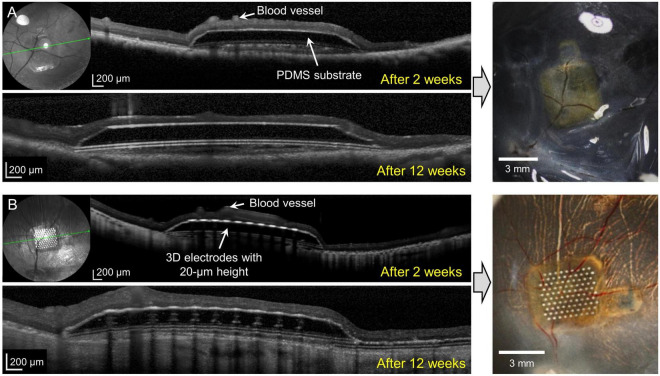
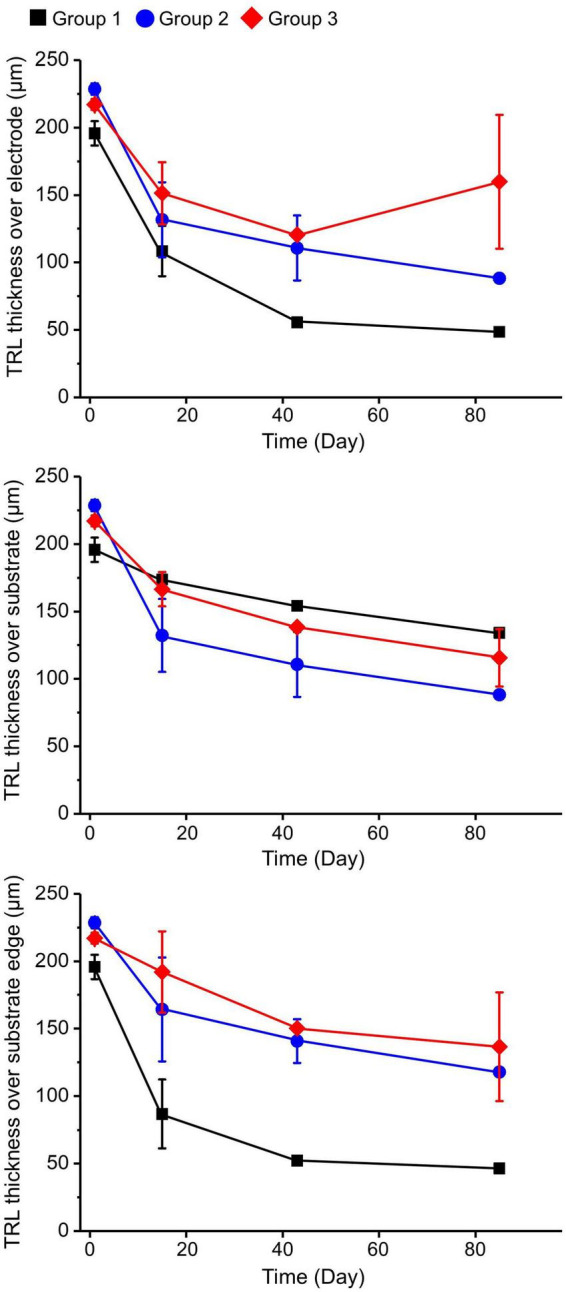
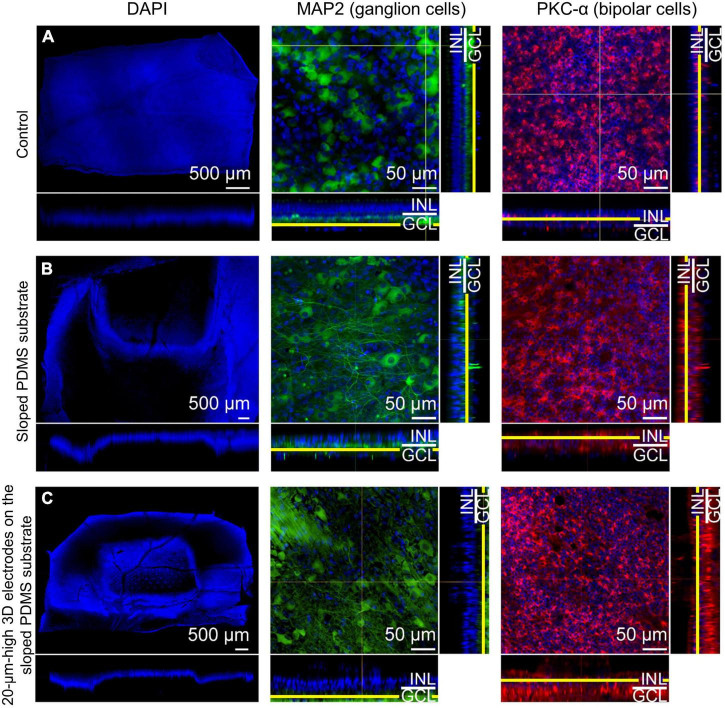
The retinal structural changes after subretinal implantation of three-dimensional (3D) microelectrodes were investigated in a mini pig. Three types of electrode were implanted into the subretinal spaces of nine mini pigs: 75-μm-high 3D electrodes on a 200-μm-thick right-angled polydimethylsiloxane (PDMS) substrate (group 1); a 140-μm-thick sloped PDMS substrate without electrodes (group 2); and a 140-μm-thick sloped PDMS substrate with 20-μm-high 3D electrodes (group 3). One mini pig was used as a control. Spectral domain-optical coherence tomography (SD-OCT) images were obtained at baseline and 2, 6, and 12 weeks post-surgery. Retinal specimens were immunostained using a tissue-clearing method 3 months post-implantation. The 75-μm-high 3D electrodes progressively penetrated the inner nuclear layer (INL) and touched the inner plexiform layer (IPL) 2 weeks post-surgery. At 6 weeks post-operatively, the electrodes were in contact with the nerve-fiber layer, accompanied by a severe fibrous reaction. In the other groups, the implants remained in place without subretinal migration. Immunostaining showed that retinal ganglion and bipolar cells were preserved without fibrosis over the retinal implants in groups 2 and 3 during the 12-week implantation period. In summary, SD-OCT and immunohistology results showed differences in the extent of reactions, such as fibrosis over the implants and penetration of the electrodes into the inner retinal layer depending on different types of electrodes. A sloped substrate performed better than a right-angled substrate in terms of retinal preservation over the implanted electrodes. The 20-μm-high electrodes showed better structural compatibility than the 75-μm-high 3D electrodes. There was no significant difference between the results of sloped implants without electrodes and 20-μm-high 3D electrodes, indicating that the latter had no adverse effects on retinal tissue.
在小型猪中研究了三维(3D)微电极视网膜下植入后的视网膜结构变化。将三种类型的电极植入9只小型猪的视网膜下间隙:在200μm厚的直角聚二甲基硅氧烷(PDMS)基底上的75μm高的3D电极(第1组);无电极的140μm厚的倾斜PDMS基底(第2组);以及有20μm高的3D电极的140μm厚的倾斜PDMS基底(第3组)。使用1只小型猪作为对照。在基线以及术后2、6和12周获取光谱域光学相干断层扫描(SD-OCT)图像。植入3个月后,使用组织透明法对视网膜标本进行免疫染色。术后2周,75μm高的3D电极逐渐穿透内核层(INL)并接触到内网状层(IPL)。术后6周,电极与神经纤维层接触,伴有严重的纤维反应。在其他组中,植入物保持在原位,没有视网膜下迁移。免疫染色显示,在12周的植入期内,第2组和第3组的视网膜植入物上的视网膜神经节细胞和双极细胞得以保留,没有纤维化。总之,SD-OCT和免疫组织学结果显示,根据不同类型的电极,在反应程度上存在差异,例如植入物上的纤维化以及电极向内视网膜层的穿透情况。就植入电极上方的视网膜保存而言,倾斜基底比直角基底表现更好。20μm高的电极比75μm高的3D电极显示出更好的结构兼容性。无电极的倾斜植入物和20μm高的3D电极的结果之间没有显著差异,表明后者对视网膜组织没有不良影响。