Department of Physical Activity and Sport, Faculty of Sports Sciences, University of Murcia, 30720 San Javier (Murcia), Spain.
Department of Sport Science, Sports Research Centre, Miguel Hernández University of Elche, 03202 Elche (Alicante), Spain.
Int J Environ Res Public Health. 2020 Apr 29;17(9):3088. doi: 10.3390/ijerph17093088.
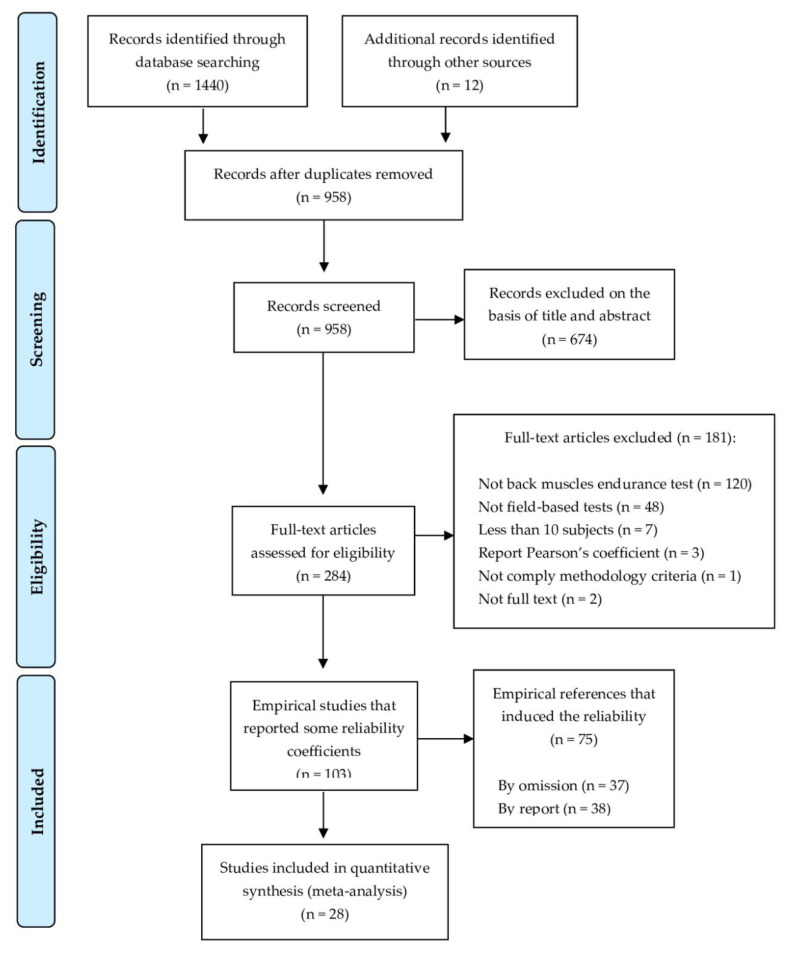
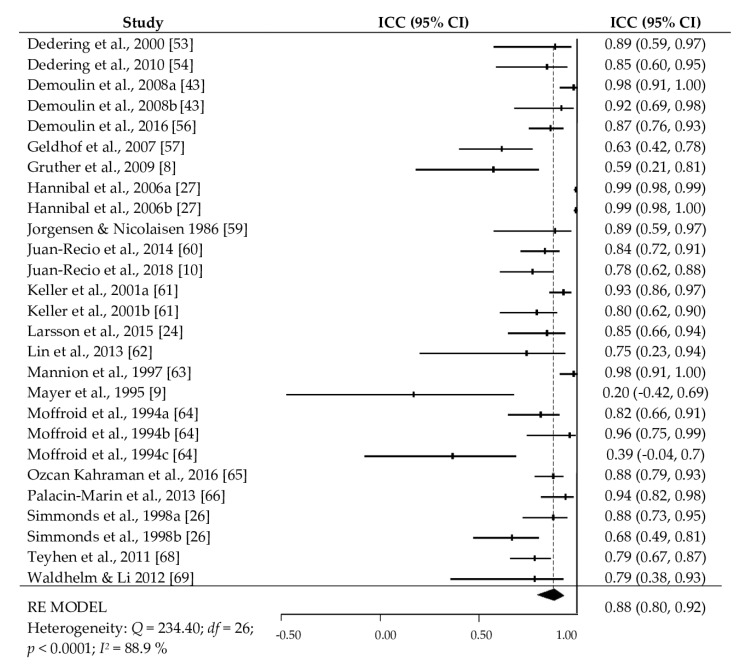
This meta-analysis aimed to estimate the inter- and intra-tester reliability of endurance measures obtained through trunk extension field-based tests and to explore the influence of the moderators on the reliability estimates. The reliability induction rate of trunk extension endurance measures was also calculated. A systematic search was conducted using various databases, and subsequently 28 studies were selected that reported intraclass correlation coefficients for trunk extension endurance measures. Separate meta-analyses were conducted using a random-effects model. When possible, analyses of potential moderator variables were carried out. The inter-tester average reliability of the endurance measure obtained from the Biering-Sorensen test was intraclass correlation coefficient (ICC) = 0.94. The intra-session reliability estimates of the endurance measures recorded using the Biering-Sorensen test, the prone isometric chest raise test, and the prone double straight-leg test were ICC = 0.88, 0.90, and 0.86, respectively. The inter-session average reliability of the endurance measures from the Biering-Sorensen test, the prone isometric chest raise test, and the dynamic extensor endurance test were ICC = 0.88, 0.95, and 0.99, respectively. However, due to the limited evidence available, the reliability estimates of the measures obtained through the prone isometric chest raise, prone double straight-leg, and dynamic extensor endurance tests should be considered with a degree of caution. Position control instruments, tools, and familiarization session demonstrated a statistical association with the inter-session reliability of the Biering-Sorensen test. The reliability induction rate was 72.8%. Only the trunk extension endurance measure obtained through the Biering-Sorensen test presented sufficient scientific evidence in terms of reliability to justify its use for research and practical purposes.
本荟萃分析旨在评估通过躯干伸展现场测试获得的耐力测量的组内和组间可靠性,并探讨调节因素对可靠性估计的影响。还计算了躯干伸展耐力测量的可靠性诱导率。使用各种数据库进行了系统搜索,随后选择了 28 项报告躯干伸展耐力测量的组内相关系数的研究。使用随机效应模型分别进行了荟萃分析。在可能的情况下,对潜在调节变量进行了分析。Biering-Sorensen 测试获得的耐力测量的组间平均可靠性的组内相关系数(ICC)为 0.94。Biering-Sorensen 测试、俯卧等长胸部抬高测试和俯卧双腿伸展测试记录的耐力测量的内-次测试可靠性估计分别为 ICC=0.88、0.90 和 0.86。Biering-Sorensen 测试、俯卧等长胸部抬高测试和动态伸展耐力测试的耐力测量的组间平均可靠性分别为 ICC=0.88、0.95 和 0.99。然而,由于证据有限,通过俯卧等长胸部抬高、俯卧双腿伸展和动态伸展耐力测试获得的测量的可靠性估计应谨慎考虑。位置控制仪器、工具和熟悉阶段与 Biering-Sorensen 测试的组间可靠性具有统计学关联。可靠性诱导率为 72.8%。只有通过 Biering-Sorensen 测试获得的躯干伸展耐力测量在可靠性方面具有足够的科学证据,足以证明其在研究和实际目的中的使用是合理的。