Center for Infectious Disease Dynamics, Department of Entomology, Penn State University, University Park, PA, USA.
Green Mountain Antibodies, Burlington, VT, USA.
Nat Ecol Evol. 2020 Jul;4(7):940-951. doi: 10.1038/s41559-020-1182-x. Epub 2020 May 4.
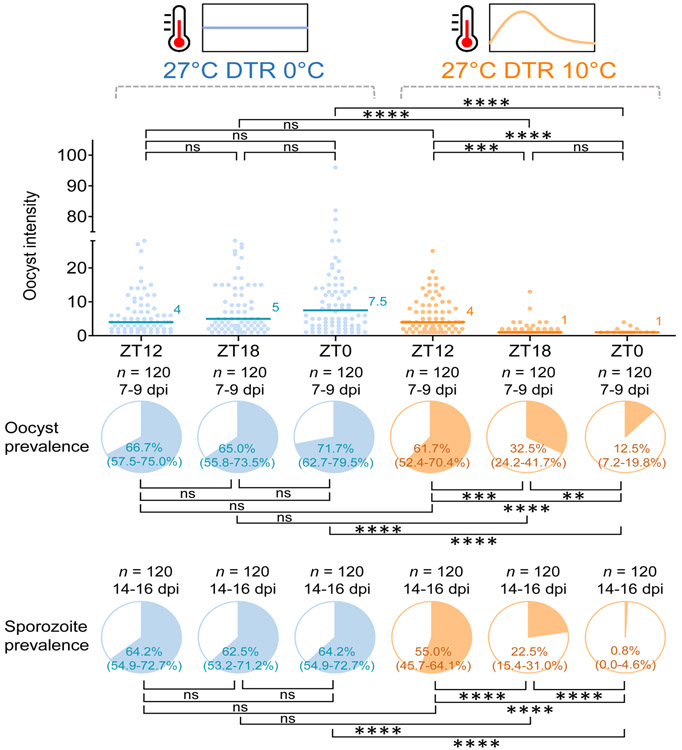
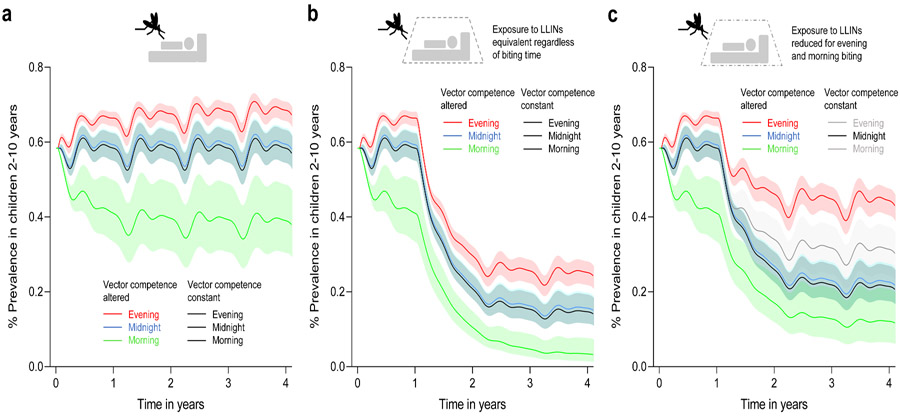
Insecticide-treated bed nets reduce malaria transmission by limiting contact between mosquito vectors and human hosts when mosquitoes feed during the night. However, malaria vectors can also feed in the early evening and in the morning when people are not protected. Here, we explored how the timing of blood feeding interacts with environmental temperature to influence the capacity of Anopheles mosquitoes to transmit the human malaria parasite Plasmodium falciparum. In laboratory experiments, we found no effect of biting time itself on the proportion of mosquitoes that became infectious (vector competence) at constant temperature. However, when mosquitoes were maintained under more realistic fluctuating temperatures, there was a significant increase in competence for mosquitoes feeding in the evening (18:00), and a significant reduction in competence for those feeding in the morning (06:00), relative to those feeding at midnight (00:00). These effects appear to be due to thermal sensitivity of malaria parasites during the initial stages of parasite development within the mosquito, and the fact that mosquitoes feeding in the evening experience cooling temperatures during the night, whereas mosquitoes feeding in the morning quickly experience warming temperatures that are inhibitory to parasite establishment. A transmission dynamics model illustrates that such differences in competence could have important implications for malaria prevalence, the extent of transmission that persists in the presence of bed nets, and the epidemiological impact of behavioural resistance. These results indicate that the interaction of temperature and feeding behaviour could be a major ecological determinant of the vectorial capacity of malaria mosquitoes.
经杀虫剂处理的蚊帐通过在蚊子夜间吸血时限制媒介与人类宿主之间的接触来减少疟疾传播。然而,疟疾媒介也可以在傍晚和清晨人们没有保护时吸血。在这里,我们探讨了吸血时间如何与环境温度相互作用,影响疟蚊传播人类疟原虫 Plasmodium falciparum 的能力。在实验室实验中,我们发现固定温度下,吸血时间本身对蚊子感染比例(媒介效能)没有影响。然而,当蚊子在更现实的波动温度下饲养时,傍晚(18:00)吸血的蚊子的效能显著增加,而清晨(06:00)吸血的蚊子的效能显著降低,与午夜(00:00)吸血的蚊子相比。这些影响似乎是由于疟原虫在蚊子体内发育的初始阶段对温度敏感,以及傍晚吸血的蚊子在夜间经历降温,而清晨吸血的蚊子很快经历抑制寄生虫定植的升温所致。传播动力学模型表明,这种效能差异可能对疟疾流行率、蚊帐存在下持续传播的程度以及行为抗性的流行病学影响产生重要影响。这些结果表明,温度和摄食行为的相互作用可能是疟疾蚊子媒介能力的主要生态决定因素。