Campbell Cassidy, Cooper Edward A, Kennedy Philip
Department of Surgery, Tamworth Rural and Referral Hospital, Tamworth, New South Wales, Australia.
J Surg Case Rep. 2020 Apr 29;2020(4):rjaa091. doi: 10.1093/jscr/rjaa091. eCollection 2020 Apr.
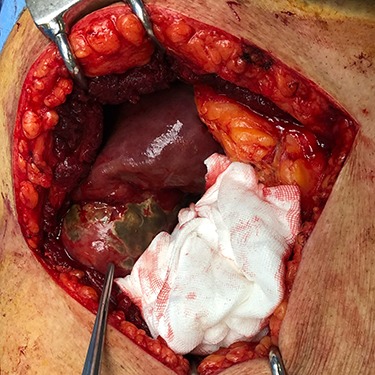
Cholecystitis is a rare sequela of colonoscopy, the relationship between which has not yet been defined. This case study reviews a rural elderly patient who developed right upper quadrant pain following routine colonoscopy. He developed emphysematous cholecystitis, which required laparoscopy with conversion to open via Kocher's incision and underwent a subtotal cholecystectomy due to the severity of necrosis and inflammation. He had an uncomplicated recovery. Colonoscopy is an important diagnostic procedure, the most common complications of which are haemorrhage and perforation. There are less than 10 cases of associated cholecystitis and no reports of emphysematous cholecystitis. The hypothesized pathogenesis is dehydration and lithogenesis associated with traumatic translocation of organisms, however, no definitive correlation has been determined. Due to the potential health impact, cholecystitis cannot be excluded regarding post-colonoscopy abdominal pain, however, the correlation between procedure and pathology remains unclear.
胆囊炎是结肠镜检查罕见的后遗症,二者之间的关系尚未明确。本病例研究回顾了一名农村老年患者,其在常规结肠镜检查后出现右上腹疼痛。他发展为气肿性胆囊炎,因坏死和炎症严重,需通过Kocher切口行腹腔镜手术并转为开放手术,接受了胆囊次全切除术。他恢复顺利。结肠镜检查是一项重要的诊断程序,其最常见的并发症是出血和穿孔。相关胆囊炎病例少于10例,气肿性胆囊炎尚无报道。推测的发病机制是与生物体创伤性移位相关的脱水和结石形成,然而,尚未确定明确的相关性。由于对健康可能产生影响,结肠镜检查后腹痛不能排除胆囊炎,但检查与病理之间的相关性仍不清楚。