Project for Immunogenomics, Cancer Precision Medicine Center, Japanese Foundation for Cancer Research, Tokyo, 135-8550, Japan.
J Hum Genet. 2020 Jul;65(7):569-575. doi: 10.1038/s10038-020-0771-5. Epub 2020 May 6.
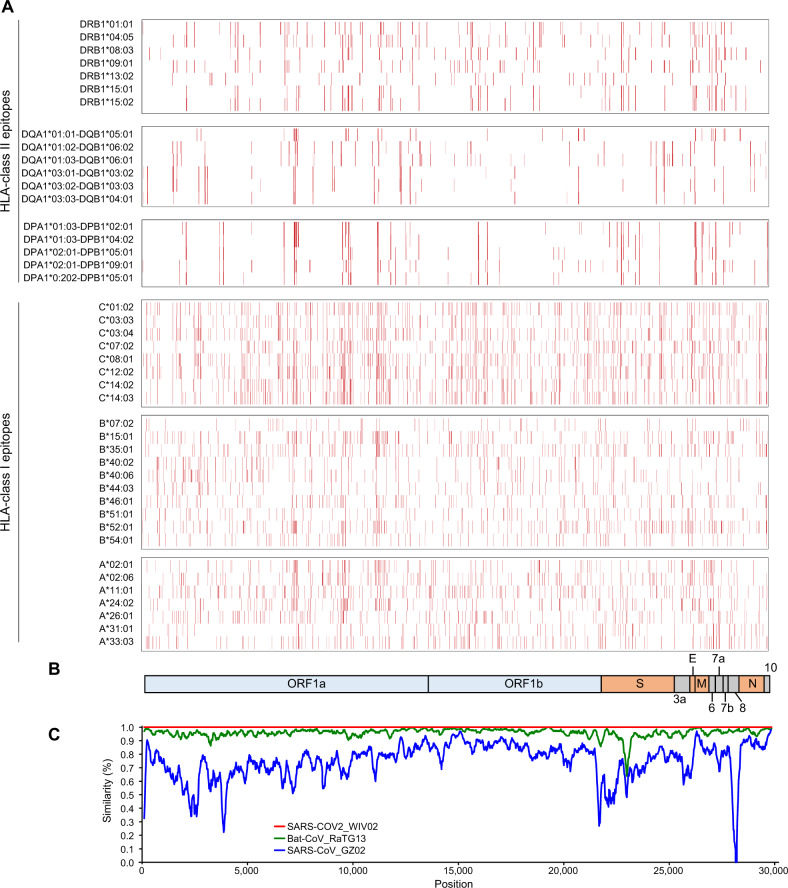
To control and prevent the current COVID-19 pandemic, the development of novel vaccines is an emergent issue. In addition, we need to develop tools that can measure/monitor T-cell and B-cell responses to know how our immune system is responding to this deleterious virus. However, little information is currently available about the immune target epitopes of novel coronavirus (SARS-CoV-2) to induce host immune responses. Through a comprehensive bioinformatic screening of potential epitopes derived from the SARS-CoV-2 sequences for HLAs commonly present in the Japanese population, we identified 2013 and 1399 possible peptide epitopes that are likely to have the high affinity (<0.5%- and 2%-rank, respectively) to HLA class I and II molecules, respectively, that may induce CD8 and CD4 T-cell responses. These epitopes distributed across the structural (spike, envelope, membrane, and nucleocapsid proteins) and the nonstructural proteins (proteins corresponding to six open reading frames); however, we found several regions where high-affinity epitopes were significantly enriched. By comparing the sequences of these predicted T cell epitopes to the other coronaviruses, we identified 781 HLA-class I and 418 HLA-class II epitopes that have high homologies to SARS-CoV. To further select commonly-available epitopes that would be applicable to larger populations, we calculated population coverages based on the allele frequencies of HLA molecules, and found 2 HLA-class I epitopes covering 83.8% of the Japanese population. The findings in the current study provide us valuable information to design widely-available vaccine epitopes against SARS-CoV-2 and also provide the useful information for monitoring T-cell responses.
为了控制和预防当前的 COVID-19 大流行,开发新的疫苗是一个紧急问题。此外,我们需要开发能够测量/监测 T 细胞和 B 细胞反应的工具,以了解我们的免疫系统对这种有害病毒的反应。然而,目前关于新型冠状病毒(SARS-CoV-2)诱导宿主免疫反应的免疫靶抗原表位的信息很少。通过对常见于日本人中的 HLA 进行 SARS-CoV-2 序列的潜在抗原表位的综合生物信息学筛选,我们鉴定出 2013 个和 1399 个可能的肽抗原表位,这些抗原表位分别与 HLA Ⅰ类和Ⅱ类分子具有高亲和力(分别为<0.5%和 2%),可能诱导 CD8 和 CD4 T 细胞反应。这些抗原表位分布在结构蛋白(刺突、包膜、膜和核衣壳蛋白)和非结构蛋白(对应六个开放阅读框的蛋白)中;然而,我们发现了几个高亲和力抗原表位显著富集的区域。通过将这些预测的 T 细胞抗原表位序列与其他冠状病毒进行比较,我们鉴定出 781 个与 SARS-CoV 具有高度同源性的 HLA Ⅰ类和 418 个 HLA Ⅱ类抗原表位。为了进一步选择适用于更大人群的常见可用抗原表位,我们根据 HLA 分子的等位基因频率计算了人群覆盖率,发现 2 个 HLA Ⅰ类抗原表位覆盖了 83.8%的日本人。本研究的结果为我们设计针对 SARS-CoV-2 的广泛可用的疫苗抗原表位提供了有价值的信息,并为监测 T 细胞反应提供了有用的信息。