Malmberg Maja, Malm Tarja, Gustafsson Oskar, Sturchio Andrea, Graff Caroline, Espay Alberto J, Wright Anthony P, El Andaloussi Samir, Lindén Anders, Ezzat Kariem
Section of Virology, Department of Biomedical Sciences and Veterinary Public Health, Swedish University of Agricultural Sciences, Uppsala, Sweden.
SLU Global Bioinformatics Centre, Department of Animal Breeding and Genetics, Swedish University of Agricultural Sciences, Uppsala, Sweden.
Front Neurosci. 2020 Apr 21;14:256. doi: 10.3389/fnins.2020.00256. eCollection 2020.
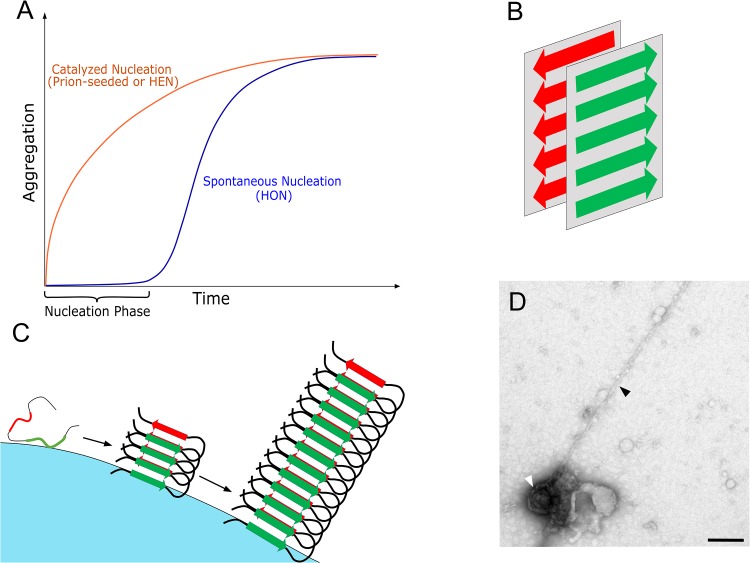
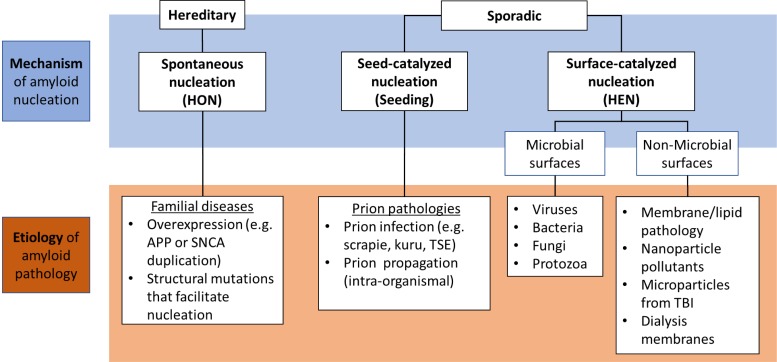
Amyloids are fibrillar protein aggregates associated with diseases such as Alzheimer's disease (AD), Parkinson's disease (PD), type II diabetes and Creutzfeldt-Jakob disease. The process of amyloid polymerization involves three pathological protein transformations; from natively folded conformation to the cross-β conformation, from biophysically soluble to insoluble, and from biologically functional to non-functional. While amyloids share a similar cross-β conformation, the biophysical transformation can either take place spontaneously via a homogeneous nucleation mechanism (HON) or catalytically on an exogenous surface via a heterogeneous nucleation mechanism (HEN). Here, we postulate that the different nucleation pathways can serve as a mechanistic basis for an etiological classification of amyloidopathies, where hereditary forms generally follow the HON pathway, while sporadic forms follow seed-induced (prions) or surface-induced (including microbially induced) HEN pathways. Critically, the conformational and biophysical amyloid transformation results in loss-of-function (LOF) of the original natively folded and soluble protein. This LOF can, at least initially, be the mechanism of amyloid toxicity even before amyloid accumulation reaches toxic levels. By highlighting the important role of non-protein species in amyloid formation and LOF mechanisms of toxicity, we propose a generalized mechanistic framework that could help better understand the diverse etiology of amyloid diseases and offer new opportunities for therapeutic interventions, including replacement therapies.
淀粉样蛋白是与阿尔茨海默病(AD)、帕金森病(PD)、II型糖尿病和克雅氏病等疾病相关的纤维状蛋白质聚集体。淀粉样蛋白聚合过程涉及三种病理性蛋白质转变:从天然折叠构象转变为交叉β构象,从生物物理可溶转变为不可溶,以及从生物功能状态转变为无功能状态。虽然淀粉样蛋白具有相似的交叉β构象,但生物物理转变既可以通过均相成核机制(HON)自发发生,也可以通过异相成核机制(HEN)在外源表面上催化发生。在这里,我们假设不同的成核途径可以作为淀粉样变性病病因分类的机制基础,其中遗传性形式通常遵循HON途径,而散发性形式遵循种子诱导(朊病毒)或表面诱导(包括微生物诱导)的HEN途径。至关重要的是,构象和生物物理淀粉样蛋白转变导致原始天然折叠和可溶蛋白质的功能丧失(LOF)。即使在淀粉样蛋白积累达到毒性水平之前,这种功能丧失至少在最初阶段可能是淀粉样蛋白毒性的机制。通过强调非蛋白质物质在淀粉样蛋白形成和毒性的功能丧失机制中的重要作用,我们提出了一个通用的机制框架,该框架有助于更好地理解淀粉样疾病的多种病因,并为治疗干预提供新机会,包括替代疗法。