Gering David, Kotrotsou Aikaterini, Young-Moxon Brett, Miller Neal, Avery Aaron, Kohli Lisa, Knapp Haley, Hoffman Jeffrey, Chylla Roger, Peitzman Linda, Mackie Thomas R
HealthMyne Inc., Madison, WI, United States.
Front Comput Neurosci. 2020 Apr 16;14:32. doi: 10.3389/fncom.2020.00032. eCollection 2020.
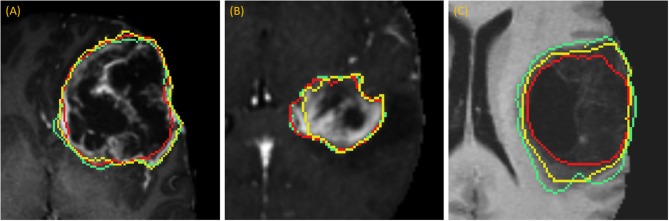
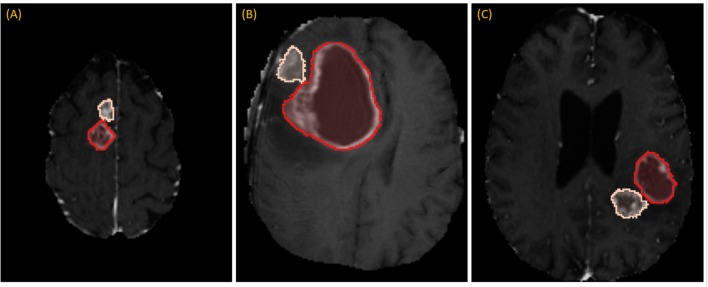
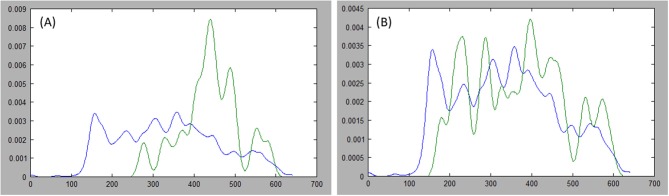
Traditionally, radiologists have crudely quantified tumor extent by measuring the longest and shortest dimension by dragging a cursor between opposite boundary points across a single image rather than full segmentation of the volumetric extent. For algorithmic-based volumetric segmentation, the degree of radiologist experiential involvement varies from confirming a fully automated segmentation, to making a single drag on an image to initiate semi-automated segmentation, to making multiple drags and clicks on multiple images during interactive segmentation. An experiment was designed to test an algorithm that allows various levels of interaction. Given the ground-truth of the BraTS training data, which delimits the brain tumors of 285 patients on multi-spectral MR, a computer simulation mimicked the process that a radiologist would follow to perform segmentation with real-time interaction. Clicks and drags were placed only where needed in response to the deviation between real-time segmentation results and assumed radiologist's goal, as provided by the ground-truth. Results of accuracy for various levels of interaction are presented along with estimated elapsed time, in order to measure efficiency. Average total elapsed time, including loading the study through confirming 3D contours, was 46 s.
传统上,放射科医生通过在单个图像上相对边界点之间拖动光标来测量最长和最短尺寸,以此粗略地量化肿瘤范围,而不是对体积范围进行全部分割。对于基于算法的体积分割,放射科医生的经验参与程度各不相同,从确认全自动分割,到在图像上单次拖动以启动半自动分割,再到在交互式分割过程中在多个图像上进行多次拖动和点击。设计了一项实验来测试一种允许不同交互级别的算法。鉴于BraTS训练数据的真实情况(其在多光谱磁共振成像上界定了285名患者的脑肿瘤),计算机模拟模仿了放射科医生在实时交互下进行分割的过程。根据真实情况提供的实时分割结果与假定的放射科医生目标之间的偏差,仅在需要的地方进行点击和拖动。给出了不同交互级别的准确性结果以及估计的耗时,以衡量效率。包括通过确认3D轮廓加载研究在内的平均总耗时为46秒。