Paul M. Rady Department of Mechanical Engineering, University of Colorado Boulder, Boulder, CO, 80309, USA.
University Medical Center Groningen, University of Groningen, Groningen, The Netherland.
Theranostics. 2020 Apr 15;10(12):5532-5549. doi: 10.7150/thno.43465. eCollection 2020.
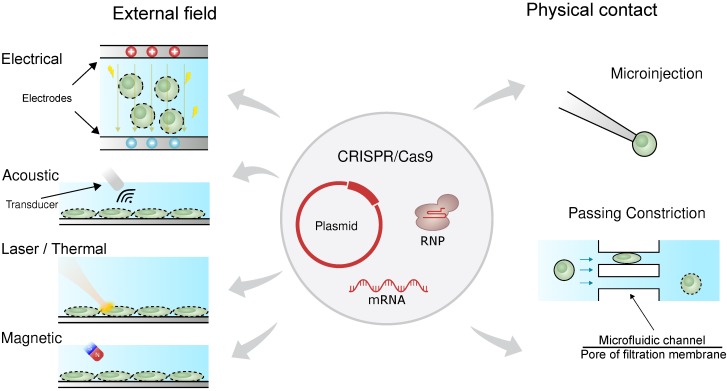
Gene editing is a versatile technique in biomedicine that promotes fundamental research as well as clinical therapy. The development of Clustered Regularly Interspaced Short Palindromic Repeats (CRISPR) as a genome editing machinery has accelerated the application of gene editing. However, the delivery of CRISPR components often suffers when using conventional transfection methods, such as viral transduction and chemical vectors, due to limited packaging size and inefficiency toward certain cell types. In this review, we discuss physical transfection methods for CRISPR gene editing which can overcome these limitations. We outline different types of physical transfection methods, highlight novel techniques to deliver CRISPR components, and emphasize the role of micro and nanotechnology to improve transfection performance. We present our perspectives on the limitations of current technology and provide insights on the future developments of physical transfection methods.
基因编辑是生物医学中一种通用的技术,它促进了基础研究和临床治疗。作为一种基因组编辑工具,簇状规律间隔短回文重复序列(CRISPR)的发展加速了基因编辑的应用。然而,由于包装大小有限以及对某些细胞类型的效率低下,传统的转染方法(如病毒转导和化学载体)在使用时经常会遇到 CRISPR 组件的传递问题。在这篇综述中,我们讨论了用于 CRISPR 基因编辑的物理转染方法,这些方法可以克服这些限制。我们概述了不同类型的物理转染方法,强调了用于递送 CRISPR 组件的新技术,并强调了微纳技术在提高转染性能方面的作用。我们提出了对当前技术局限性的看法,并对物理转染方法的未来发展提供了见解。