Dental Public Health Group, Faculty of Dentistry, Oral & Craniofacial Sciences, King's College London, London, UK.
National Health Service (NHS) Tayside, Dundee, UK.
J Dent Res. 2020 Jul;99(8):898-906. doi: 10.1177/0022034520917398. Epub 2020 May 6.
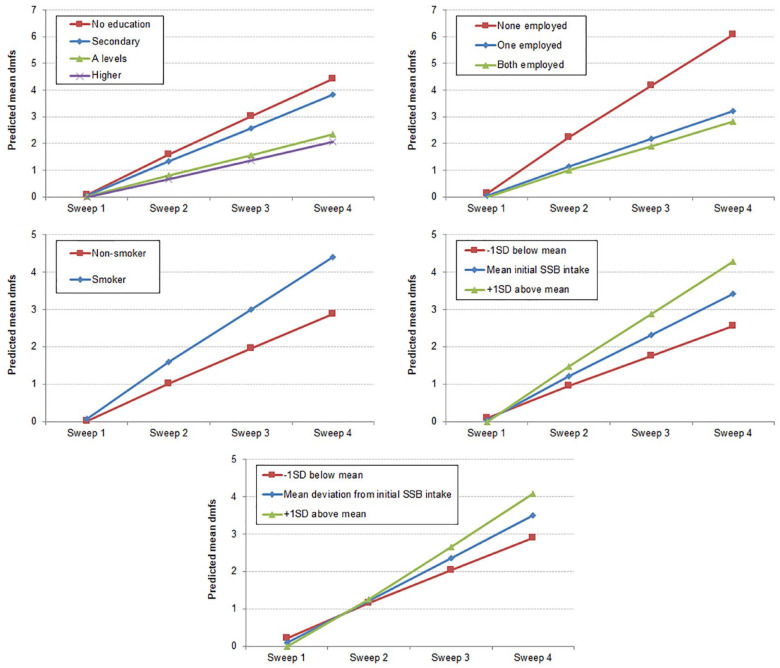
Early exposure to sweet tastes predicts similar food preferences and eating behavior in later life and is associated with childhood obesity. The aim of this study was to explore the associations of early (during the first year of life) and subsequent intake of sugar-sweetened beverages (SSBs) with 4-y caries trajectories among Scottish young children. We used data from 1,111 Scottish children who were followed annually from age 12 to 48 mo (4 sweeps in total). SSB intake was reported by parents in every sweep. SSB intake was broken down into 2 components, the initial SSB intake and the deviation over time from that initial value. Childhood dental caries was clinically determined (including noncavitated and cavitated lesions) every year. The association of SSB intake with baseline decayed, missing, and filled tooth surfaces (dmfs) (intercept) and rate of change in dmfs over time (slope) was examined in 2-level linear mixed-effects models, with repeated observations nested within children. Both the initial SSB intake and the deviation from the initial SSB intake were positively associated with steeper caries trajectories. By sweep 4, the predicted mean dmfs difference was 1.73 between children with low and high initial SSB intake (1 standard deviation below and above the mean) and 1.17 between children with low and high deviation from their initial SSB intake (1 SD below and above the mean). The findings of this prospective study among Scottish young children provide evidence that the introduction of SSBs during the first year of life can put children in a trajectory of high levels of dental caries. They support current recommendations to avoid sugars for very young children and interventions targeting early feeding practices for caries prevention.
早期接触甜味与日后相似的食物偏好和饮食习惯有关,并与儿童肥胖有关。本研究旨在探讨苏格兰幼儿早期(生命的第一年)和随后摄入含糖饮料(SSB)与 4 年龋齿轨迹的关系。我们使用了从 12 个月到 48 个月(共 4 次)期间每年随访的 1111 名苏格兰儿童的数据。家长在每次随访中都报告了 SSB 的摄入量。SSB 摄入量分为两个组成部分,即初始 SSB 摄入量和随时间的偏差。每年通过临床确定儿童龋齿(包括非龋性和龋性病变)。在 2 级线性混合效应模型中,对 SSB 摄入量与基线龋齿、缺失和补牙牙面(dmfs)(截距)和随时间变化的 dmfs 变化率(斜率)的关系进行了检验,重复观察嵌套在儿童内。初始 SSB 摄入量和初始 SSB 摄入量的偏差都与更陡峭的龋齿轨迹呈正相关。到第 4 次随访时,低初始 SSB 摄入量和高初始 SSB 摄入量的儿童之间的预测平均 dmfs 差异为 1.73(低于和高于平均值的 1 个标准差),低初始 SSB 摄入量和高初始 SSB 摄入量之间的儿童之间的预测平均 dmfs 差异为 1.17(低于和高于平均值的 1 个标准差)。这项针对苏格兰幼儿的前瞻性研究的结果表明,生命的第一年引入 SSB 可能会使儿童处于高龋齿水平的轨迹。它们支持目前避免儿童食用糖的建议,以及针对龋齿预防的早期喂养实践的干预措施。