• 文献检索
  • 文档翻译
  • 深度研究
  • 学术资讯
  • Suppr Zotero 插件Zotero 插件
  • 邀请有礼
  • 套餐&价格
  • 历史记录
应用&插件
Suppr Zotero 插件Zotero 插件浏览器插件Mac 客户端Windows 客户端微信小程序
定价
高级版会员购买积分包购买API积分包
服务
文献检索文档翻译深度研究API 文档MCP 服务
关于我们
关于 Suppr公司介绍联系我们用户协议隐私条款
关注我们

Suppr 超能文献

核心技术专利:CN118964589B侵权必究
粤ICP备2023148730 号-1Suppr @ 2026

文献检索

告别复杂PubMed语法,用中文像聊天一样搜索,搜遍4000万医学文献。AI智能推荐,让科研检索更轻松。

立即免费搜索

文件翻译

保留排版,准确专业,支持PDF/Word/PPT等文件格式,支持 12+语言互译。

免费翻译文档

深度研究

AI帮你快速写综述,25分钟生成高质量综述,智能提取关键信息,辅助科研写作。

立即免费体验

2020 年寻找直系同源物基准服务和共识调用。

The Quest for Orthologs benchmark service and consensus calls in 2020.

机构信息

SIB Swiss Institute of Bioinformatics, Lausanne, Switzerland.

ETH Zurich, Department of Computer Science, Zurich, Switzerland.

出版信息

Nucleic Acids Res. 2020 Jul 2;48(W1):W538-W545. doi: 10.1093/nar/gkaa308.

DOI:10.1093/nar/gkaa308
PMID:32374845
原文链接:https://pmc.ncbi.nlm.nih.gov/articles/PMC7319555/
Abstract

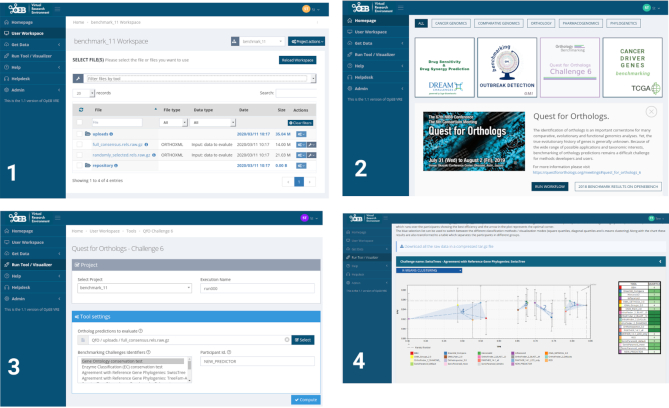
The identification of orthologs-genes in different species which descended from the same gene in their last common ancestor-is a prerequisite for many analyses in comparative genomics and molecular evolution. Numerous algorithms and resources have been conceived to address this problem, but benchmarking and interpreting them is fraught with difficulties (need to compare them on a common input dataset, absence of ground truth, computational cost of calling orthologs). To address this, the Quest for Orthologs consortium maintains a reference set of proteomes and provides a web server for continuous orthology benchmarking (http://orthology.benchmarkservice.org). Furthermore, consensus ortholog calls derived from public benchmark submissions are provided on the Alliance of Genome Resources website, the joint portal of NIH-funded model organism databases.

摘要

在比较基因组学和分子进化的许多分析中,识别来自同一祖先的不同物种中的直系同源基因(orthologs-genes)是前提。为此,人们已经设计了许多算法和资源,但对它们进行基准测试和解释却困难重重(需要在公共输入数据集上进行比较,缺乏真实情况,调用直系同源基因的计算成本)。为了解决这个问题,寻找直系同源基因联盟维护了一个蛋白质组参考集,并提供了一个用于连续直系同源基因基准测试的网络服务器(http://orthology.benchmarkservice.org)。此外,来自公共基准提交的共识直系同源基因调用结果也可以在联盟基因组资源网站上获得,该网站是由美国国立卫生研究院资助的模式生物数据库的联合门户。

https://cdn.ncbi.nlm.nih.gov/pmc/blobs/99e6/7319555/f74c4081d786/gkaa308fig4.jpg
https://cdn.ncbi.nlm.nih.gov/pmc/blobs/99e6/7319555/a7d5bdba6564/gkaa308fig1.jpg
https://cdn.ncbi.nlm.nih.gov/pmc/blobs/99e6/7319555/e5ad461e2912/gkaa308fig2.jpg
https://cdn.ncbi.nlm.nih.gov/pmc/blobs/99e6/7319555/c6438e8ab199/gkaa308fig3.jpg
https://cdn.ncbi.nlm.nih.gov/pmc/blobs/99e6/7319555/f74c4081d786/gkaa308fig4.jpg
https://cdn.ncbi.nlm.nih.gov/pmc/blobs/99e6/7319555/a7d5bdba6564/gkaa308fig1.jpg
https://cdn.ncbi.nlm.nih.gov/pmc/blobs/99e6/7319555/e5ad461e2912/gkaa308fig2.jpg
https://cdn.ncbi.nlm.nih.gov/pmc/blobs/99e6/7319555/c6438e8ab199/gkaa308fig3.jpg
https://cdn.ncbi.nlm.nih.gov/pmc/blobs/99e6/7319555/f74c4081d786/gkaa308fig4.jpg

相似文献

1
The Quest for Orthologs benchmark service and consensus calls in 2020.2020 年寻找直系同源物基准服务和共识调用。
Nucleic Acids Res. 2020 Jul 2;48(W1):W538-W545. doi: 10.1093/nar/gkaa308.
2
The Quest for Orthologs orthology benchmark service in 2022.2022 年的同源基因基准服务探索。
Nucleic Acids Res. 2022 Jul 5;50(W1):W623-W632. doi: 10.1093/nar/gkac330.
3
Big data and other challenges in the quest for orthologs.大数据和其他挑战在寻找直系同源基因的过程中。
Bioinformatics. 2014 Nov 1;30(21):2993-8. doi: 10.1093/bioinformatics/btu492. Epub 2014 Jul 26.
4
Automatic clustering of orthologs and in-paralogs from pairwise species comparisons.通过成对物种比较对直系同源基因和旁系同源基因进行自动聚类。
J Mol Biol. 2001 Dec 14;314(5):1041-52. doi: 10.1006/jmbi.2000.5197.
5
Toward community standards in the quest for orthologs.追求同源物的社区标准。
Bioinformatics. 2012 Mar 15;28(6):900-4. doi: 10.1093/bioinformatics/bts050. Epub 2012 Feb 12.
6
Automatic clustering of orthologs and inparalogs shared by multiple proteomes.多个蛋白质组共有的直系同源基因和旁系同源基因的自动聚类。
Bioinformatics. 2006 Jul 15;22(14):e9-15. doi: 10.1093/bioinformatics/btl213.
7
Standardized benchmarking in the quest for orthologs.寻找直系同源基因过程中的标准化基准测试。
Nat Methods. 2016 May;13(5):425-30. doi: 10.1038/nmeth.3830. Epub 2016 Apr 4.
8
Advances and Applications in the Quest for Orthologs.同源基因的探索、发展与应用。
Mol Biol Evol. 2019 Oct 1;36(10):2157-2164. doi: 10.1093/molbev/msz150.
9
Benchmarking ortholog identification methods using functional genomics data.使用功能基因组学数据对直系同源物鉴定方法进行基准测试。
Genome Biol. 2006;7(4):R31. doi: 10.1186/gb-2006-7-4-r31. Epub 2006 Apr 13.
10
MetaPhOrs 2.0: integrative, phylogeny-based inference of orthology and paralogy across the tree of life.MetaPhOrs 2.0:基于系统发育的综合方法,推断生命之树上的直系同源和旁系同源。
Nucleic Acids Res. 2020 Jul 2;48(W1):W553-W557. doi: 10.1093/nar/gkaa282.

引用本文的文献

1
Feature Architecture-Aware Ortholog Search With fDOG Reveals the Distribution of Plant Cell Wall-Degrading Enzymes Across Life.基于fDOG的特征架构感知直系同源物搜索揭示了植物细胞壁降解酶在生命中的分布。
Mol Biol Evol. 2025 Jun 4;42(6). doi: 10.1093/molbev/msaf120.
2
A compendium of human gene functions derived from evolutionary modelling.基于进化建模得出的人类基因功能概要。
Nature. 2025 Apr;640(8057):146-154. doi: 10.1038/s41586-025-08592-0. Epub 2025 Feb 26.
3
A metric and its derived protein network for evaluation of ortholog database inconsistency.

本文引用的文献

1
OrthoFinder: phylogenetic orthology inference for comparative genomics.OrthoFinder:用于比较基因组学的系统发育直系同源推断。
Genome Biol. 2019 Nov 14;20(1):238. doi: 10.1186/s13059-019-1832-y.
2
Domainoid: domain-oriented orthology inference.域型体:面向域的直系同源推断。
BMC Bioinformatics. 2019 Oct 28;20(1):523. doi: 10.1186/s12859-019-3137-2.
3
Alliance of Genome Resources Portal: unified model organism research platform.基因组资源联盟门户:统一的模式生物研究平台。
一种用于评估直系同源数据库不一致性的度量标准及其衍生的蛋白质网络。
BMC Bioinformatics. 2025 Jan 7;26(1):6. doi: 10.1186/s12859-024-06023-x.
4
New developments for the Quest for Orthologs benchmark service.直系同源物搜索基准服务的新进展。
NAR Genom Bioinform. 2024 Dec 11;6(4):lqae167. doi: 10.1093/nargab/lqae167. eCollection 2024 Dec.
5
COG database update 2024.2024年COG数据库更新
Nucleic Acids Res. 2025 Jan 6;53(D1):D356-D363. doi: 10.1093/nar/gkae983.
6
SonicParanoid2: fast, accurate, and comprehensive orthology inference with machine learning and language models.SonicParanoid2:使用机器学习和语言模型实现快速、准确、全面的直系同源推断。
Genome Biol. 2024 Jul 25;25(1):195. doi: 10.1186/s13059-024-03298-4.
7
FAIRsoft-a practical implementation of FAIR principles for research software.FAIRsoft- 研究软件 FAIR 原则的实际实现。
Bioinformatics. 2024 Aug 2;40(8). doi: 10.1093/bioinformatics/btae464.
8
Ancient eukaryotic protein interactions illuminate modern genetic traits and disorders.古代真核生物蛋白质相互作用揭示现代遗传特征和疾病。
bioRxiv. 2024 May 29:2024.05.26.595818. doi: 10.1101/2024.05.26.595818.
9
OrthoRefine: automated enhancement of prior ortholog identification via synteny.OrthoRefine:通过共线性自动增强先前的直系同源物识别。
BMC Bioinformatics. 2024 Apr 25;25(1):163. doi: 10.1186/s12859-024-05786-7.
10
Challenges and best practices in omics benchmarking.组学基准测试中的挑战和最佳实践。
Nat Rev Genet. 2024 May;25(5):326-339. doi: 10.1038/s41576-023-00679-6. Epub 2024 Jan 12.
Nucleic Acids Res. 2020 Jan 8;48(D1):D650-D658. doi: 10.1093/nar/gkz813.
4
Inferring Orthology and Paralogy.推断直系同源和旁系同源关系。
Methods Mol Biol. 2019;1910:149-175. doi: 10.1007/978-1-4939-9074-0_5.
5
Advances and Applications in the Quest for Orthologs.同源基因的探索、发展与应用。
Mol Biol Evol. 2019 Oct 1;36(10):2157-2164. doi: 10.1093/molbev/msz150.
6
MBGD update 2018: microbial genome database based on hierarchical orthology relations covering closely related and distantly related comparisons.MBGD 更新 2018 版:基于层次同源关系的微生物基因组数据库,涵盖了密切相关和远距离相关的比较。
Nucleic Acids Res. 2019 Jan 8;47(D1):D382-D389. doi: 10.1093/nar/gky1054.
7
eggNOG 5.0: a hierarchical, functionally and phylogenetically annotated orthology resource based on 5090 organisms and 2502 viruses.eggNOG 5.0:一个基于 5090 个生物体和 2502 种病毒的层次化、功能和系统发育注释的同源资源。
Nucleic Acids Res. 2019 Jan 8;47(D1):D309-D314. doi: 10.1093/nar/gky1085.
8
UniProt: a worldwide hub of protein knowledge.UniProt:蛋白质知识的全球枢纽。
Nucleic Acids Res. 2019 Jan 8;47(D1):D506-D515. doi: 10.1093/nar/gky1049.
9
OrthoList 2: A New Comparative Genomic Analysis of Human and Genes.OrthoList 2:人类和 基因的新比较基因组分析。
Genetics. 2018 Oct;210(2):445-461. doi: 10.1534/genetics.118.301307. Epub 2018 Aug 17.
10
Gearing up to handle the mosaic nature of life in the quest for orthologs.在寻找直系同源基因的过程中做好准备以应对生命的镶嵌性。
Bioinformatics. 2018 Jan 15;34(2):323-329. doi: 10.1093/bioinformatics/btx542.