Department of Internal Medicine, Kaohsiung Medical University Hospital, Kaohsiung, Taiwan.
College of Medicine, Kaohsiung Medical University, Kaohsiung, Taiwan.
Kaohsiung J Med Sci. 2020 May;36(5):296-304. doi: 10.1002/kjm2.12228. Epub 2020 May 6.
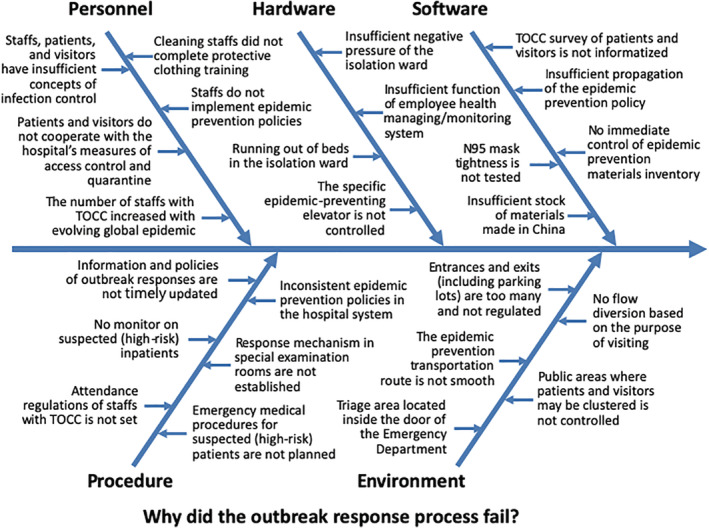
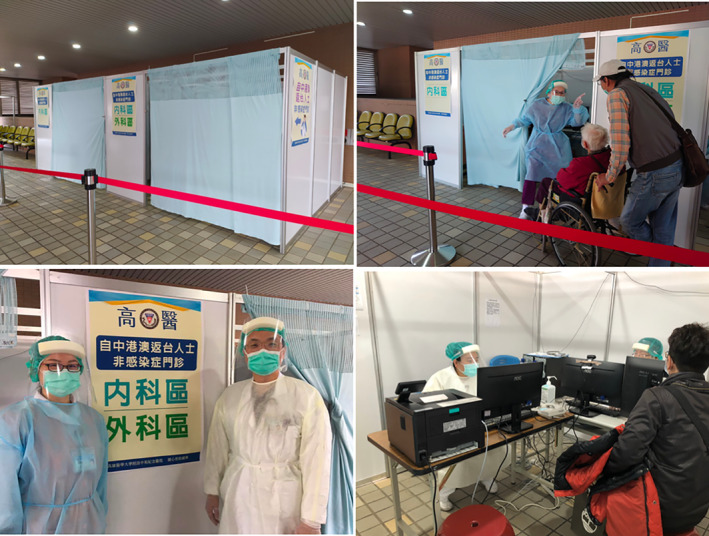
The World Health Organization announced the coronavirus disease 2019 (COVID-19) outbreak a pandemic on 12 March 2020. Although being in proximity to China, the original epicenter of the COVID-19 outbreak, Taiwan has maintained a low number of COVID-19 cases despite its close social ties and heavy traffic between Taiwan and China. Containment strategies executed by the Taiwanese government have attracted global attention. Similarly, in-hospital settings, high alertness and swift responses to the changing outbreak situation are necessary to ensure hospital staff members' safety so they can continue to save patients' lives. Herein, we present infection control measures that can be adopted in hospital settings that were executed in a Taiwanese hospital to confront the COVID-19 pandemic, including emergency preparedness and responses from the hospital administration, education, surveillance, patient flow arrangement, the partition of hospital zones, and the prevention of a systemic shutdown by using the "divided cabin, divided flow" strategy. The measures implemented by a Taiwan hospital during the COVID-19 pandemic may not be universally applicable in every hospital. Nonetheless, the presented infection control methods have been practically executed and can be referenced or modified to fit each hospital's unique condition.
世界卫生组织于 2020 年 3 月 12 日宣布 2019 年冠状病毒病(COVID-19)疫情为大流行。尽管台湾紧邻中国这一 COVID-19 疫情的最初震中,但由于与中国大陆之间密切的社会联系和繁忙的交通,台湾的 COVID-19 病例数量保持在较低水平。台湾政府实施的防控策略引起了全球关注。同样,在医院环境中,高度警惕并迅速应对不断变化的疫情形势对于确保医院工作人员的安全至关重要,这样他们才能继续拯救患者的生命。在此,我们介绍了在台湾医院实施的一些感染控制措施,以应对 COVID-19 大流行,包括医院管理层的应急准备和响应、教育、监测、患者流程安排、医院区域划分以及采用“分区舱、分流通”策略防止医院系统关闭。台湾医院在 COVID-19 大流行期间实施的措施并非在每家医院都普遍适用。尽管如此,所提出的感染控制方法已经实际执行,并可参考或修改以适应每家医院的独特情况。