• 文献检索
  • 文档翻译
  • 深度研究
  • 学术资讯
  • Suppr Zotero 插件Zotero 插件
  • 邀请有礼
  • 套餐&价格
  • 历史记录
应用&插件
Suppr Zotero 插件Zotero 插件浏览器插件Mac 客户端Windows 客户端微信小程序
定价
高级版会员购买积分包购买API积分包
服务
文献检索文档翻译深度研究API 文档MCP 服务
关于我们
关于 Suppr公司介绍联系我们用户协议隐私条款
关注我们

Suppr 超能文献

核心技术专利:CN118964589B侵权必究
粤ICP备2023148730 号-1Suppr @ 2026

文献检索

告别复杂PubMed语法,用中文像聊天一样搜索,搜遍4000万医学文献。AI智能推荐,让科研检索更轻松。

立即免费搜索

文件翻译

保留排版,准确专业,支持PDF/Word/PPT等文件格式,支持 12+语言互译。

免费翻译文档

深度研究

AI帮你快速写综述,25分钟生成高质量综述,智能提取关键信息,辅助科研写作。

立即免费体验

利用考虑韩国行为变化的数学模型预测 COVID-19 传播动态。

Prediction of COVID-19 transmission dynamics using a mathematical model considering behavior changes in Korea.

机构信息

Department of Mathematics, Konkuk University, Seoul, Korea.

Division of Infectious Diseases, Department of Internal Medicine, Hallym University College of Medicine, Chuncheon, Korea.

出版信息

Epidemiol Health. 2020;42:e2020026. doi: 10.4178/epih.e2020026. Epub 2020 Apr 13.

DOI:10.4178/epih.e2020026
PMID:32375455
原文链接:https://pmc.ncbi.nlm.nih.gov/articles/PMC7285444/
Abstract

OBJECTIVES

Since the report of the first confirmed case in Daegu on February 18, 2020, local transmission of coronavirus disease 2019 (COVID-19) in Korea has continued. In this study, we aimed to identify the pattern of local transmission of COVID-19 using mathematical modeling and predict the epidemic size and the timing of the end of the spread.

METHODS

We modeled the COVID-19 outbreak in Korea by applying a mathematical model of transmission that factors in behavioral changes. We used the Korea Centers for Disease Control and Prevention data of daily confirmed cases in the country to estimate the nationwide and Daegu/Gyeongbuk area-specific transmission rates as well as behavioral change parameters using a least-squares method.

RESULTS

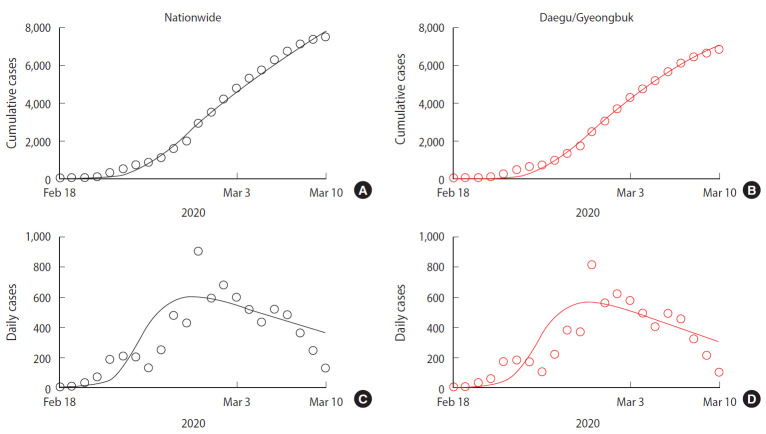
The number of transmissions per infected patient was estimated to be about 10 times higher in the Daegu/Gyeongbuk area than the average of nationwide. Using these estimated parameters, our models predicts that about 13,800 cases will occur nationwide and 11,400 cases in the Daegu/Gyeongbuk area until mid-June.

CONCLUSIONS

We mathematically demonstrate that the relatively high per-capita rate of transmission and the low rate of changes in behavior have caused a large-scale transmission of COVID-19 in the Daegu/Gyeongbuk area in Korea. Since the outbreak is expected to continue until May, non-pharmaceutical interventions that can be sustained over the long term are required.

摘要

目的

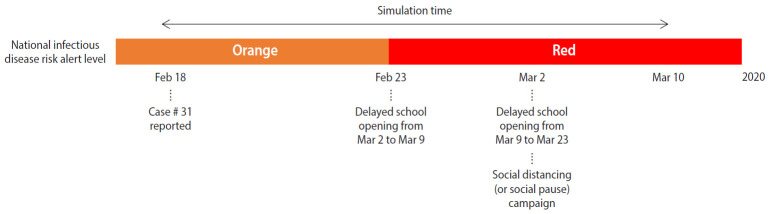
自 2020 年 2 月 18 日韩国大邱首例确诊病例报告以来,2019 年冠状病毒病(COVID-19)在韩国的本地传播持续存在。在这项研究中,我们旨在通过数学建模确定 COVID-19 的本地传播模式,并预测疫情规模和传播结束的时间。

方法

我们通过应用考虑行为变化的传播数学模型来模拟韩国的 COVID-19 疫情。我们使用韩国疾病控制与预防中心(KCDC)在全国范围内每日确诊病例的数据,使用最小二乘法估计全国和大邱/庆尚北道特定地区的传播率以及行为变化参数。

结果

感染患者的传播数量估计在大邱/庆尚北道比全国平均水平高约 10 倍。使用这些估计的参数,我们的模型预测,截至 6 月中旬,全国将发生约 13800 例病例,大邱/庆尚北道将发生 11400 例病例。

结论

我们从数学上证明,相对较高的人均传播率和行为变化率低导致了韩国大邱/庆尚北道 COVID-19 的大规模传播。由于预计疫情将持续到 5 月,因此需要采取能够长期持续的非药物干预措施。
https://cdn.ncbi.nlm.nih.gov/pmc/blobs/0d45/7285444/65fc9c01d1fb/epih-42-e2020026f3.jpg
https://cdn.ncbi.nlm.nih.gov/pmc/blobs/0d45/7285444/47930e1de3e3/epih-42-e2020026f1.jpg
https://cdn.ncbi.nlm.nih.gov/pmc/blobs/0d45/7285444/65fc9c01d1fb/epih-42-e2020026f3.jpg
https://cdn.ncbi.nlm.nih.gov/pmc/blobs/0d45/7285444/47930e1de3e3/epih-42-e2020026f1.jpg
https://cdn.ncbi.nlm.nih.gov/pmc/blobs/0d45/7285444/65fc9c01d1fb/epih-42-e2020026f3.jpg

相似文献

1
Prediction of COVID-19 transmission dynamics using a mathematical model considering behavior changes in Korea.利用考虑韩国行为变化的数学模型预测 COVID-19 传播动态。
Epidemiol Health. 2020;42:e2020026. doi: 10.4178/epih.e2020026. Epub 2020 Apr 13.
2
Estimating the reproductive number and the outbreak size of COVID-19 in Korea.估算韩国 COVID-19 的繁殖数和疫情规模。
Epidemiol Health. 2020;42:e2020011. doi: 10.4178/epih.e2020011. Epub 2020 Mar 12.
3
The impact of social distancing and public behavior changes on COVID-19 transmission dynamics in the Republic of Korea.社交距离和公众行为改变对韩国 COVID-19 传播动力学的影响。
PLoS One. 2020 Sep 24;15(9):e0238684. doi: 10.1371/journal.pone.0238684. eCollection 2020.
4
Individual-based simulation model for COVID-19 transmission in Daegu, Korea.基于个体的韩国大邱 COVID-19 传播模拟模型。
Epidemiol Health. 2020;42:e2020042. doi: 10.4178/epih.e2020042. Epub 2020 Jun 15.
5
School Opening Delay Effect on Transmission Dynamics of Coronavirus Disease 2019 in Korea: Based on Mathematical Modeling and Simulation Study.学校延迟开学对韩国 2019 年冠状病毒病传播动力学的影响:基于数学建模和模拟研究。
J Korean Med Sci. 2020 Apr 6;35(13):e143. doi: 10.3346/jkms.2020.35.e143.
6
Evaluation of COVID-19 epidemic outbreak caused by temporal contact-increase in South Korea.评估韩国因时间接触增加而引发的 COVID-19 疫情爆发。
Int J Infect Dis. 2020 Jul;96:454-457. doi: 10.1016/j.ijid.2020.05.036. Epub 2020 May 14.
7
Mass Infection Analysis of COVID-19 Using the SEIRD Model in Daegu-Gyeongbuk of Korea from April to May, 2020.2020 年 4 月至 5 月韩国大邱庆北地区使用 SEIRD 模型对 COVID-19 的大规模感染分析。
J Korean Med Sci. 2020 Aug 31;35(34):e317. doi: 10.3346/jkms.2020.35.e317.
8
Analyzing the effects of social distancing on the COVID-19 pandemic in Korea using mathematical modeling.利用数学模型分析社交距离对韩国 COVID-19 大流行的影响。
Epidemiol Health. 2020;42:e2020064. doi: 10.4178/epih.e2020064. Epub 2020 Sep 7.
9
Estimating a breakpoint in the pattern of spread of COVID-19 in South Korea.估计韩国 COVID-19 传播模式中的断点。
Int J Infect Dis. 2020 Aug;97:360-364. doi: 10.1016/j.ijid.2020.06.055. Epub 2020 Jun 20.
10
Risk estimation and prediction of the transmission of coronavirus disease-2019 (COVID-19) in the mainland of China excluding Hubei province.中国大陆(不含湖北省) 2019 年冠状病毒病(COVID-19)传播的风险估计和预测。
Infect Dis Poverty. 2020 Aug 24;9(1):116. doi: 10.1186/s40249-020-00683-6.

引用本文的文献

1
Forecasting the spread of COVID-19 based on policy, vaccination, and Omicron data.基于政策、疫苗接种和奥密克戎数据预测 COVID-19 的传播。
Sci Rep. 2024 Apr 30;14(1):9962. doi: 10.1038/s41598-024-58835-9.
2
Numerical Scheme for Compartmental Models: New Matlab Software Codes for Numerical Simulation. compartmental 模型的数值方案:用于数值模拟的新 Matlab 软件代码。
F1000Res. 2023 Sep 25;12:445. doi: 10.12688/f1000research.130458.2. eCollection 2023.
3
Factors Influencing Infection Anxiety in Korean Male Firefighters Due to COVID-19 Infection Status.

本文引用的文献

1
Epidemiologic characteristics of early cases with 2019 novel coronavirus (2019-nCoV) disease in Korea.韩国 2019 年新型冠状病毒(2019-nCoV)疾病早期病例的流行病学特征。
Epidemiol Health. 2020;42:e2020007. doi: 10.4178/epih.e2020007. Epub 2020 Feb 9.
2
Towards a characterization of behavior-disease models.朝向行为-疾病模型的特征化。
PLoS One. 2011;6(8):e23084. doi: 10.1371/journal.pone.0023084. Epub 2011 Aug 3.
新冠病毒感染状况对韩国男性消防员感染焦虑的影响因素
Healthcare (Basel). 2023 Jun 1;11(11):1623. doi: 10.3390/healthcare11111623.
4
Mathematical Modeling of COVID-19 Transmission and Intervention in South Korea: A Review of Literature.《韩国 COVID-19 传播及干预的数学建模:文献综述》。
Yonsei Med J. 2023 Jan;64(1):1-10. doi: 10.3349/ymj.2022.0471.
5
Model-informed COVID-19 exit strategy with projections of SARS-CoV-2 infections generated by variants in the Republic of Korea.基于模型的韩国新冠疫情解封策略及新冠病毒变异株引发感染情况的预测
BMC Public Health. 2022 Nov 17;22(1):2098. doi: 10.1186/s12889-022-14576-w.
6
A model of COVID-19 pandemic with vaccines and mutant viruses.一种带有疫苗和变异病毒的 COVID-19 大流行模型。
PLoS One. 2022 Oct 24;17(10):e0275851. doi: 10.1371/journal.pone.0275851. eCollection 2022.
7
Evolution and consequences of individual responses during the COVID-19 outbreak.个体在 COVID-19 疫情期间反应的演变及其后果。
PLoS One. 2022 Sep 1;17(9):e0273964. doi: 10.1371/journal.pone.0273964. eCollection 2022.
8
Mathematical modeling of the impact of Omicron variant on the COVID-19 situation in South Korea.奥密克戎变异株对韩国新冠疫情影响的数学建模
Genomics Inform. 2022 Jun;20(2):e22. doi: 10.5808/gi.22025. Epub 2022 Jun 22.
9
Multi-Faceted Analysis of COVID-19 Epidemic in Korea Considering Omicron Variant: Mathematical Modeling-Based Study.考虑奥密克戎变异株的韩国 COVID-19 疫情的多方面分析:基于数学模型的研究。
J Korean Med Sci. 2022 Jul 4;37(26):e209. doi: 10.3346/jkms.2022.37.e209.
10
Compartmental structures used in modeling COVID-19: a scoping review.用于建模 COVID-19 的隔室结构:范围综述。
Infect Dis Poverty. 2022 Jun 21;11(1):72. doi: 10.1186/s40249-022-01001-y.