Department of Mathematics and Physics, North China Electric Power University, Baoding, 071003, China.
Department of Epidemiology and Health Statistics, Fudan University, Shanghai, 200032, China.
Infect Dis Poverty. 2022 Jun 21;11(1):72. doi: 10.1186/s40249-022-01001-y.
The coronavirus disease 2019 (COVID-19) epidemic, considered as the worst global public health event in nearly a century, has severely affected more than 200 countries and regions around the world. To effectively prevent and control the epidemic, researchers have widely employed dynamic models to predict and simulate the epidemic's development, understand the spread rule, evaluate the effects of intervention measures, inform vaccination strategies, and assist in the formulation of prevention and control measures. In this review, we aimed to sort out the compartmental structures used in COVID-19 dynamic models and provide reference for the dynamic modeling for COVID-19 and other infectious diseases in the future.
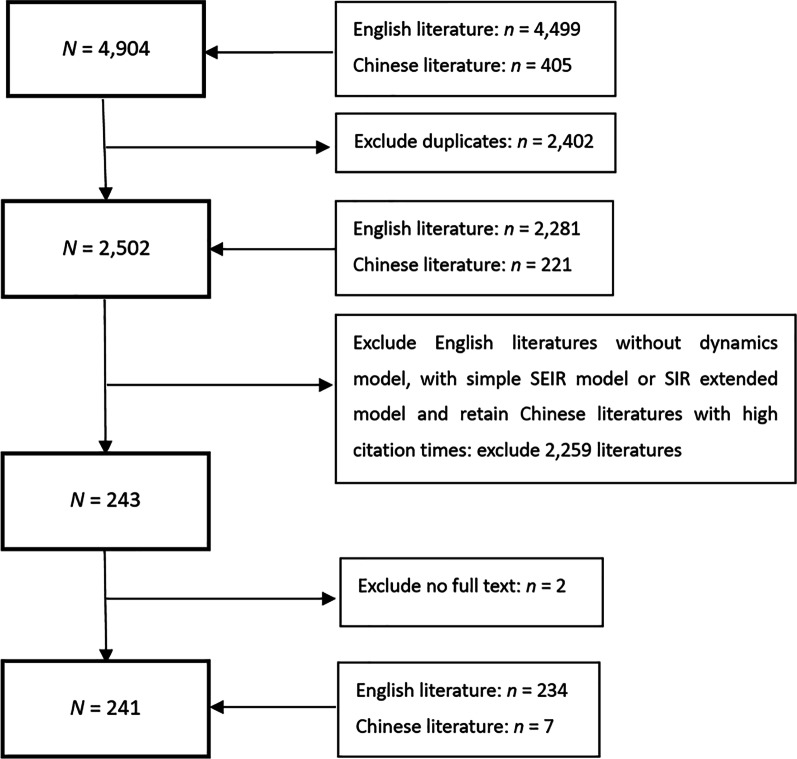
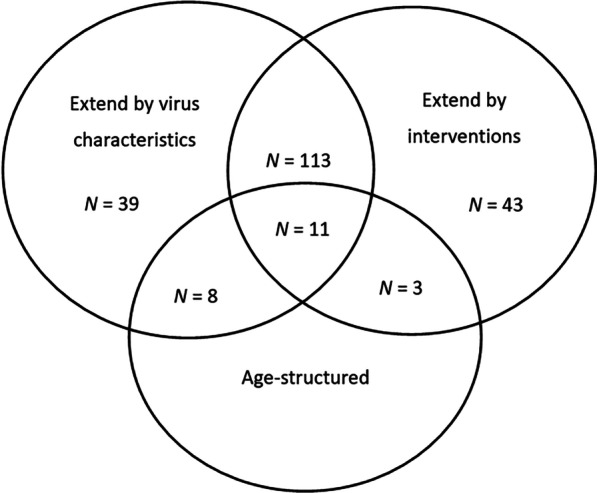
A scoping review on the compartmental structures used in modeling COVID-19 was conducted. In this scoping review, 241 research articles published before May 14, 2021 were analyzed to better understand the model types and compartmental structures used in modeling COVID-19. Three types of dynamics models were analyzed: compartment models expanded based on susceptible-exposed-infected-recovered (SEIR) model, meta-population models, and agent-based models. The expanded compartments based on SEIR model are mainly according to the COVID-19 transmission characteristics, public health interventions, and age structure. The meta-population models and the agent-based models, as a trade-off for more complex model structures, basic susceptible-exposed-infected-recovered or simply expanded compartmental structures were generally adopted.
There has been a great deal of models to understand the spread of COVID-19, and to help prevention and control strategies. Researchers build compartments according to actual situation, research objectives and complexity of models used. As the COVID-19 epidemic remains uncertain and poses a major challenge to humans, researchers still need dynamic models as the main tool to predict dynamics, evaluate intervention effects, and provide scientific evidence for the development of prevention and control strategies. The compartmental structures reviewed in this study provide guidance for future modeling for COVID-19, and also offer recommendations for the dynamic modeling of other infectious diseases.
2019 年冠状病毒病(COVID-19)疫情被认为是近一个世纪以来最严重的全球公共卫生事件,已严重影响全球 200 多个国家和地区。为了有效预防和控制疫情,研究人员广泛采用动力学模型来预测和模拟疫情的发展,了解传播规律,评估干预措施的效果,为疫苗接种策略提供信息,并协助制定防控措施。在本综述中,我们旨在梳理 COVID-19 动力学模型中使用的房室结构,为未来 COVID-19 和其他传染病的动力学建模提供参考。
对用于 COVID-19 建模的房室结构进行了范围界定综述。在这项范围界定综述中,我们分析了截至 2021 年 5 月 14 日之前发表的 241 篇研究文章,以更好地了解 COVID-19 建模中使用的模型类型和房室结构。分析了三种类型的动力学模型:基于易感-暴露-感染-恢复(SEIR)模型扩展的房室模型、元人群模型和基于主体的模型。基于 SEIR 模型扩展的房室主要是根据 COVID-19 的传播特征、公共卫生干预措施和年龄结构。元人群模型和基于主体的模型,作为更复杂模型结构的权衡,通常采用基本的易感-暴露-感染-恢复或简单扩展的房室结构。
有大量模型用于了解 COVID-19 的传播,并帮助制定预防和控制策略。研究人员根据实际情况、研究目标和使用的模型复杂性来构建房室。由于 COVID-19 疫情仍然不确定,对人类构成重大挑战,研究人员仍然需要动力学模型作为预测动力学、评估干预效果以及为制定防控策略提供科学依据的主要工具。本研究中综述的房室结构为未来 COVID-19 建模提供了指导,也为其他传染病的动力学建模提供了建议。