Aumueller Nicole, Gruszfeld Dariusz, Gradowska Kinga, Escribano Joaquín, Ferré Natalia, Martin Françoise, Poncelet Pascale, Verduci Elvira, ReDionigi Alice, Koletzko Berthold, Grote Veit
Division of Metabolic and Nutritional Medicine, Department of Paediatrics, Dr. von Hauner Children's Hospital, LMU-Ludwig-Maximilians-Universität Munich, Lindwurmstr. 4, 80337, Munich, Germany.
Neonatal Intensive Care Unit, Children's Memorial Health Institute, Warsaw, Poland.
Eur J Nutr. 2021 Feb;60(1):435-442. doi: 10.1007/s00394-020-02229-w. Epub 2020 May 6.
We aimed to characterize the association of dietary sugar intake with blood lipids and glucose-related markers in childhood.
Data from the multicentric European Childhood Obesity Project Trial were used. Three-day weighed dietary records were obtained at 8 years of age along with serum concentrations of triglycerides, total cholesterol, low-density lipoprotein cholesterol, high-density lipoprotein cholesterol (HDL-C), glucose, and insulin. Total sugar intake comprised all mono- and disaccharides; different sugar sources were defined. Linear regression models were applied to investigate the cross-sectional association of total sugar intake with blood lipids and glucose-related markers with adjustment for total energy intake using the residual method.
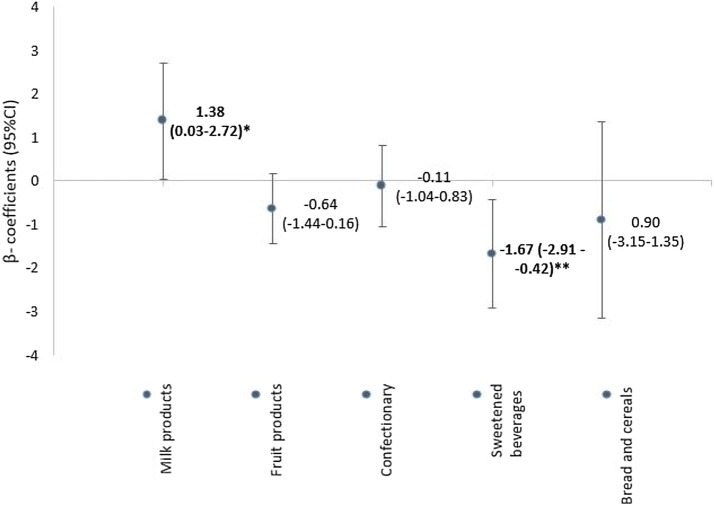
Data were available for 325 children. Children consumed on average 332 kcal (SD 110) and 21% (SD 6) of energy from total sugar. In an energy-adjusted model, an increase of 100 kcal from total sugar per day was significantly associated with a z score HDL-C decrease (- 0.14; 95% CI - 0.01, - 0.27; p value = 0.031). Concerning different food groups of total sugar intake, 100 kcal total sugar from sweetened beverages was negatively associated with z score HDL-C (- 1.67; 95% CI - 0.42, - 2.91; p value = 0.009), while total sugar from milk products was positively related to z score HDL-C (1.38, 95% CI 0.03, 2.72; p value = 0.045). None of the other blood lipids or glucose-related markers showed a significant relationship with total sugar intake.
Increasing dietary total sugar intake in children, especially from sweetened beverages, was associated with unfavorable effects on HDL-C, which might increase the long-term risk for dyslipidemia and cardiovascular disease.
ClinicalTrials.gov Identifier: NCT00338689; Registered: June 19, 2006. URL: https://clinicaltrials.gov/ct2/show/NCT00338689?term=NCT00338689&rank=1 .
我们旨在描述儿童期膳食糖摄入量与血脂及血糖相关指标之间的关联。
使用了多中心欧洲儿童肥胖项目试验的数据。在8岁时获取了3天的称重膳食记录以及甘油三酯、总胆固醇、低密度脂蛋白胆固醇、高密度脂蛋白胆固醇(HDL-C)、葡萄糖和胰岛素的血清浓度。总糖摄入量包括所有单糖和双糖;定义了不同的糖来源。应用线性回归模型,采用残差法在调整总能量摄入的情况下,研究总糖摄入量与血脂及血糖相关指标的横断面关联。
有325名儿童的数据可用。儿童平均从总糖中摄入332千卡(标准差110)能量,占总能量的21%(标准差6)。在能量调整模型中,每天总糖摄入量增加100千卡与HDL-C的z评分显著降低相关(-0.14;95%置信区间-0.01,-0.27;p值 = 0.031)。关于总糖摄入量的不同食物组,来自含糖饮料的100千卡总糖与HDL-C的z评分呈负相关(-1.67;95%置信区间-0.42,-2.91;p值 = 0.009),而来自乳制品的总糖与HDL-C的z评分呈正相关(1.38,95%置信区间0.03,2.72;p值 = 0.045)。其他血脂或血糖相关指标均未显示与总糖摄入量有显著关系。
儿童膳食总糖摄入量增加,尤其是来自含糖饮料的摄入量增加,与对HDL-C的不利影响相关,这可能会增加血脂异常和心血管疾病的长期风险。
ClinicalTrials.gov标识符:NCT00338689;注册时间:2006年6月19日。网址:https://clinicaltrials.gov/ct2/show/NCT00338689?term=NCT00338689&rank=1 。