School of Public Policy and Government, Fundação Getúlio Vargas, Brasília, Distrito Federal, Brazil.
School of Public Policy and Government, Fundação Getúlio Vargas, Brasília, Distrito Federal, Brazil.
Sci Total Environ. 2020 Aug 15;730:139144. doi: 10.1016/j.scitotenv.2020.139144. Epub 2020 May 1.
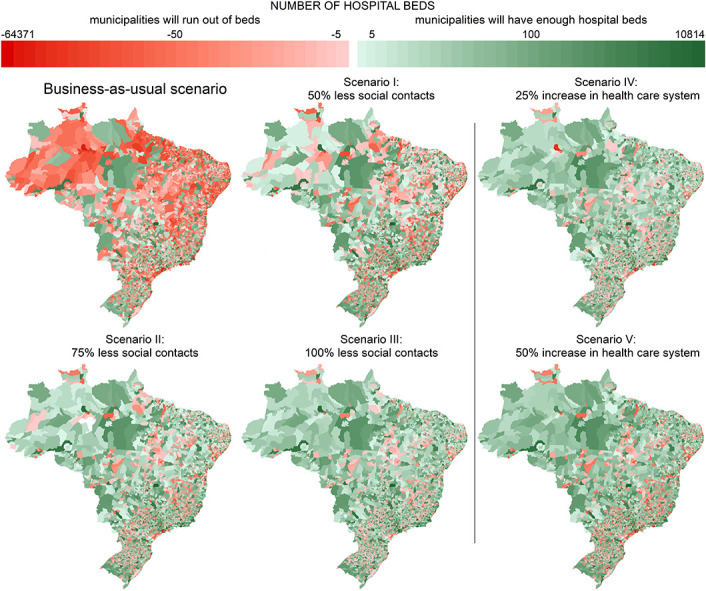
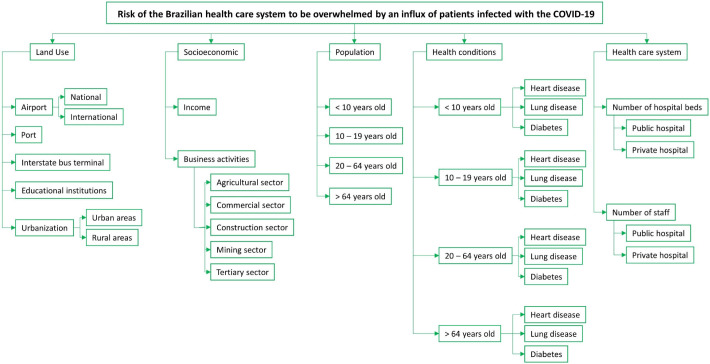
The spread of the 2019 novel coronavirus (COVID-19) has challenged governments to develop public policies to reduce the load of the COVID-19 on health care systems, which is commonly referred to as "flattening the curve". This study aims to address this issue by proposing a spatial multicriteria approach to estimate the risk of the Brazilian health care system, by municipality, to exceed the health care capacity because of an influx of patients infected with the COVID-19. We estimated this risk for 5572 municipalities in Brazil using a combination of a multicriteria decision-making approach with spatial analysis to estimate the exceedance risk, and then, we examined the risk variation by designing 5 control intervention scenarios (3 scenarios representing reduction on social contacts, and 2 scenarios representing investment on health care system). For the baseline scenario using an average infection rate across Brazil, we estimated a mean Hospital Bed Capacity (HBC) value of -16.73, indicating that, on average, the Brazilian municipalities will have a deficit of approximately 17 beds. This deficit is projected to occur in 3338 municipalities with the north and northeast regions being at the greatest risk of exceeding health care capacity due to the COVID-19. The intervention scenarios indicate across all of Brazil that they could address the bed shortage, with an average of available beds between 23 and 32. However, when we consider the shortages at a municipal scale, bed exceedances still occur for at least 2119 municipalities in the most effective intervention scenario. Our findings are essential to identify priority areas, to compare populations, and to provide options for government agencies to act. This study can be used to provide support for the creation of effective health public policies for national, regional, and local intervention.
2019 年新型冠状病毒(COVID-19)的传播给各国政府带来了挑战,要求它们制定公共政策,以减轻 COVID-19 对医疗系统的负担,这通常被称为“曲线变平”。本研究旨在通过提出一种空间多标准方法来解决这个问题,以估计巴西各城市因 COVID-19 感染患者涌入而超过医疗能力的风险。我们使用多标准决策方法与空间分析相结合的方法,对巴西 5572 个城市的这种风险进行了估计,以估计超出风险,然后,我们通过设计 5 个控制干预情景(3 个情景代表减少社会接触,2 个情景代表投资医疗保健系统)来检查风险变化。对于使用巴西平均感染率的基线情景,我们估计平均医院床位容量(HBC)值为-16.73,这表明,平均而言,巴西各城市将缺少大约 17 张床位。预计这种短缺将出现在 3338 个城市,北部和东北部地区由于 COVID-19 而面临医疗能力超过的最大风险。干预情景表明,在巴西各地,通过干预平均可提供 23 至 32 张可用床位,可以解决床位短缺问题。然而,当我们从城市层面考虑这些短缺时,在最有效的干预情景下,仍至少有 2119 个城市会出现床位短缺。我们的研究结果对于确定优先领域、比较人口以及为政府机构提供行动方案至关重要。本研究可用于为国家、地区和地方干预措施制定有效的公共卫生政策提供支持。