Jung F, Krieger V, Hufert F T, Küpper J-H
Institute of Biotechnology, Molecular Cell Biology, Brandenburg University of Technology, Senftenberg, Germany.
TMM AG Böblingen, Department Head Lab Planning and Norming of Information Management, Böblingen, Germany.
Clin Hemorheol Microcirc. 2020;74(4):363-372. doi: 10.3233/CH-209004.
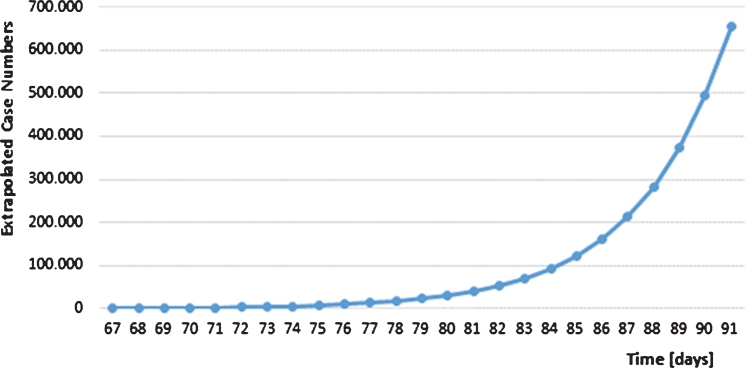
In the early phase of the COVID-19 pandemic Germany missed to set up efficient containment measures. Consequently, the number of cases increased exponentially until a lockdown was implemented to suppress the spread of SARS-CoV-2. Fortunately, Germany has a high capability for coronavirus lab testing and more than 30,000 ICU beds. These capabilities and the lockdown turned out to be an advantage to combat the pandemic and to prevent a health-system overload.
The aim was to predict the plateau day of SARS-CoV-2 infections or deaths.
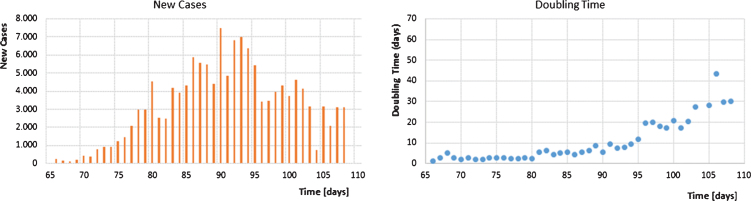
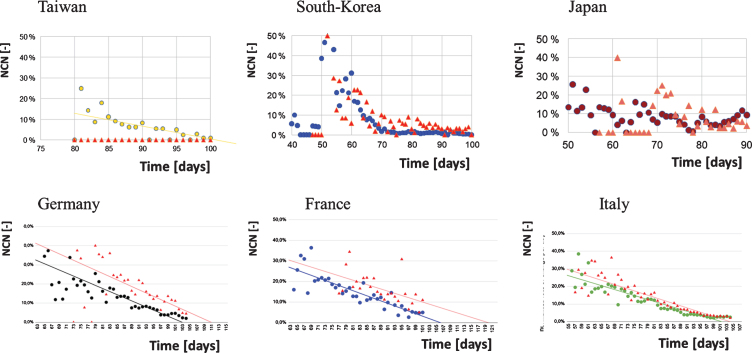
The effect on the viral spread of the German measures taken and the impact on the peak of new infection cases is shown. By normalizing daily case numbers, the plateau day of the current outbreak in Germany could be calculated to be reached at April 12, 2020 (day 103 of 2020).
Normalized case number curves are helpful to predict the time point at which no further new infections will occur if the epidemic situation remains stable. Upon reaching the plateau day during a lockdown phase, a residual time-period of about 2-3 weeks can be utilized to prepare a safe unlocking period. As can be learned from Asian countries such as South Korea and Taiwan there must be strict rules to keep the risk of infection low. Those include social distancing, face mask wearing in combination with digital contact tracing and serosurveillance studies. Following those rules, a safe dance around the infection curve allows to keep the population at a reduced infection rate.
在新冠疫情早期,德国未能建立有效的防控措施。因此,病例数呈指数级增长,直到实施封锁以抑制严重急性呼吸综合征冠状病毒2(SARS-CoV-2)的传播。幸运的是,德国具备很高的冠状病毒实验室检测能力以及3万多张重症监护病床。这些能力以及封锁措施成为抗击疫情和防止卫生系统不堪重负的一项优势。
目的是预测SARS-CoV-2感染或死亡的平稳期日期。
展示了德国所采取措施对病毒传播的影响以及对新增感染病例峰值的影响。通过对每日病例数进行标准化处理,可以计算出德国当前疫情的平稳期将于2020年4月12日(2020年第103天)达到。
标准化的病例数曲线有助于预测在疫情形势保持稳定的情况下不再出现新感染病例的时间点。在封锁阶段达到平稳期后,可以利用大约2至3周的剩余时间来准备一个安全的解封期。从韩国和中国台湾等亚洲国家可以了解到,必须有严格的规定以降低感染风险。这些规定包括保持社交距离、佩戴口罩并结合数字接触者追踪和血清学监测研究。遵循这些规定,在感染曲线周围安全应对,可使人群维持较低的感染率。