Teo Alvin Kuo Jing, Prem Kiesha, Tuot Sovannary, Ork Chetra, Eng Sothearith, Pande Tripti, Chry Monyrath, Hsu Li Yang, Yi Siyan
Saw Swee Hock School of Public Health, National University of Singapore, National University Health System, Singapore.
Dept of Infectious Disease Epidemiology, Faculty of Epidemiology and Population Health, London School of Hygiene and Tropical Medicine, London, UK.
ERJ Open Res. 2020 May 4;6(2). doi: 10.1183/23120541.00368-2019. eCollection 2020 Apr.
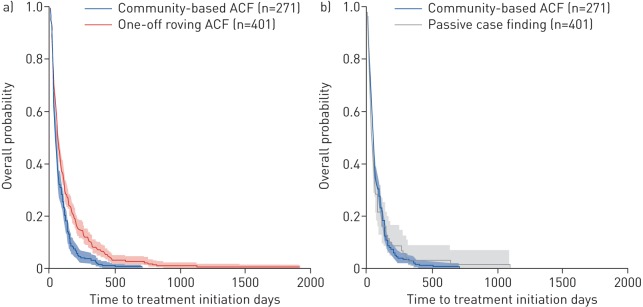
The effects of active case finding (ACF) models that mobilise community networks for early identification and treatment of tuberculosis (TB) remain unknown. We investigated and compared the effect of community-based ACF using a seed-and-recruit model with one-off roving ACF and passive case finding (PCF) on the time to treatment initiation and identification of bacteriologically confirmed TB.
In this retrospective cohort study conducted in 12 operational districts in Cambodia, we assessed relationships between ACF models and: 1) the time to treatment initiation using Cox proportional hazards regression; and 2) the identification of bacteriologically confirmed TB using modified Poisson regression with robust sandwich variance.
We included 728 adults with TB, of whom 36% were identified the community-based ACF using a seed-and-recruit model. We found community-based ACF using a seed-and-recruit model was associated with shorter delay to treatment initiation compared to one-off roving ACF (hazard ratio 0.81, 95% CI 0.68-0.96). Compared to one-off roving ACF and PCF, community-based ACF using a seed-and-recruit model was 45% (prevalence ratio (PR) 1.45, 95% CI 1.19-1.78) and 39% (PR 1.39, 95% CI 0.99-1.94) more likely to find and detect bacteriologically confirmed TB, respectively.
Mobilising community networks to find TB cases was associated with early initiation of TB treatment in Cambodia. This approach was more likely to find bacteriologically confirmed TB cases, contributing to the reduction of risk of transmission within the community.
利用社区网络进行结核病(TB)早期识别与治疗的主动病例发现(ACF)模式的效果尚不清楚。我们调查并比较了使用种子招募模式的社区ACF、一次性巡回ACF和被动病例发现(PCF)对开始治疗时间和痰菌确诊结核病识别的影响。
在柬埔寨12个业务区进行的这项回顾性队列研究中,我们评估了ACF模式与以下方面的关系:1)使用Cox比例风险回归分析开始治疗的时间;2)使用稳健三明治方差的修正泊松回归分析痰菌确诊结核病的识别情况。
我们纳入了728例成年结核病患者,其中36%是通过使用种子招募模式的社区ACF识别出来的。我们发现,与一次性巡回ACF相比,使用种子招募模式的社区ACF与开始治疗的延迟时间较短有关(风险比0.81,95%可信区间0.68-0.96)。与一次性巡回ACF和PCF相比,使用种子招募模式的社区ACF分别有45%(患病率比(PR)1.45,95%可信区间1.19-1.78)和39%(PR 1.39,95%可信区间0.99-1.94)的可能性发现并检测到痰菌确诊的结核病。
在柬埔寨,动员社区网络发现结核病病例与结核病治疗的早期开始有关。这种方法更有可能发现痰菌确诊的结核病病例,有助于降低社区内传播风险。