Prem Kiesha, Pheng Sok Heng, Teo Alvin Kuo Jing, Evdokimov Konstantin, Nang Ei Ei Khaing, Hsu Li Yang, Saphonn Vonthanak, Tieng Sivanna, Mao Tan Eang, Cook Alex R
Saw Swee Hock School of Public Health, National University of Singapore and National University Health System, Singapore.
National Center for Tuberculosis and Leprosy Control (CENAT), Ministry of Health, Phnom Penh, Cambodia.
BMJ Glob Health. 2019 Jan 24;4(1):e001083. doi: 10.1136/bmjgh-2018-001083. eCollection 2019.
Cambodia is among the 30 highest burden of tuberculosis (TB) countries. Active TB prevalence has been estimated using nationally representative multistage sampling that represents urban, rural and remote parts of the country, but the prevalence in non-sampled communes remains unknown. This study uses geospatial Bayesian statistics to estimate point prevalence across Cambodia, and demographic modelling that accounts for secular trends in fertility, mortality, urbanisation and prevalence rates to project the future burden of active TB.
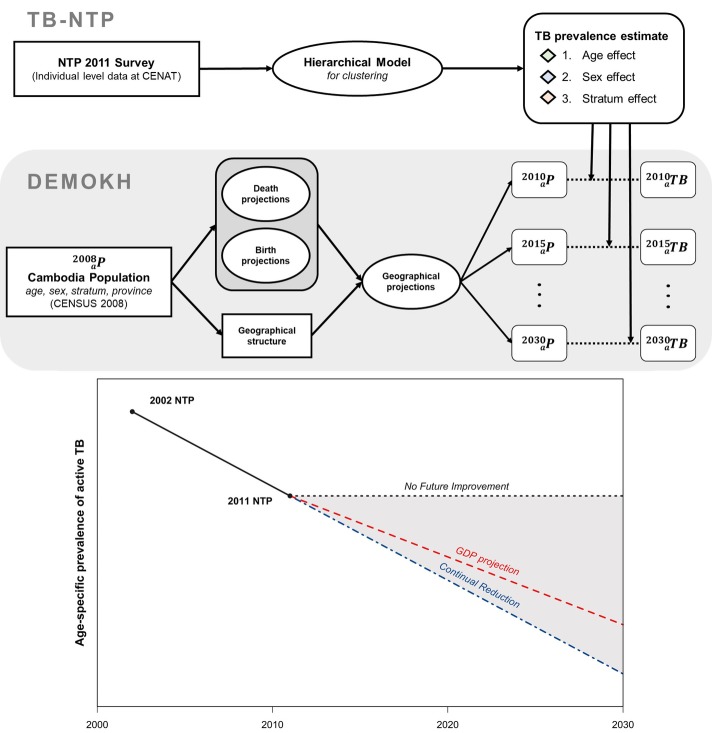
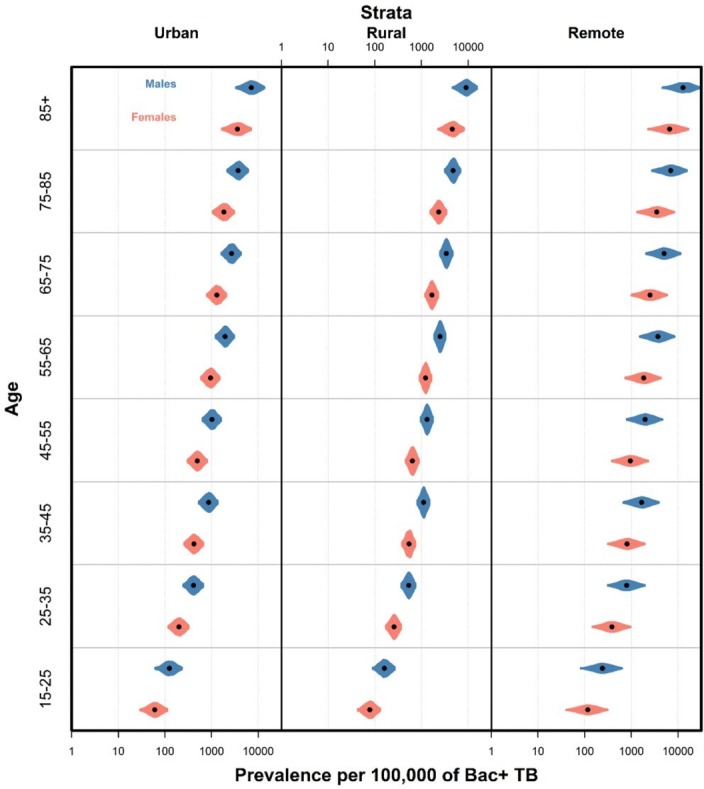
A Bayesian hierarchical model was developed for the 2011 National Tuberculosis Prevalence survey to estimate the differential effect of age, sex and geographic stratum on active TB prevalence; these estimates were then married with high-resolution geographic information system layers to project prevalence across Cambodia. Future TB projections under alternative scenarios were then derived by interfacing these estimates with an individual-based demographic model.
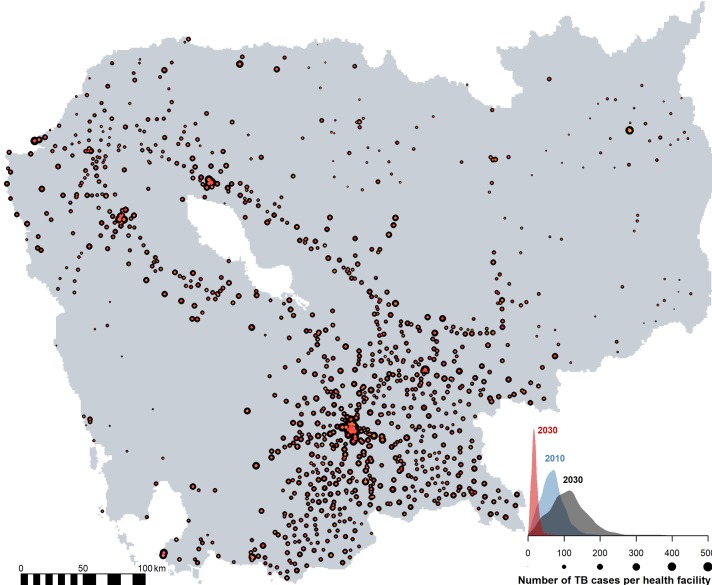
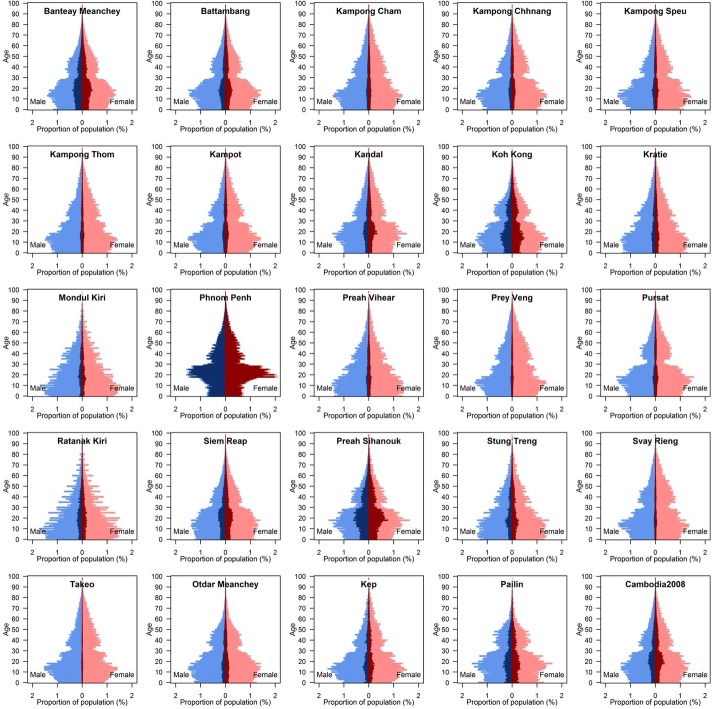
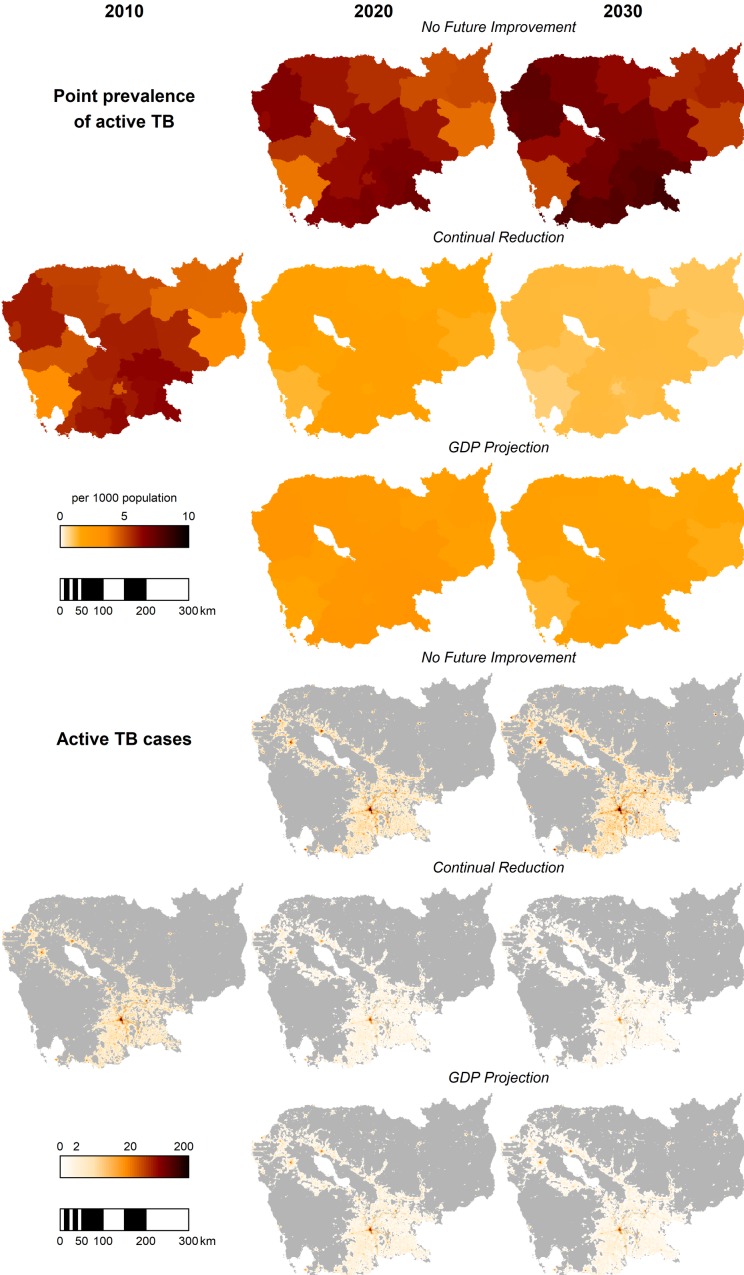
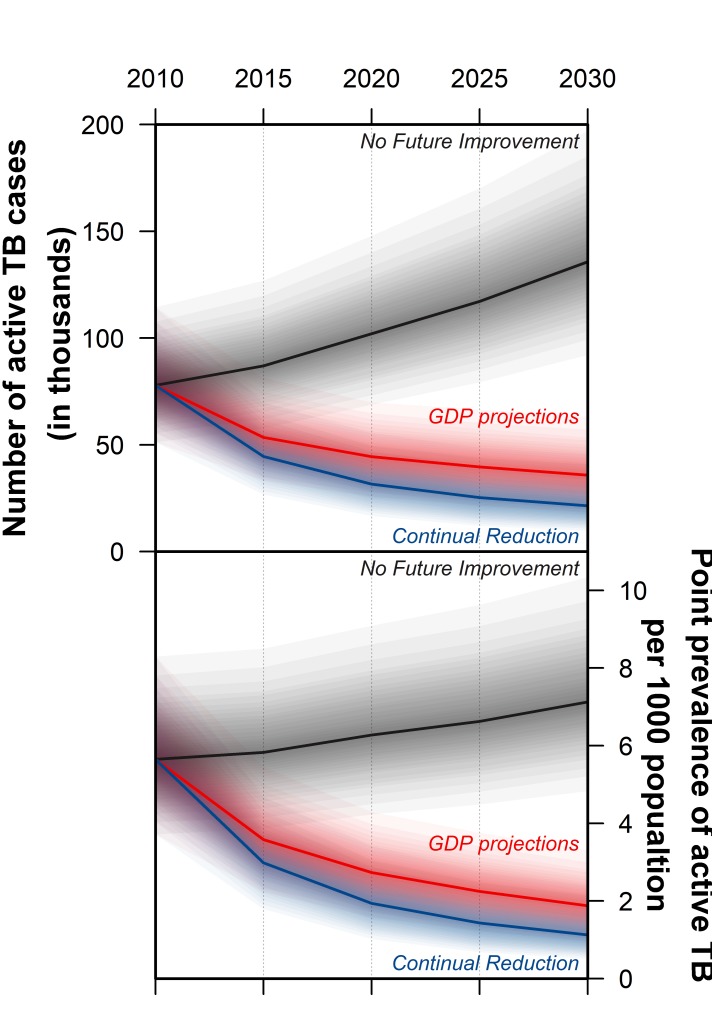
Strong differences in risk by age and sex, together with geographically varying population structures, yielded the first estimated prevalence map at a 1 km scale. The projected number of active TB cases within the catchment area of each existing government healthcare facility was derived, together with projections to the year 2030 under three scenarios: , and .
Synthesis of health and geographic data allows likely disease rates to be mapped at a high resolution to facilitate resource planning, while demographic modelling allows scenarios to be projected, demonstrating the need for the acceleration of control efforts to achieve a substantive impact on the future burden of TB in Cambodia.
柬埔寨是结核病负担最高的30个国家之一。已采用具有全国代表性的多阶段抽样方法估计活动性结核病患病率,该抽样代表了该国的城市、农村和偏远地区,但未抽样社区的患病率仍然未知。本研究使用地理空间贝叶斯统计方法估计柬埔寨的点患病率,并通过人口统计学模型考虑生育率、死亡率、城市化和患病率的长期趋势,以预测未来活动性结核病的负担。
针对2011年全国结核病患病率调查开发了一个贝叶斯分层模型,以估计年龄、性别和地理分层对活动性结核病患病率的差异影响;然后将这些估计值与高分辨率地理信息系统图层相结合,以预测柬埔寨各地的患病率。通过将这些估计值与基于个体的人口模型相结合,得出了不同情景下的未来结核病预测。
年龄和性别在风险上的显著差异,以及地理上不同的人口结构,得出了第一张1公里尺度的估计患病率地图。得出了每个现有政府医疗机构集水区内活动性结核病病例的预测数量,以及到2030年在三种情景下的预测: , 和 。
健康数据与地理数据的综合使我们能够以高分辨率绘制可能的疾病发病率,以促进资源规划,而人口统计学模型则可以预测各种情景,这表明需要加快控制努力,以便对柬埔寨未来的结核病负担产生实质性影响。