Department of Public Health Solutions, Finnish Institute for Health and Welfare, P.O. Box 30, FI-00271 Helsinki, Finland.
Scand J Work Environ Health. 2020 Sep 1;46(5):533-541. doi: 10.5271/sjweh.3899. Epub 2020 May 11.
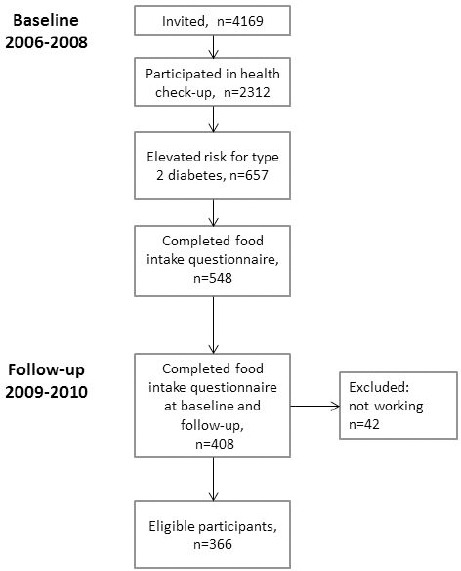
Objectives In a prospective study among workers in an airline company, we explored whether change in work stress symptoms or night shifts was associated with nutrient intake. Methods Participants in a workplace type 2 diabetes (T2D) prevention study completed a questionnaire on lifestyle, work stress symptoms, work schedule, and food intake at baseline and after 2.4-years follow-up (211 men and 155 women, 93% with increased risk for T2D). Multiple linear regression models with covariates were used to explore the associations between change in work stress symptoms or night shifts and change in nutrient intake during the follow-up. Results Among men, an increase in stress and a decrease in perceived workability was associated with a higher proportion of energy (E%) from fat [β 0.6, 95% confidence interval (CI) 0.07-1.11, β 1.3, 95% CI 0.57-2.05] and saturated fat (β 0.3, 95% CI 0.02-0.58, β 0.5, 95% CI 0.14-0.90), respectively. Furthermore, a decrease in workability was associated with lower vitamin C intake (β-9.2, 95% CI -16.56- -1.84) and an increase in sleepiness with higher E% from saturated fat (β 0.7, 95% CI 0.00-0.15). Among women, an increase in work-related fatigue was associated with higher alcohol intake (β 7.5, 95% CI 1.25-13.74) and an increase of night shifts was associated with higher E% from fat (β 0.24, 95% CI 0.00-0.47) and saturated fat (β 0.17, 95% CI 0.04-0.29). Conclusions Work stress symptoms were associated with a reduction in diet quality especially among men. The possible impact of work stress symptoms on workers' dietary habits should be acknowledged and the assessment of dietary habits should consequently be incorporated into occupational health examinations.
在对一家航空公司员工进行的前瞻性研究中,我们探讨了工作压力症状或倒班变化是否与营养摄入有关。
参加 2 型糖尿病(T2D)预防研究的工作场所的参与者在基线和 2.4 年随访时(211 名男性和 155 名女性,93%患有 T2D 风险增加)完成了关于生活方式、工作压力症状、工作时间表和食物摄入的问卷。使用带有协变量的多元线性回归模型来探讨随访期间工作压力症状或倒班变化与营养摄入变化之间的关系。
在男性中,压力增加和工作能力感知下降与脂肪提供的能量(E%)[β 0.6,95%置信区间(CI)0.07-1.11,β 1.3,95%CI 0.57-2.05]和饱和脂肪(β 0.3,95%CI 0.02-0.58,β 0.5,95%CI 0.14-0.90)的比例增加有关。此外,工作能力下降与维生素 C 摄入减少有关(β-9.2,95%CI-16.56- -1.84),而困倦增加与饱和脂肪的 E%增加有关(β 0.7,95%CI 0.00-0.15)。在女性中,与工作相关的疲劳增加与酒精摄入增加有关(β 7.5,95%CI 1.25-13.74),而夜班增加与脂肪提供的 E%增加有关(β 0.24,95%CI 0.00-0.47)和饱和脂肪(β 0.17,95%CI 0.04-0.29)。
工作压力症状与饮食质量下降有关,尤其是在男性中。应认识到工作压力症状对工人饮食习惯的可能影响,因此应将饮食习惯评估纳入职业健康检查。