Health and Sustainable Development, WHO Regional Office for Europe, Copenhagen, Denmark.
Health and Society Group, Wageningen University and Research, Wageningen, the Netherlands.
Eur J Public Health. 2020 Mar 1;30(Suppl_1):i3-i9. doi: 10.1093/eurpub/ckaa026.
Forty-three out of 53 of the WHO European Member States have set up political and institutional mechanisms to implement the United Nations (UN) 2030 Agenda for Sustainable Development. This includes governance and institutional mechanisms, engaging stakeholders, identifying targets and indicators, setting governmental and sectoral priorities for action and reporting progress regularly. Still, growing evidence suggests that there is room for advancing implementation of some of the Sustainable Development Goals (SDGs) and targets at a higher pace in the WHO European Region. This article proposes the E4A approach to support WHO European Member States in their efforts to achieve the health-related SDG targets.
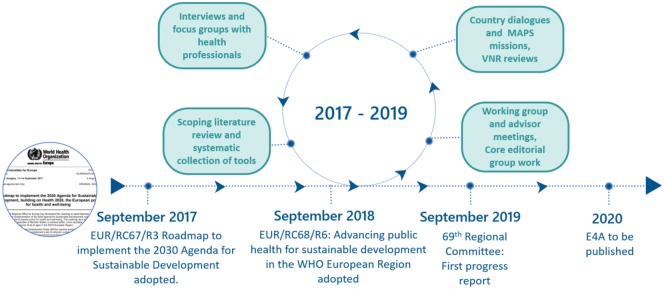
The E4A approach was developed through a 2-year, multi-stage process, starting with the endorsement of the SDG Roadmap by all WHO European Member States in 2017. This approach resulted from a mix of qualitative methods: a semi-structured desk review of existing committal documents and tools; in-country policy dialogs, interviews and reports; joint UN missions and discussion among multi-lateral organizations; consultation with an advisory group of academics and health policy experts across countries.
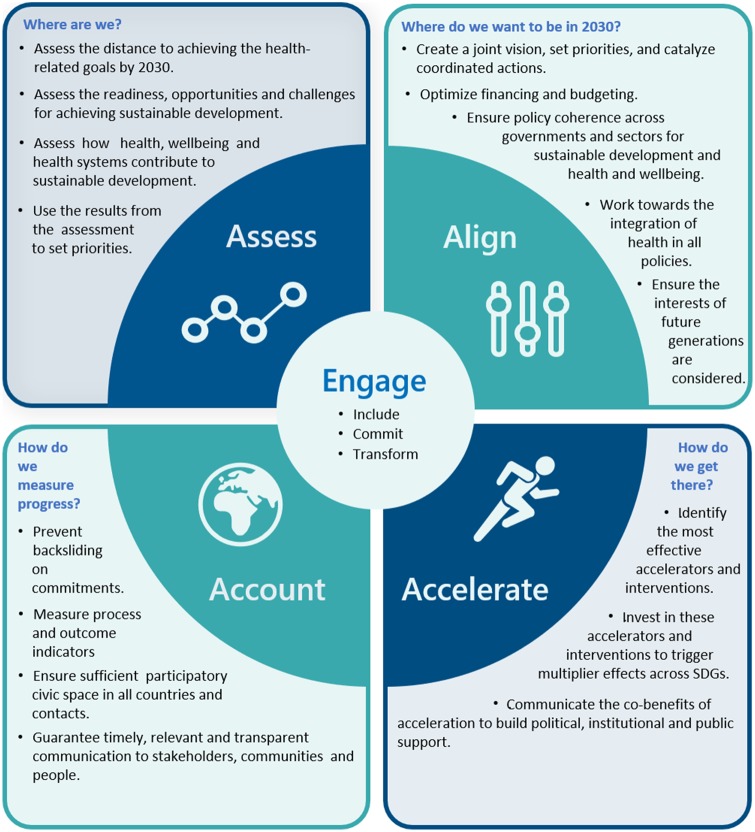
The E-engage-functions as the driver and pace-maker; the 4 As-assess, align, accelerate and account-serve as building blocks composed of policies, processes, activities and interventions operating in continuous and synchronized action. Each of the building blocks is an essential part of the approach that can be applied across geographic and institutional levels.
While the E4A approach is being finalized, this article aims to generate debate and input to further refine and test this approach from a public health and user perspective.
53 个世界卫生组织欧洲成员国中有 43 个建立了政治和机构机制来执行联合国 2030 年可持续发展议程。这包括治理和机构机制、让利益攸关方参与、确定目标和指标、为行动确定政府和部门优先事项以及定期报告进展情况。尽管如此,越来越多的证据表明,在世界卫生组织欧洲区域,一些可持续发展目标(SDG)和目标仍有加快执行的空间。本文提出 E4A 方法,以支持世界卫生组织欧洲成员国努力实现与健康相关的可持续发展目标。
E4A 方法是通过一个为期 2 年、多阶段的过程制定的,始于 2017 年所有世界卫生组织欧洲成员国都认可可持续发展目标路线图。该方法源于一系列定性方法:对现有承诺文件和工具进行半结构化案头审查;在各国开展政策对话、访谈和报告;与联合国特派团联合开展工作以及与多边组织开展讨论;与来自各国的学术和卫生政策专家咨询小组协商。
E-即参与-作为驱动因素和节奏制造者;4As-即评估、调整、加速和报告-作为由政策、流程、活动和干预措施组成的构建模块,这些政策、流程、活动和干预措施以连续和同步的方式运作。每个构建模块都是该方法的重要组成部分,可以在地理和机构各级应用。
虽然 E4A 方法正在敲定中,但本文旨在引发辩论并提供投入,以便从公共卫生和用户角度进一步完善和测试该方法。