School of Nursing and midwifery, Institute of Health Sciences, Wollega University, Nekemte, Ethiopia.
PLoS One. 2020 May 11;15(5):e0232703. doi: 10.1371/journal.pone.0232703. eCollection 2020.
Antiretroviral therapy has a remarkable clinical effect in reducing the progress of Acquired Immune Deficiency Syndrome. The clinical outcome of Anti-Retroviral therapy depends on strict adherence. Poor adherence reduces the effectiveness of antiretroviral therapy and increases viral replication. With changes in service delivery over time and differences in socio-demographic status from region to region, it is essential to measure adherence. Therefore, this study aimed to assess adherence to antiretroviral therapy and its associated factors among HIV/AIDS patients accessing treatment at Nekemte referral hospital, West Ethiopia.
Institutional based cross-sectional study was conducted on 311 HIV/AIDS patients from March 01 to March 30, 2019. The study participants were selected by a simple random sampling method and interviewed using structured questionnaires. Bivariable logistic regression was conducted to find an association between each independent variable and adherence to antiretroviral medication. Multivariable logistic regression was used to find the independent variables which best predict adherence. The statistical significance was measured using odds ratio at a 95% confidence interval with a p-value of less than 0.05.
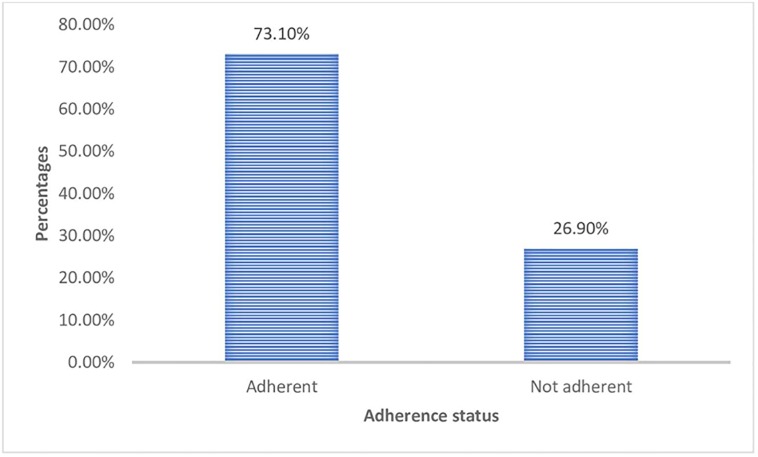
Out of a total of 311 patients sampled, 305 were participated in the study, making a response rate of 98.07%. From these 305 study participants,73.1% (95% CI = 68.2, 78.0) were adherent to their medication. Having knowledge about HIV and its treatment (AOR = 8.24, 95% CI: 3.10, 21.92), having strong family/social support (AOR = 6.21, 95% CI: 1.39, 27.62), absence of adverse drug reaction (AOR = 5.33, 95% CI: 1.95, 14.57), absence of comorbidity of other chronic diseases (AOR = 5.72, 95% CI: 1.91, 17.16) and disclosing HIV status to the family (AOR = 5.08, 95% CI: 2.09, 12.34) were significantly associated with an increased likelihood of adherence to antiretroviral medication.
The level of adherence to antiretroviral therapy was found low compared to WHO recommendation. The clinician should emphasize reducing adverse drug reaction, detecting and treating co-morbidities early, improving knowledge through health education, and encouraging the patients to disclose their HIV status to their families.
抗逆转录病毒疗法在降低获得性免疫缺陷综合征的进展方面具有显著的临床效果。抗逆转录病毒治疗的临床效果取决于严格的依从性。依从性差会降低抗逆转录病毒治疗的效果,并增加病毒复制。随着服务提供方式随时间的变化以及不同地区社会人口地位的差异,衡量依从性至关重要。因此,本研究旨在评估在埃塞俄比亚西部内克姆特转诊医院接受治疗的艾滋病毒/艾滋病患者对抗逆转录病毒治疗的依从性及其相关因素。
2019 年 3 月 1 日至 3 月 30 日,对 311 名艾滋病毒/艾滋病患者进行了基于机构的横断面研究。采用简单随机抽样法选取研究对象,并采用结构化问卷进行访谈。采用单变量逻辑回归分析确定每个自变量与抗逆转录病毒药物依从性之间的关联。采用多变量逻辑回归分析确定预测依从性的最佳独立变量。采用比值比(95%置信区间)衡量统计学意义,p 值<0.05 表示差异有统计学意义。
在总共抽样的 311 名患者中,有 305 名患者参加了研究,应答率为 98.07%。在这 305 名研究参与者中,73.1%(95%CI=68.2,78.0)对其药物治疗有依从性。具有艾滋病及其治疗的知识(AOR=8.24,95%CI:3.10,21.92)、有强大的家庭/社会支持(AOR=6.21,95%CI:1.39,27.62)、无药物不良反应(AOR=5.33,95%CI:1.95,14.57)、无其他慢性疾病合并症(AOR=5.72,95%CI:1.91,17.16)和向家庭透露艾滋病状况(AOR=5.08,95%CI:2.09,12.34)与增加抗逆转录病毒药物治疗的依从性显著相关。
与世界卫生组织的建议相比,抗逆转录病毒治疗的依从性水平较低。临床医生应强调减少药物不良反应、及早发现和治疗合并症、通过健康教育提高知识水平,并鼓励患者向家人透露自己的艾滋病状况。