Institut d'Investigació Sanitària Pere Virgili (IISPV), 43204 Reus, Spain.
Analyze & Realize GmbH, 13467 Berlin, Germany.
Nutrients. 2020 May 7;12(5):1330. doi: 10.3390/nu12051330.
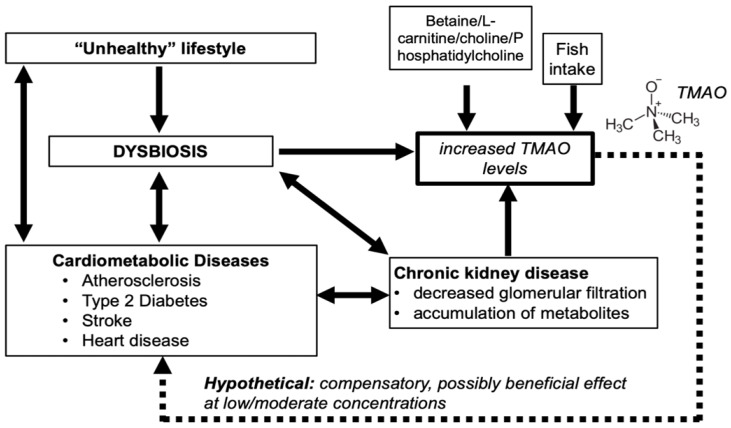
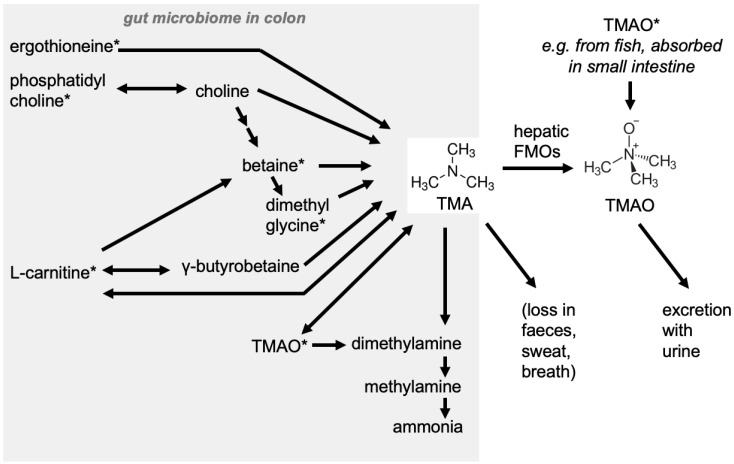
Trimethylamine-N-oxide (TMAO) is generated in a microbial-mammalian co-metabolic pathway mainly from the digestion of meat-containing food and dietary quaternary amines such as phosphatidylcholine, choline, betaine, or L-carnitine. Fish intake provides a direct significant source of TMAO. Human observational studies previously reported a positive relationship between plasma TMAO concentrations and cardiometabolic diseases. Discrepancies and inconsistencies of recent investigations and previous studies questioned the role of TMAO in these diseases. Several animal studies reported neutral or even beneficial effects of TMAO or its precursors in cardiovascular disease model systems, supporting the clinically proven beneficial effects of its precursor, L-carnitine, or a sea-food rich diet (naturally containing TMAO) on cardiometabolic health. In this review, we summarize recent preclinical and epidemiological evidence on the effects of TMAO, in order to shed some light on the role of TMAO in cardiometabolic diseases, particularly as related to the microbiome.
三甲基胺 N-氧化物(TMAO)主要通过含肉食物和膳食季铵盐(如磷脂酰胆碱、胆碱、甜菜碱或左旋肉碱)的消化,在微生物-哺乳动物共代谢途径中产生。鱼类摄入是 TMAO 的直接重要来源。先前的人类观察性研究报告称,血浆 TMAO 浓度与心血管代谢疾病之间存在正相关关系。最近的调查和先前的研究存在差异和不一致,这使得 TMAO 在这些疾病中的作用受到质疑。一些动物研究报告称,TMAO 或其前体在心血管疾病模型系统中具有中性甚至有益的作用,这支持了其前体左旋肉碱或富含海鲜(天然含有 TMAO)的饮食对心血管代谢健康的临床已证实的有益作用。在这篇综述中,我们总结了 TMAO 的最近临床前和流行病学证据,以期阐明 TMAO 在心血管代谢疾病中的作用,特别是与微生物组的关系。